Germany Dominates European Crypto Licensing Under MiCA as Crucial Deadline Approaches
New MiCA licensing statistics reveal 244 authorized firms throughout EU and EEA territories, with Germany taking the lead while France and the Netherlands emerge as significant regulatory centers before the July 1 cutoff date.

The Markets in Crypto-Assets (MiCA) regulatory framework being implemented throughout the European Union is resulting in disparate crypto authorization patterns among member nations and European Economic Area (EEA) territories, with Germany emerging as the frontrunner in approvals under this new regulatory structure that becomes effective on Wednesday.
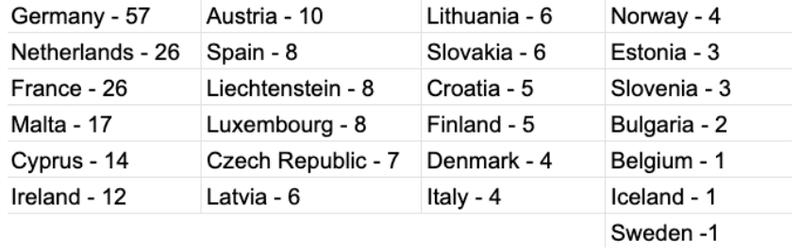
Information gathered from the European Securities and Markets Authority (ESMA) interim register, analyzed on Friday, reveals that Germany has granted authorization to 57 crypto-asset service providers (CASPs) under MiCA, representing approximately 23% of the 244 licenses that have been granted in total.
France ranks second with 26 authorized companies, representing around 11% of total approvals, positioning it next to the Netherlands as one of the bloc's most significant centers for MiCA authorization.
This distribution indicates that despite MiCA's objective to establish a unified European cryptocurrency marketplace, the actual execution continues to be divided among individual national regulatory bodies in advance of the July 1 transitional cutoff date.
France leads late-June approval wave
Although Germany maintains the highest number of overall MiCA authorizations, France has experienced a surge in approvals recently, representing the biggest portion of eleventh-hour licenses being granted.
Based on ESMA interim information, France granted five CASP licenses during the timeframe spanning June 18 through June 22, representing the highest number within that period. Collectively, 11 licenses were granted throughout EU and EEA territories during this interval, with Malta coming in second behind France with two licenses issued.
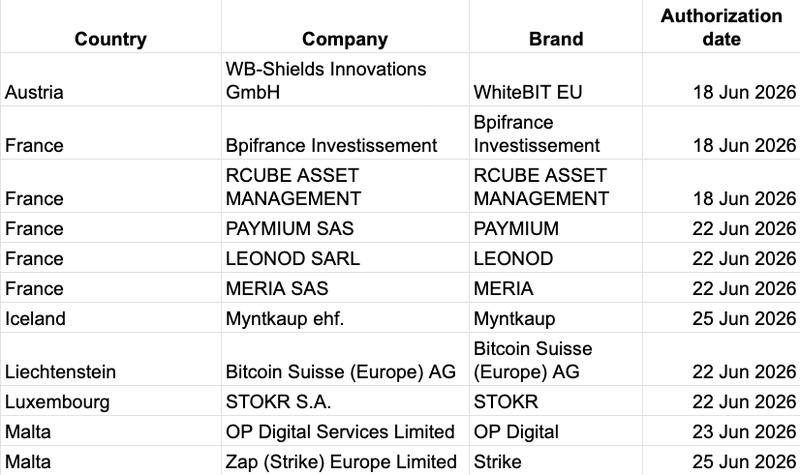
Among France's authorizations are CASPs including Bpifrance Investissement, RCUBE Asset Management, Paymium, Leonod and Meria.
The clustering of MiCA licenses in Germany, France and the Netherlands mirrors wider trends present in Europe's financial infrastructure. Based on 2024 EU statistics, Germany, France, Luxembourg, the Netherlands and Ireland together represented approximately 72% of the financial assets and liabilities held by financial corporations throughout the bloc.
Cointelegraph contacted Germany's Federal Financial Supervisory Authority (BaFin) for commentary regarding this development but had not received a reply by the time of publication.
Five EU states have not issued any MiCA licenses
Five member states of the EU, namely Greece, Hungary, Poland, Portugal and Romania, have failed to issue any MiCA authorizations as of June 26, based on ESMA interim register information.
Greece is particularly noteworthy after Binance submitted an authorization request in the country but subsequently retracted its application, redirecting its licensing strategy to a different MiCA jurisdiction.
Poland also warrants attention, with postponements in MiCA implementation legislation coupled with three documented presidential vetoes, resulting in the nation lacking an operational licensing system by the EU deadline.
By comparison, Italy led ESMA's register of non-compliant CASPs as of June 26, representing an exceptionally large proportion of listings with 160 out of 162, whereas the Netherlands and Slovakia each registered one entry, associated with MEXC and LWEX, respectively.
Additional reporting by Yohan Yun.