Galaxy Research: Proposed SEC Elimination of 'Rule 611' Could Unlock Tokenized Stock Trading
According to Galaxy's Alex Thorn, the Securities and Exchange Commission's proposal to eliminate regulations governing stock order execution and price quotes could dismantle a significant obstacle preventing tokenized equities from operating on decentralized trading venues.
A proposal by the US Securities and Exchange Commission to eliminate regulations concerning order protection mechanisms and price quotations has the potential to dismantle a substantial legal obstacle standing in the way of tokenized US equities.
On Thursday, the SEC put forward a proposal aimed at eliminating two regulations within its national market system framework. These include Rule 611, which prohibits "trade-throughs" whereby a stock transaction on one trading venue cannot be executed at an inferior price compared to what's available on another venue, along with Rule 610(e) which prevents exchanges from showing a bid price that matches or exceeds what can be found on competing platforms.
According to Alex Thorn, who serves as head of research at Galaxy, the regulatory proposal represents "one of the biggest unlocks yet for tokenized stocks" because it would eliminate "one of the biggest structural barriers to tokenized US equities trading in DeFi."
The regulatory agency has been working toward reversing regulations that impose limitations on cryptocurrency and blockchain technology. The commission initiated "Project Crypto" in August 2025 with the objective of establishing regulatory frameworks for the utilization of digital assets and blockchain technology within US financial markets.
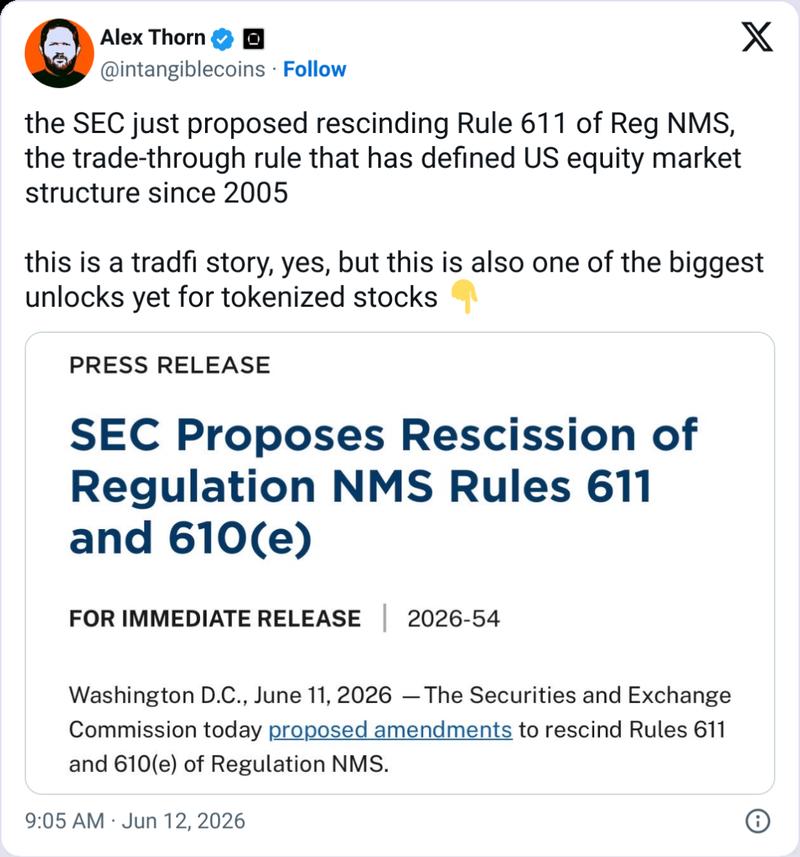
According to Thorn's analysis, automated market makers (AMM) within the cryptocurrency ecosystem, which are programs designed to facilitate trading through asset pooling mechanisms, are unable to maintain compliance with trade-through regulations since these systems execute transactions against "whatever the pool price is."
Thorn further explained that an AMM lacks the capability to halt a transaction when a superior price quote is available on another platform, which means any liquidity pool offering a tokenized stock under current regulatory requirements "would commit trade-throughs constantly and arguably be an illegal trading center."
Additionally, pricing mechanisms within AMMs experience continuous fluctuations and would therefore be in perpetual violation of the regulation designed to ensure investors receive optimal pricing across all available platforms, according to Thorn's assessment.
Thorn indicated that the SEC will likely substitute the existing rules with a "best execution" regulatory framework, which would potentially allow AMMs to operate within the parameters of the new rules.
The regulatory body has opened its proposal to public feedback for a 60-day period, after which it will evaluate submitted responses and potentially modify its proposal based on the commentary received.
This development follows reports that the SEC was preparing to unveil a framework last month that would have enabled tokenized stock trading, but the agency delayed the initiative after representatives from stock exchanges voiced concerns regarding the implementation methodology of the proposed plan.