Fraudsters targeting vessels near Strait of Hormuz with crypto extortion scheme: Report
Vessels stuck in waters close to the Strait of Hormuz are facing extortion attempts from fraudsters impersonating Iranian officials, who are requesting Bitcoin or USDt payments in exchange for "safe passage."

Impersonators claiming to be Iranian officials have allegedly been reaching out to shipping firms with vessels stuck to the west of the Strait of Hormuz, requesting cryptocurrency payments in return for guaranteed safe transit through the waterway.
Maritime risk firm Marisks released an advisory on Monday warning that unidentified groups have been making contact with vessel owners while falsely claiming affiliation with Iranian security forces and demanding passage "fees" to be paid in Bitcoin (BTC) or USDt (USDT) for authorization to navigate the strait, as reported by Reuters.
"These specific messages are a scam," Marisks allegedly stated, emphasizing that the communications do not come from legitimate Iranian authorities. Iran's government has not issued any public statement regarding these allegations.
These warnings surface as the vital shipping channel continues to remain mostly inaccessible due to the ongoing Middle Eastern conflict. Serving as a crucial bottleneck for worldwide energy transportation, the Strait of Hormuz was previously responsible for facilitating approximately one-fifth of global oil and liquefied natural gas shipments before regional tensions intensified.
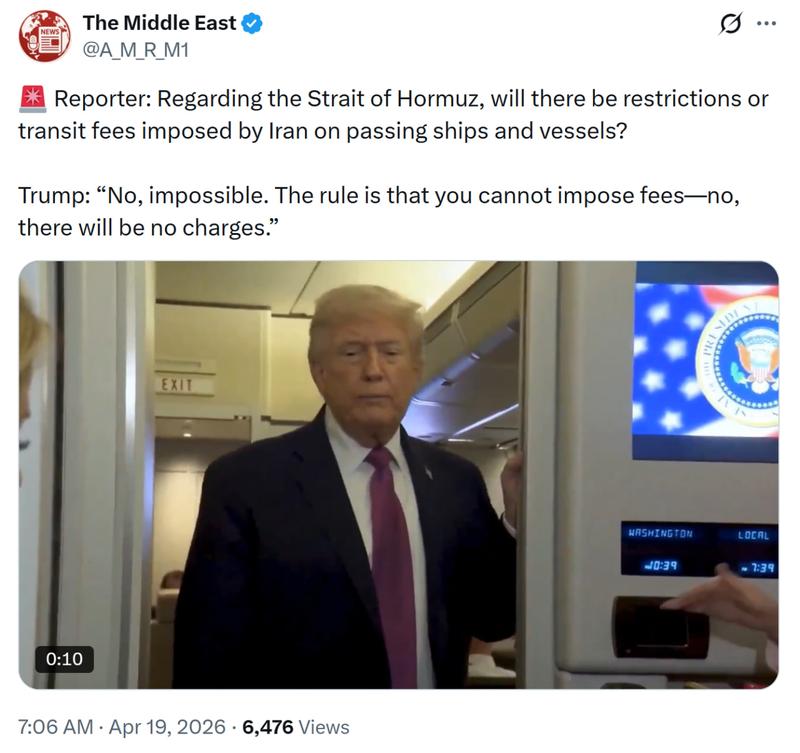
Earlier in the month, news emerged suggesting that Iran was contemplating implementing a tariff system for vessels transiting the Strait of Hormuz, with fees to be collected in Bitcoin, allowing empty tankers to pass without charge while others might face costs of approximately $1 per barrel of oil transported.
Cryptocurrency "transit fee" fraud requires document submission
The fraudulent communications reportedly direct those who receive them to provide documentation for authentication purposes prior to being allocated a cryptocurrency-based "fee," following which safe passage would purportedly be authorized at a mutually agreed-upon time.
According to one instance highlighted by Marisks, the communication indicated that Iranian security personnel would evaluate qualification before establishing payment requirements in BTC or USDt, presenting cryptocurrency transactions as a prerequisite for safe and unobstructed passage through the waterway.
The maritime security firm further indicated that no fewer than one ship that was recently fired upon while trying to leave the strait may have been subjected to these deceptive communications, although this information remains unconfirmed through independent sources.
Cointelegraph contacted Marisks seeking additional commentary but had not received a response at the time of publication.
Iranian cryptocurrency transactions could expose companies to sanctions: Chainalysis
Maritime companies contemplating cryptocurrency payments for transit fees to Iran may be exposing themselves to significant sanctions-related risks, according to Kaitlin Martin, a senior intelligence analyst at Chainalysis.
In her statement to Cointelegraph, she explained that any transactions associated with waterways under Iranian control might be classified as "material support," which could represent violations of US and global sanctions imposed on organizations including the Islamic Revolutionary Guard Corps.