Five Years of Bitcoin in El Salvador: A Benefit for Whom?
Half a decade has passed since El Salvador granted Bitcoin legal tender status. While the initiative hasn't delivered on its domestic commitments to citizens, it has significantly elevated Bitcoin's standing worldwide.
Half a decade has elapsed since El Salvador made history by becoming the world's first nation to designate Bitcoin as legal tender.
The announcement came from President Nayib Bukele during the Bitcoin conference held in Miami on June 5, 2021, sparking enthusiastic cheers and standing ovations from the Bitcoin faithful, who celebrated the small Central American country as concrete evidence that BTC could function as sovereign currency.
The initiative was marketed by Bukele as a pathway to providing banking services to the unbanked population, reducing the cost of international money transfers, and drawing foreign capital to the economically disadvantaged country.
However, as the five-year mark passes, questions arise about who truly benefited from this initiative and what tangible outcomes it delivered?
"There is little doubt that the project was a failure if we take seriously the reasons Bukele gave for its adoption. Foreign direct investment in this sector didn't increase, it did not effectively bank the unbanked, and it is not widely used for remittances."
Nevertheless, El Salvador's cryptocurrency gamble undeniably transformed global discourse surrounding the world's leading digital currency, and converted the theoretical concept of nation-state adoption into tangible reality. The verdict on its success or failure hinges on one's interpretation of what El Salvador set out to accomplish.
Half a Decade After El Salvador's Cryptocurrency Gamble
In a recorded message broadcast at Bitcoin 2021, Bukele stated that making Bitcoin legal tender would create employment opportunities immediately and "help provide financial inclusion to thousands outside the formal economy."
Currently, the data supporting widespread adoption proves challenging to reconcile with those stated objectives.
A 2025 study conducted by Boos, Grigera and Schmid revealed that Salvadorans who embraced Bitcoin were typically younger, male, residing in urban areas, possessing higher education levels, and, significantly, already integrated into the banking system. Boos's conclusion states that, "Mass adoption by citizens did not occur."
At the time of Bitcoin's adoption, El Salvador ranked among the region's lowest in banking accessibility, with merely 35.9% of individuals aged 15 and above maintaining bank accounts in 2021, based on World Bank statistics.
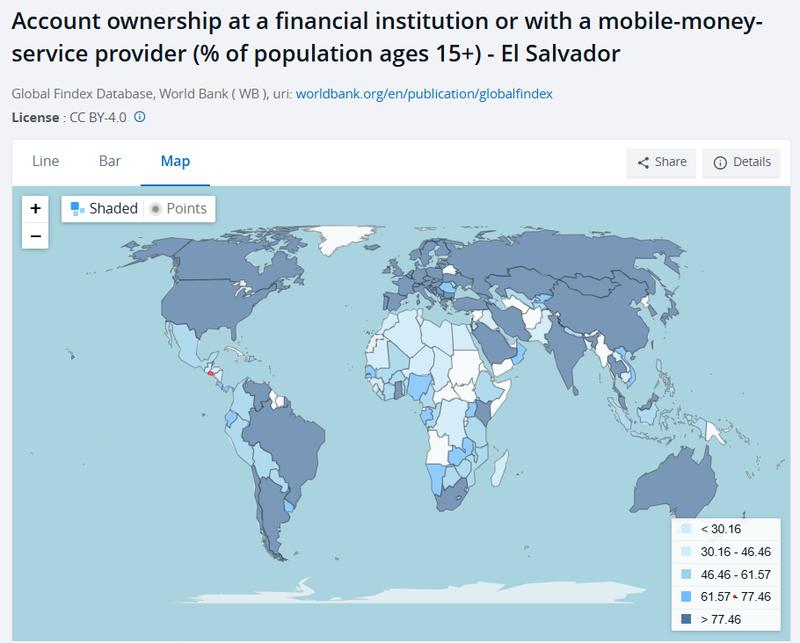
However, the state-sponsored Chivo Bitcoin wallet proved inadequate in addressing the issue: while it enabled fund transfers to traditional bank accounts, it failed to eliminate the fundamental obstacles preventing unbanked Salvadorans from gaining access to financial services initially.
As documented by Boos and his research team, similar challenges emerged regarding remittances, another cornerstone of Bukele's proposal. During 2024, remittances comprised approximately 24% of El Salvador's gross domestic product, with the United States contributing fully 98% of that amount. Yet El Salvador had embraced USD as its official currency over two decades earlier, and receiving the majority of remittances from a nation sharing the same currency eliminated one of the primary cost advantages that Bitcoin could theoretically provide: exchange rate conversion.
Notwithstanding promises that Bitcoin would reduce transfer expenses, cryptocurrency wallets handled barely 1% of remittances by 2024, declining from a high point of 1.7% in 2020-21.
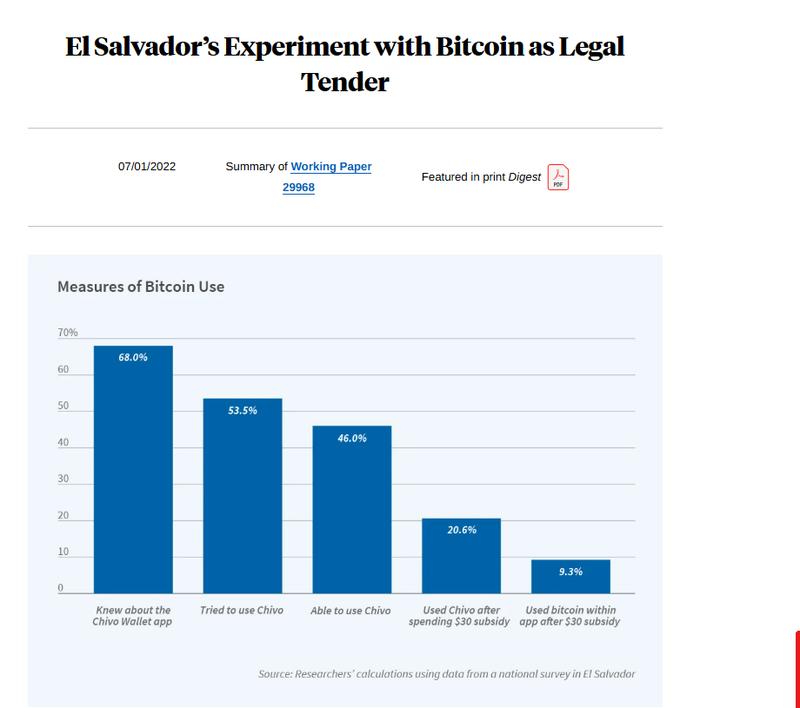
This data indicates that early governmental initiatives to encourage adoption didn't result in sustained utilization. Chivo provided users with $30 in Bitcoin upon registration, yet nationally representative research conducted by the National Bureau of Economic Research discovered that over 60% of initial Chivo users never completed another transaction following the depletion of their complimentary BTC.
Joe Nakamoto, a journalist specializing in Bitcoin coverage who has conducted multiple reporting trips to El Salvador, observed a comparable gap between promise and reality.
"It's very, very hard, borderline impossible to genuinely live on Bitcoin in El Salvador. Unless you're just eating pupusas on the beach in El Zonte, and then going across to the other Bitcoin circular economies and finding workarounds."
The IMF's Intervention and Its Consequences
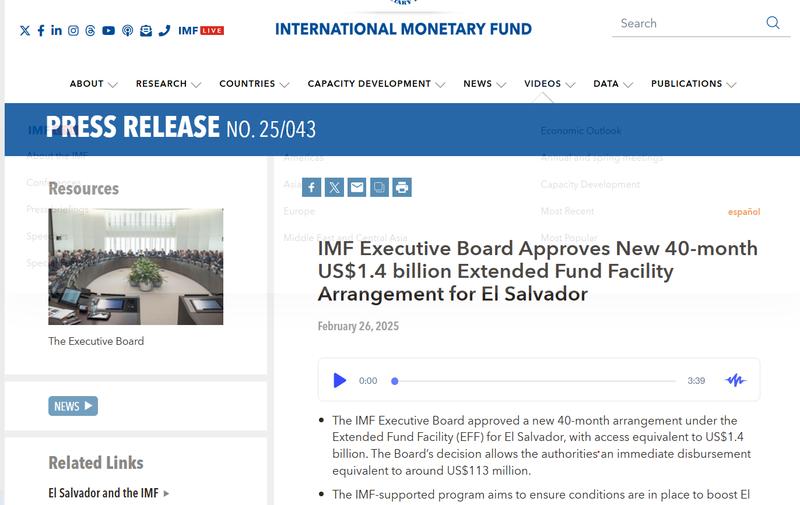
The Salvadoran government has additionally encountered international pressure demanding withdrawal from its cryptocurrency initiative. During December 2024, it secured a $1.4 billion financing agreement with the International Monetary Fund, wherein it committed to reducing its engagement with Bitcoin.
The agreement received approval during February 2025, and in January, authorities modified the Bitcoin legislation to make merchant acceptance optional, mandate tax payments in US dollars and restrict government participation in Bitcoin-related operations, effectively dismantling the most transformative elements of Bukele's initiative.
Although Bitcoin remained available for voluntary transactions, the government no longer mandated business acceptance or incorporated it within the nation's public finance infrastructure.
Subsequently, the IMF determined that Bitcoin had generated "no evidence" of beneficial applications for the unbanked and had produced negligible effects on financial inclusion. According to Boos:
"The 'soft adoption,' as we refer to it in one of our articles, never led to mass adoption for payments. I am not aware of any instances where tax payments were made using Bitcoin, and the infrastructure has largely remained unused."
The Genuine Accomplishments of the Bitcoin Initiative
While El Salvador didn't succeed in transforming Bitcoin into commonplace currency, it nonetheless accomplished what no nation had previously achieved: it converted sovereign Bitcoin adoption from theory into practice.
"The question in front of every president or finance minister shifted from whether a sovereign could hold Bitcoin to why it hadn't."
The initiative additionally positioned El Salvador at the heart of the worldwide Bitcoin movement, with numerous influential Bitcoiners, including Max Keiser and Stacy Herbert, relocating to Bitcoin country as their permanent residence. Herbert subsequently assumed the role of director of El Salvador's National Bitcoin Office, demonstrating the depth of integration between segments of the Bitcoin movement and the government apparatus.
Bitcoin Beach, the community-driven initiative in El Zonte that preceded the nationwide program, remains among the most compelling demonstrations of a viable Bitcoin-based economy, with local merchants, accommodations and tourism businesses continuing Bitcoin acceptance, even following the government's decision to make acceptance discretionary.
Nakamoto's investigative journalism has additionally chronicled multiple concrete achievements for ordinary Salvadorans, including Mama Rosa, who accumulates Bitcoin savings from her pupusa business, and Napo, who grew from operating a single taxi to managing an entire fleet.
Bukele's administration even surpassed simply maintaining BTC on its financial statements or granting it legal tender status by advancing proposals for Volcano Bonds and Bitcoin City.
Following numerous postponements, the IMF agreement essentially halted progress on those initiatives, yet the symbolic influence remains significant. Mow elaborates:
"Bitcoin gained a proof of concept, and El Salvador gained a global platform."
Additionally, there exists a crucial distinction between El Salvador's achievements for Bitcoin and Bitcoin's achievements for El Salvador.
Boos contends that the symbolic importance has primarily served "for" the international Bitcoin community, rather than demonstrating economic success "in" El Salvador. Nakamoto observes:
"It looks more like a marketing campaign for foreigners than a genuine economic strategy for Salvadorans. It's beautiful branding, pointed at people with the passports and the capital. Bukele is a razor-sharp operator. He knows exactly who's watching and who's clapping. The Bitcoin country strategy, it's not for them. It breaks my heart to say it, but it's for us."
The Difficult Reality: Bitcoin's Association with Bukele
Perhaps the most challenging question concerns what El Salvador's Bitcoin initiative reveals about the alignment between Bitcoiners' principles of individual liberty and the administration that mandated it.
Throughout his tenure, Bukele has consolidated authority, and the emergency measures implemented to address gang-related violence in March 2022 continue in effect more than four years subsequently.
According to Human Rights Watch, the administration has persistently dismantled limitations on executive authority, and domestic and international human rights organizations have recorded widespread arbitrary detentions and due process infringements under emergency rule.
However, evaluating Bukele exclusively through this perspective risks overlooking the reasons for his enduring domestic popularity. El Salvador previously suffered under the control of formidable criminal organizations, with numerous Salvadorans enduring constant threats of extortion, brutality and murder. The official murder rate dropped from 53.1 per 100,000 individuals during his first year in office, to merely 1.3 per 100,000 in 2025.
Bukele's security offensive has revolutionized public safety, and many Salvadorans perceive the balance between security and civil liberties substantially differently than foreign critics. Nakamoto states:
"It's a country that has serious scars. Bukele has saved the nation in many ways. He kicked out the gangs and also he has done wonderful things for Bitcoin in terms of putting it on the world map."
Though Mow recognizes the beneficial consequences of Bukele's anti-gang campaign, he emphasizes that the wider ramifications of normalizing emergency authority cannot be disregarded:
"In the hands of someone with restraint, those same powers can accomplish real things, like El Salvador's crackdown on the gangs. But it's important to think ahead. What serves a leader with restraint today can just as easily serve one without restraint once there's a change of guard."
For the Bitcoin community, this creates an uneasy contradiction. El Salvador's cryptocurrency initiative has become inextricably linked to the administration that enabled it, and to a president whose legacy proves considerably more complex than the Bitcoin achievement narrative alone indicates.
This may ultimately represent the most challenging aspect of evaluating El Salvador five years later: Bitcoin provided Bukele with international visibility, and Bukele provided Bitcoin with something previously unattained — a sovereign nation prepared to position it at the core of its economic framework.