Figure's Q1 Performance Highlights Distinct Position in Blockchain Marketplace Sector, Bernstein Reports
Analysis of Figure Technology's performance in the first quarter by Bernstein analysts demonstrates that this fintech enterprise is rapidly establishing itself as a distinctive player within the blockchain marketplace landscape.

On Friday, analysts from Bernstein indicated that the first-quarter financial results released by Figure Technology Solutions demonstrate the company's emergence as a distinctly unique entity within the blockchain marketplace ecosystem.
The earnings report released by Figure on May 11 significantly exceeded analyst projections for both revenue and EBITDA, showcasing a business model focused on transforming tangible credit assets into blockchain-based instruments capable of being traded, funded, and financed with greater efficiency.
The analysts anticipate that as Figure continues developing its blockchain-based capital market infrastructure, the company will likely catch investors off guard with how substantially it diverges from traditional balance sheet-dependent fintech lending operations, positioning FIGR stock as a live indicator of blockchain loan activity.
FIGR's live blockchain data suggests an all-time high record Q2 upcoming. As the market gets more efficient in tracking live blockchain volume data, we believe FIGR's stock price should become a real-time reflection of blockchain loan volumes.
Bernstein analysts in a May 15 note to clients
The company's objective is to convince both Wall Street and the decentralized finance community that it represents more than just a rapidly expanding home equity line of credit provider with blockchain marketing, but rather a comprehensive blockchain-enabled capital markets infrastructure.
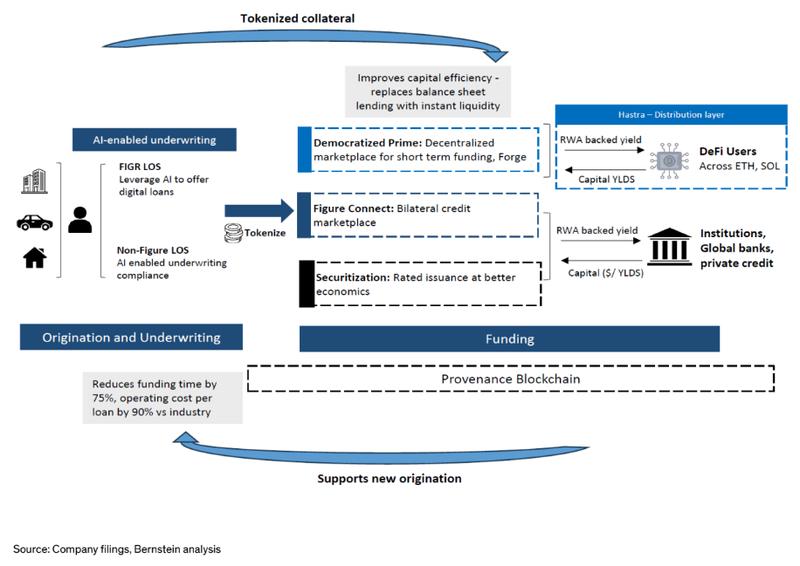
During the earnings call held on May 12, Mike Cagney, who serves as executive chairman and co-founder, explained that approximately one year after migrating Figure's digital assets to DeFi for financing purposes, the company encountered an obstacle that affects all real-world assets operating on blockchain technology.
DeFi is asset-based lending. The premise is that the collateral backing the loan is liquid. What are the collateral as a whole loan? Given an LTV breach, how does a lender take a fractional position in the whole loan? Even if they could, where would they sell it?
Mike Cagney, executive chairman and co-founder
According to Cagney, the company's Forge platform transforms complete loans into smaller, individual-dollar liquid participation units.
The Bernstein analysis indicates that Figure is constructing a comprehensive marketplace infrastructure where tangible assets from the real world, encompassing both loans and ultimately equities, can function as active collateral for liquidity borrowing and lending activities. "That's going more towards a model where FIGR simply clips a small fee of the entire blockchain economy within its ecosystem," they said.
At the same time, institutional investment communities continue to approach blockchain-for-finance concepts with caution, a reality that CEO Michael Tannenbaum recognized during the earnings call, maintaining that Figure's competitive edge stems from operational efficiency rather than philosophical positioning. He characterized AI as "the brain" and blockchain as "the nervous system," contending that data structures native to blockchain technology facilitate easier automation of underwriting, compliance verification, and loan validation processes.
Tokenized credit market could draw from wide swath
According to earlier research conducted by Bernstein, the addressable market for total annual credit origination volume across various loan categories that may ultimately transition to onchain tokenized assets carries an estimated valuation of $4 trillion.
This encompasses lending categories including mortgages, automobile loans, home equity lines of credit, and small-business financing — market segments where Figure is pursuing expansion opportunities beyond its primary business operations.
Within the larger RWA market landscape, tokenized credit continues to represent a relatively modest segment. Current industry data indicates the sector holds a valuation of approximately $5.14 billion, underscoring the substantial distance between present-day adoption levels and the extended-term growth potential that Bernstein's analysis projects.
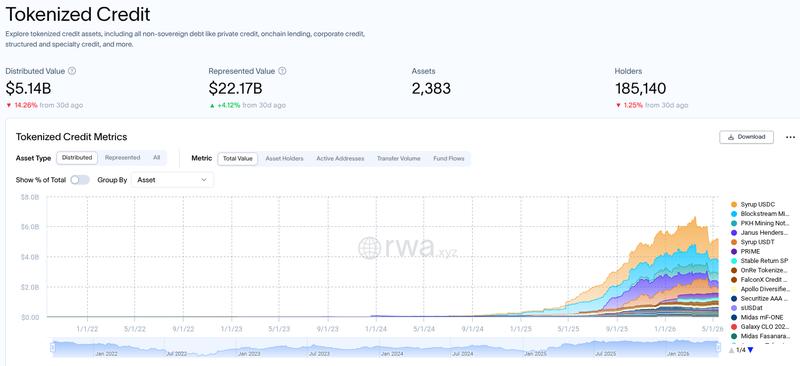
Additional projects have begun exploring the integration of credit instruments into blockchain environments. Centrifuge has broadened its decentralized finance infrastructure to incorporate tokenized credit instruments and US Treasury products across additional blockchain networks, with the goal of bridging institutional-quality assets with DeFi liquidity pools.
Figure has ventured into sectors including automobile lending through the Hastra DeFI protocol, where tokenized credit instruments are engineered to integrate with decentralized finance systems and wider blockchain market infrastructure. The protocol, which was introduced last year by the Provenance Blockchain Foundation, exchanges wrapped yields for a Prime token. In recent developments, Hastra revealed its deployment on the Morpho protocol operating on Ethereum, thereby accessing a significantly larger potential DeFi market.