Fellowship Crypto PAC Withdraws Texas Senate Ad Campaign: Sources
The cryptocurrency-funded Fellowship PAC has withdrawn from a major ad buy intended to bolster Texas Attorney General Ken Paxton's campaign in advance of the upcoming May runoff election.

Fellowship, a political action committee that announced its formation with backing exceeding $100 million from cryptocurrency-supporting donors, has withdrawn from a planned advertising campaign designed to boost Texas Attorney General Ken Paxton's bid in a pivotal United States Senate contest.
A report published Thursday by Axios revealed that leaders within the Republican Party reached out to US Commerce Secretary Howard Lutnick regarding his ties to Fellowship, an organization that has received partial financing from Cantor Fitzgerald.
As the former chief executive and president of the financial services firm, and with his sons currently leading the company, Lutnick allegedly faced inquiries from Republican officials concerning Fellowship's backing of Paxton. The PAC had disclosed on Tuesday that it spent $1.75 million on advertisements supporting the attorney general's campaign.
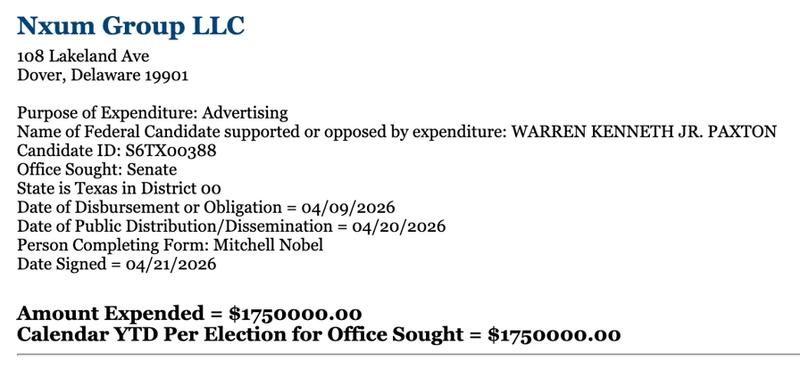
The advertising expenditure that Fellowship reported to the Federal Election Commission (FEC) via the marketing firm Nxum Group was never actually executed, according to sources. The FEC documentation indicating the $1.75 million expense remained publicly accessible as of Friday. Cointelegraph attempted to contact Fellowship for clarification but had not received a reply at the time of publication.
The withdrawal of support from a cryptocurrency-aligned PAC such as Fellowship for a United States Senate candidate, potentially due to pushback from GOP leadership, represents an atypical situation. Digital asset-focused political action committees typically provide support to candidates across the political spectrum whom they view as favorable toward cryptocurrency policies.
In addition to Fellowship, organizations such as Fairshake and similar PACs are projected to collectively deploy hundreds of millions of dollars during the US midterm election cycle following their substantial investment in advertising campaigns for candidates during the 2024 election season to sway voter opinion.
Paxton, who was unable to secure an outright victory in the March primary contest against Senator John Cornyn, is scheduled to compete against the sitting Republican senator in a May 26 runoff election before the general election in November. The Republican candidate who secures a majority in the runoff will most likely compete against Democratic challenger James Talarico in the contest for one of Texas' United States Senate positions.
Cryptocurrency organizations demand Senate action on market structure legislation
The Republican Party has maintained a narrow majority in the United States Senate starting in January 2025, which has resulted in the approval of the stablecoin legislation, the GENIUS Act, along with deliberation on additional cryptocurrency-related legislative proposals. Nevertheless, should the Democratic Party obtain majority control of the chamber following the 2026 midterm elections, the Senate's methodology for addressing cryptocurrency legislation could undergo significant transformation.
Beginning in July 2025, the Senate has been reviewing legislation focused on cryptocurrency market structure, which is anticipated to represent one of the most far-reaching legislative measures impacting the sector. Postponements, partially attributable to federal government shutdowns, ethical considerations, and debates surrounding stablecoin yield mechanisms, have continued for multiple months, with the full chamber having yet to schedule a voting session on the proposed legislation.
On Thursday, a coalition of more than 120 organizations connected to the cryptocurrency and blockchain sectors called upon leaders of the Senate Banking Committee to cease delaying progress on the market structure legislation, known as the CLARITY Act. The committee must conduct a markup session on the proposed bill before the full Senate can potentially arrange a floor vote on the measure.