Federal regulator CFTC takes legal action against New York in prediction market jurisdiction battle
The federal Commodity Futures Trading Commission has initiated legal proceedings to prevent New York from imposing gambling regulations on prediction market platforms, maintaining that federal oversight holds exclusive jurisdiction over event-based contract markets.
The Commodity Futures Trading Commission (CFTC) has initiated legal proceedings against the state of New York in an effort to prevent state authorities from imposing gambling regulations on prediction market platforms that operate under federal oversight, marking an intensification of an expanding dispute regarding regulatory jurisdiction over these financial products.
Through a legal complaint submitted to the US District Court for the Southern District of New York, the federal regulator contended that it possesses exclusive jurisdiction over these market operations under federal statute, requesting both a declaratory judgment and permanent injunction to block New York's enforcement measures.
CFTC-registered exchanges have faced an onslaught of state lawsuits seeking to limit Americans' access to event contracts and undermine the CFTC's sole regulatory jurisdiction over prediction markets
CFTC Chair Michael Selig
Just days ago, New York authorities initiated lawsuits against cryptocurrency exchanges Coinbase and Gemini, alleging that their prediction market products constituted violations of state gambling regulations. The state had similarly taken aim at Kalshi previously, issuing directives to cease operations related to certain sports-oriented contracts.
States say federal law doesn't legalize sports betting
This past Friday, a broad alliance consisting of 37 states along with Washington, D.C. submitted an amicus brief in support of Massachusetts in its ongoing litigation against Kalshi, calling upon the state's supreme court to dismiss Kalshi's contention that federal legislation permits the company to provide sports wagering services across the nation without adhering to individual state regulations.
Kalshi maintains that its wagering products qualify as "swaps" subject to federal agency regulation under legislation enacted in 2010 governing financial instruments. The coalition of states contends that this legislation was not designed to legalize or regulate sports wagering and fails to explicitly preempt state authority, which has traditionally maintained jurisdiction over gambling activities.
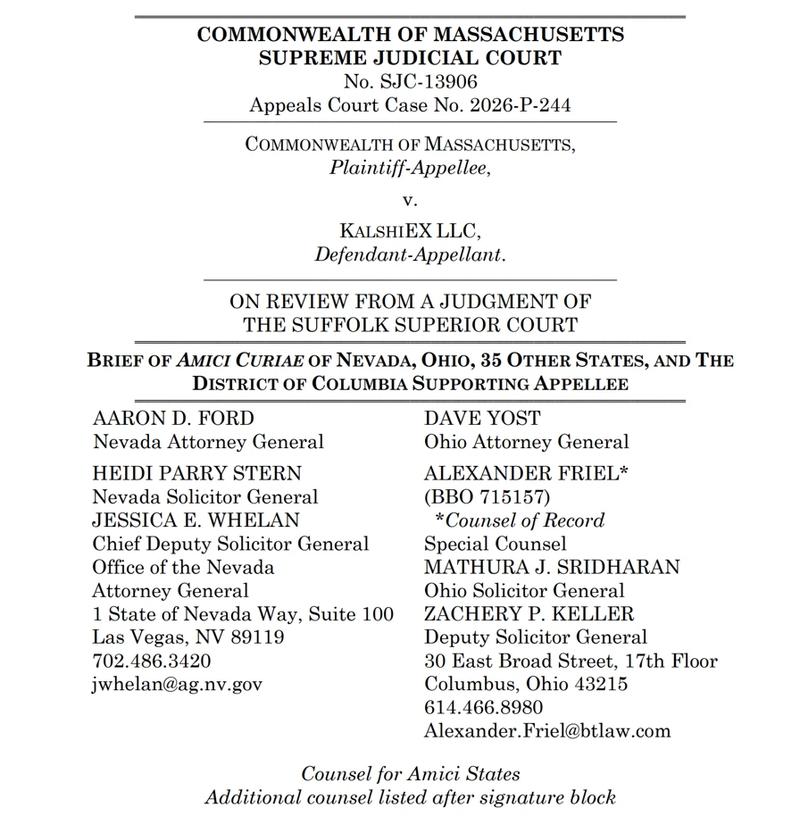
The state coalition further contends that eliminating state-level regulatory oversight would undermine critical consumer safeguards. State gambling statutes currently manage licensing requirements, age verification procedures, fraud detection mechanisms, and problem gambling intervention programs, which represent areas that fall outside the scope of federal financial regulatory frameworks.
States ramp up crackdown on prediction markets
State regulatory authorities have adopted an increasingly confrontational approach toward prediction market operations in recent months, distributing cease-and-desist notices and initiating legal proceedings against companies offering prediction-based contract products.
States including Arizona, Connecticut and Illinois are actively pursuing enforcement of their gambling statutes against prediction market platforms. In recent weeks, a Nevada judicial official granted an extension to a prohibition preventing Kalshi from providing event-based contract offerings within state boundaries, aligning with state regulators who contend these products constitute unauthorized gambling operations.