Federal Judge Approves $71M ETH Transfer from Arbitrum DAO to Aave in North Korea Hack Case
In a New York federal court ruling, Arbitrum DAO has been permitted to move $71 million worth of frozen Ether to Aave after a North Korean-linked security breach, though terrorism victims maintain their legal rights to the assets.

A federal judge in Manhattan has granted permission for Arbitrum DAO to relocate $71 million worth of frozen Ether to Aave, paving the way for the decentralized finance protocol's efforts to recover from a security breach connected to North Korea.
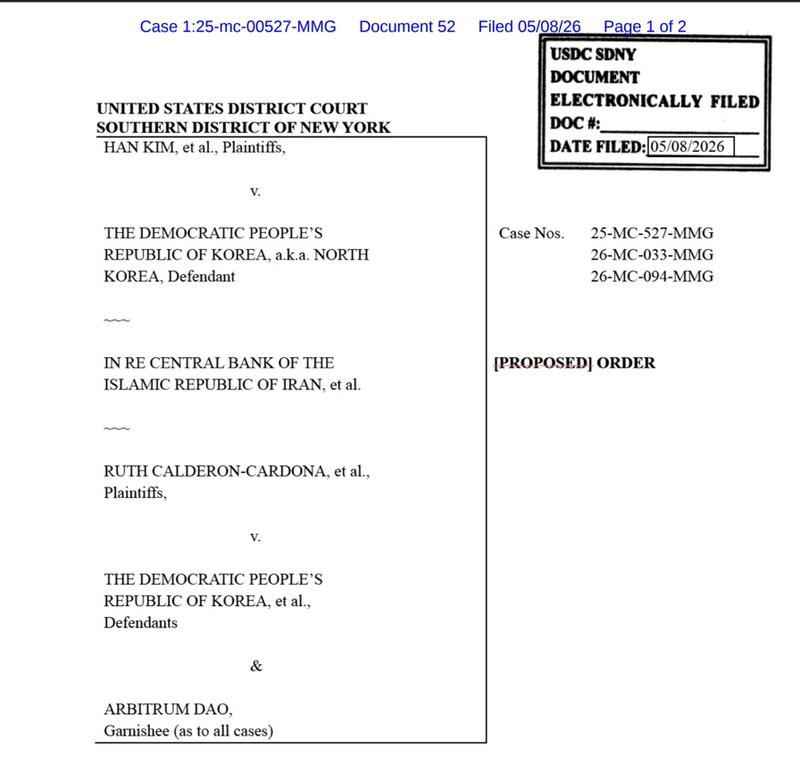
On Friday, Judge Margaret Garnett from the Southern District of New York delivered the ruling, which modifies a restraining notice that had previously secured the assets within Arbitrum DAO. The modified order authorizes an onchain governance vote to transfer the funds to a wallet under Aave LLC's control, while explicitly shielding all participants involved in the transfer from any potential violations of the freeze.
However, the ruling maintains the legal rights of terrorism victims to claim the funds, which means Aave cannot freely utilize the assets and may be compelled to surrender them should the court's final decision favor the terrorism victims.
The ruling followed a demonstration of substantial support from Arbitrum delegates for the proposed transfer through an off-chain Snapshot vote, which forms part of Aave's comprehensive recovery strategy after last month's North Korea-linked rsETH security breach. Nevertheless, any actual movement of funds requires a separate binding onchain governance vote to proceed.
Aave petitions court to remove restraining order on assets
In the preceding week, Aave submitted an emergency motion to a New York court requesting the removal of a restraining notice that had prevented Arbitrum DAO from moving the funds to those affected by the Kelp DAO exploit. The restraining notice was issued by Gerstein Harrow LLP, the legal firm representing families who hold $877 million in outstanding terrorism judgments against North Korea and assert that the funds are rightfully theirs since North Korean hackers took them during the April 18 security breach.
Aave mounted a vigorous defense, contending that a thief does not acquire legitimate ownership of stolen assets and that connecting the hack to North Korea is based on nothing more than online speculation. The protocol also cautioned that upholding the restraining notice by the court could discourage future DeFi recovery initiatives and provide malicious actors with a blueprint for exploiting legal ambiguity in the aftermath of hacks.
Gerstein Harrow has a history of pursuing comparable claims. Earlier this year in January, the firm filed a lawsuit against Railgun DAO, claiming the privacy protocol facilitated the laundering of proceeds from previous North Korean hacking incidents, including the $1.5 billion Bybit security breach.
Kelp security breach creates $174 million deficit in rsETH collateral
The security breach at Kelp DAO resulted in a substantial deficit in rsETH's collateral backing. The exploit resulted in the release of 116,500 rsETH on Ethereum without a matching burn on the originating side, leaving just 40,373 rsETH in the adapter contract compared to confirmed backing for 152,577, creating a shortfall of approximately 76,127 rsETH, valued at around $174.5 million based on current market prices.
The 30,765 ETH that has been frozen by Arbitrum is being recognized as a significant measure toward addressing that deficit, with supporters maintaining that even a partial restoration of rsETH's collateral backing would contribute to stabilizing conditions for users throughout Arbitrum and the broader decentralized finance ecosystem.