Federal Appeals Court Blocks New Jersey's Attempt to Regulate Kalshi Prediction Market
Federal appellate judges sided with Kalshi in determining that the CFTC holds sole regulatory authority over prediction markets, as states attempt to assert control.

A federal appellate court has delivered a decision blocking New Jersey gaming regulators from pursuing enforcement measures against Kalshi, a prediction market platform, concerning its sports event-based contracts.
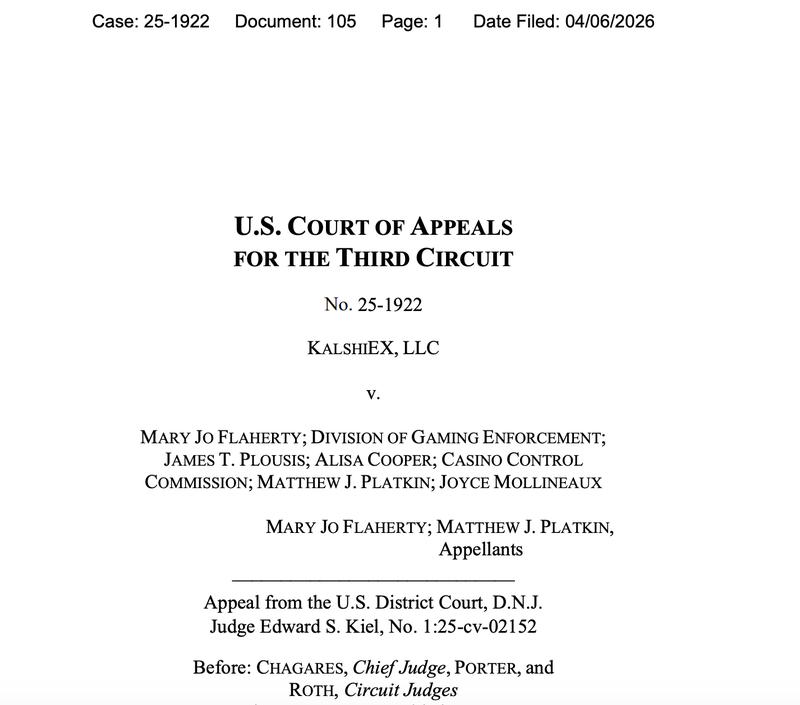
Through an opinion released on Monday, judges on the US Court of Appeals for the Third Circuit voted 2-1 to support Kalshi's assertion that the platform demonstrated a "reasonable chance of success" in its claim that federal Commodity Exchange Act provisions override state regulations, potentially paving the way for the US Supreme Court to weigh in on the dispute over gaming legislation.
"This is a big win for the industry and millions of users," Kalshi CEO Tarek Mansour said in a social media post on X.
The decision from the appellate court upheld a previous lower court determination, where Kalshi maintained that the US Commodity Futures Trading Commission (CFTC) possessed "exclusive jurisdiction" over the regulation of sports-related event contracts, classifying them as swaps under the agency's regulatory authority.
"Allowing New Jersey to enforce its gambling laws and state constitution would create an obstacle to executing the Act because such state enforcement would prohibit Kalshi, which operates a licensed [designated contract market] under the exclusive jurisdiction of the CFTC, from offering its sports-related event contracts in New Jersey," wrote Circuit Judge David J. Porter. "This state regulation is exactly the patchwork that Congress replaced wholecloth by creating the CFTC."
This decision from the circuit court arrived merely days following a Nevada judge's order extending a prohibition on Kalshi from providing event-based contracts, as numerous other state authorities continue their enforcement actions against sports betting activities on prediction market platforms. The fragmented array of state-level judicial decisions may result in the US Supreme Court accepting one of these cases for review, which could potentially reverse its 2018 ruling that granted states authority over sports gambling regulation.
In her dissent, Circuit Judge Jane Roth said the prediction markets platform's actions were a "performative sleight meant to obscure the reality that Kalshi's products are sports gambling," adding that the company's event contracts were "virtually indistinguishable" from those on betting websites:
"[T]he question of whether sports-event contracts are swaps is a thorny issue with the potential to radically upend the legal landscape governing the gambling industry, and I am not convinced the Majority's analysis does this issue justice."
CFTC chair reiterates agency's position on prediction markets
CFTC Chair Michael Selig, who remains the single commissioner at the financial regulatory body after acting chair Caroline Pham's December departure, has positioned prediction markets as a core focus area for the commission since assuming his role. Over the past four months, Selig has asserted that the CFTC maintains "exclusive jurisdiction" over the regulation of event contracts on prediction market platforms, initiated a proposed rulemaking process for public feedback and submitted an amicus brief defending its stance in the Ninth Circuit Court of Appeals regarding a dispute involving Nevada's gaming regulators.
The regulator last week sued Arizona, Connecticut and Illinois to block them from pursuing what it said were unlawful efforts to regulate prediction markets.
"Our definition of commodity and statute is very broad," Selig said at the Digital Assets and Emerging Tech Policy Summit at Vanderbilt University on Monday. "It includes events on sports, it includes events in politics, it includes corn and grains and all sorts of things. It doesn't really distinguish between if you're offering an event contract on grains, you're regulating that differently than an event contract on sports."
The CFTC chair added that there were exceptions for event contracts that were "readily susceptible to manipulation."