FCA Approves Framework for Blockchain-Based Investment Funds Under Current Regulations
Britain's financial watchdog has approved regulations allowing investment funds to maintain onchain registries and implement a Direct-to-Fund dealing structure, designed to streamline tokenized fund operations within current regulatory frameworks.

Britain's financial watchdog has approved a fresh set of regulations and guidance designed for tokenized investment funds, with the objective of facilitating asset managers' adoption of blockchain technology within the current fund regulatory framework instead of through separate pilot programs.
According to a policy statement released Thursday, designated PS26/7, the Financial Conduct Authority (FCA) stated that distributed ledger technology (DLT) and tokenization have the potential to enhance fund management efficiency, and the regulator is committed to "support innovation in the UK asset management sector," forming part of a digital assets strategy initially presented in a January 2025 correspondence to the prime minister.
The regulatory modifications provide companies with a more defined route to incorporate blockchain technology into regulated fund activities, as authorities work to update market infrastructure while maintaining existing frameworks for investor safeguards, and demonstrate a wider effort to incorporate tokenized finance within the regulatory boundary instead of permitting its evolution in separate systems.
In the announcement, Simon Walls, executive director of markets at the FCA, stated that tokenization is set to "play an important role in asset management," and noted that the authority had established a workable framework to provide companies with certainty regarding how fund tokenization can function within the FCA's rules.
How tokenized funds move into the UK rulebook
PS26/7 permits companies to maintain investor records on DLT utilizing the industry "Blueprint" model, establishing that onchain transaction documentation can function as the principal ledgers for unit transactions without necessitating a complete off-chain copy, contingent upon "appropriate resiliency plans" being implemented.
The FCA indicated that the Blueprint has been previously utilized to grant authorization to the initial tokenized UK undertakings for collective investment in transferable securities (UCITS), and that approved funds may keep their register on public DLT networks provided controls satisfy its requirements, including the issuance of units across several blockchains so long as investors' rights and fees remain uniform.
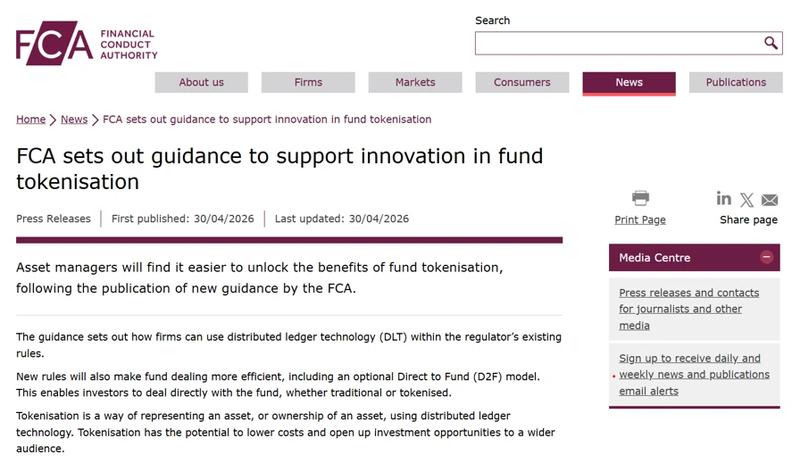
The primary regulatory modification introduces an elective "Direct‑to‑Fund" (D2F) dealing structure, in which the fund itself or its depositary, as opposed to the manager, acts as the counterparty to investor transactions. Transactions proceed through a single phase in which units are created or redeemed directly in exchange for cash transferring between investors and the fund, a framework the FCA indicates is designed to enhance fund operational efficiency and facilitate better alignment with onchain settlement processes.
In terms of future developments, the FCA outlines a strategic plan that progresses from current tokenized funds to tokenized assets and, in time, tokenized cash flows, encompassing models in which investors maintain tokenized assets in digital wallets while managers utilize smart contracts to administer them.
The authority indicates it continues to be receptive to waivers allowing funds to utilize digital cash and stablecoins for settlement purposes and specific expenses, and that it intends to solicit additional feedback in 2026 regarding broader implementation of DLT in wholesale markets
The policy statement follows the FCA's initiation of a consultation on guidance for its comprehensive cryptoasset regime earlier this month, addressing stablecoin issuance, trading, custody and staking, in advance of a complete framework scheduled to become effective in October 2027.
Cointelegraph reached out to the FCA for comment but had not received a response by publication.