European Commission seeks input on MiCA framework covering stablecoins and decentralized finance
The EU has initiated a comprehensive MiCA review process to evaluate stablecoin regulations, decentralized finance challenges and asset classification problems before complete implementation in 2026.

A comprehensive review of the European Union's groundbreaking cryptocurrency legislation has been initiated by the European Commission, indicating that officials are weighing modifications to the digital asset regulatory framework merely two years following its initial implementation.
On Wednesday, the commission unveiled a public consultation process designed to gather input from cryptocurrency sector participants and the general public regarding potential modifications to the Markets in Crypto-Assets Regulation (MiCA). Public feedback will be accepted through Aug. 31.
According to the commission, both cryptocurrency markets and the international regulatory landscape have undergone continuous transformation since MiCA's implementation in 2024, leading regulators to evaluate whether the existing framework continues to serve its intended purpose effectively.
This development represents a significant regulatory milestone for the European Union, with certain industry analysts already using the term "MiCA 2" when discussing prospective amendments to the regulatory framework.
Stablecoin interest ban included in regulatory review
The focused consultation process associated with MiCA consists of an extensive questionnaire created to evaluate the regulation's practical performance and identify areas requiring potential modifications.
The consultation requests input regarding persistent classification difficulties, especially the unclear distinction between crypto assets and conventional financial instruments under European Union legislation, encompassing wrapped tokens, synthetic assets and tokenized fund interests.
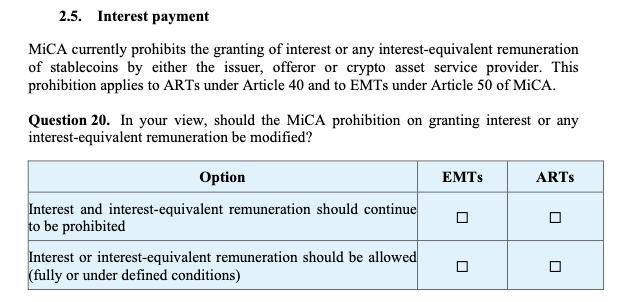
Stablecoins represent a primary area of emphasis, featuring a reconsideration of MiCA's ban on interest or interest-like remuneration. Officials are inquiring whether this limitation should be preserved or modified, in addition to more comprehensive questions concerning reserve requirements, liquidity management, redemption rights and the criteria employed to identify "significant" tokens.
In addition to stablecoins, the consultation investigates developing areas of risk, such as decentralized finance (DeFi), staking, lending, non-fungible tokens, and crypto asset service providers (CASPs), along with concerns related to market integrity, investor protection and possible simplification of compliance rules.
The incorporation of DeFi and tokenized financial assets carries particular significance given that both domains currently fall predominantly beyond MiCA's regulatory reach.
EU probes whether consumers actually trust crypto
The public consultation materials reveal that the commission is examining not merely whether MiCA functions effectively as a legal framework, but additionally whether everyday consumers comprehend and have confidence in digital assets operating under the new regulatory structure.
A substantial portion of the questions concentrate on user familiarity with Bitcoin (BTC), Ether (ETH), stablecoins, DeFi and tokenized assets.
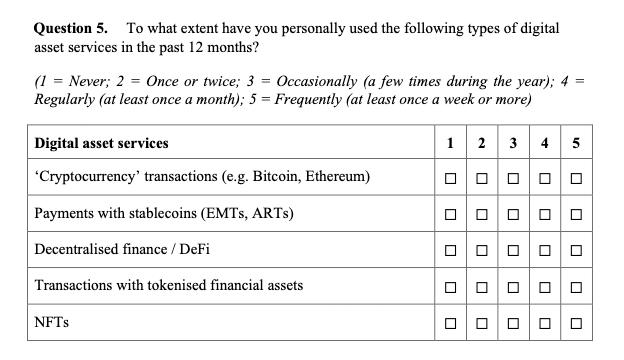
The consultation additionally investigates factors that could enhance consumer trust in cryptocurrency services, such as reinforced protections, more transparent regulations, enhanced supervision and simplified access via regulated banks and payment providers.
This review arrives as MiCA nears an important transitional milestone in July 2026, following which CASPs must obtain complete authorization under the European Union framework or discontinue their operations.