European and Korean Banking Consortia Partner with Chainlink for FX Settlement Infrastructure
Financial institutions from Europe and South Korea are examining how euro and won stablecoins under regulatory oversight could facilitate instant cross-border foreign exchange transactions.

A collaborative working group featuring Chainlink alongside banking organizations from Europe and South Korea has been formed to investigate stablecoin utilization for foreign exchange (FX) settlement, highlighting the growing momentum of blockchain technology testing within traditional financial infrastructure modernization efforts.
The announcement came Tuesday as Chainlink unveiled Project Pangea in partnership with FairSquareLab, a South Korean company specializing in digital asset infrastructure, the Unified Korea Alliance (UniKA) — a banking consortium representing more than a dozen commercial banks in Korea — and Qivalis, a euro-focused stablecoin consortium with backing from 37 European financial institutions.
The objective of Project Pangea centers on uniting financial institutions from South Korea and Europe to assess atomic, direct swaps involving euro- and South Korean won-backed stablecoins through the integration of Chainlink's data infrastructure combined with FairSquareLab's onchain technology for foreign exchange settlement.
This initiative represents yet another case of financial institutions examining stablecoins for wholesale financial infrastructure applications instead of consumer-facing payment solutions. Data from the Bank for International Settlements indicates that the worldwide foreign exchange market handles approximately $9.6 trillion in daily trading volume.
As a working group, Project Pangea does not constitute a live operational payment network, and no timeline for production deployment has been made public. The project exemplifies a wider movement among banking institutions experimenting with tokenized deposits and stablecoins operating under regulatory frameworks to enhance cross-border payment systems and settlement processes.
Comparable initiatives are taking shape elsewhere. Fintech company OpenFX has recently secured $94 million in funding to broaden its stablecoin-powered payments network, concentrating initially on markets in Southeast Asia and Latin America.
Stablecoins gain traction among banks and corporations
Financial institutions worldwide are showing increased interest in stablecoins as tools to enhance corporate payment systems, cross-border settlement mechanisms and foreign exchange operations, supported by more defined regulatory frameworks emerging in the United States, Europe and additional major financial centers.
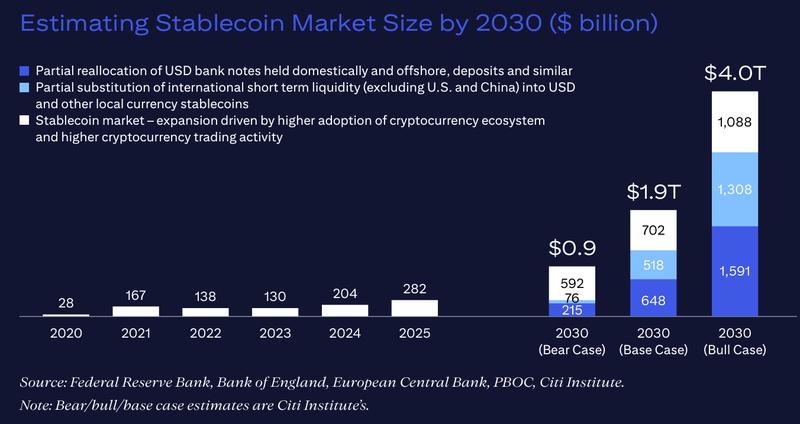
Brad Garlinghouse, CEO of Ripple, recently characterized stablecoins as experiencing a "ChatGPT moment" as an expanding number of financial institutions assess how this technology might integrate into their operational frameworks. This trend provides context for Citigroup's projection that the worldwide stablecoin market will reach $1.9 trillion by 2030, representing substantial growth from the current level of approximately $315 billion.
Citigroup's analysis attributes this anticipated expansion to sustained adoption throughout crypto markets, a progressive transition from physical US dollar currency to digital dollars, and increasing reliance on stablecoins as vehicles for storing short-term liquidity in both US dollars and local currency denominations.