Ethereum's EIP-8363 Staking Proposal Triggers Major Community Controversy
The proposed EIP-8363 staking reform for Ethereum seeks to cut issuance rates, yet opponents warn it may damage DeFi ecosystems, network decentralization, and institutional trust.

What began as an effort by Ethereum researchers to dial back staking incentives has morphed into one of the most contentious discussions about the network's economic fundamentals since the transition to proof-of-stake.
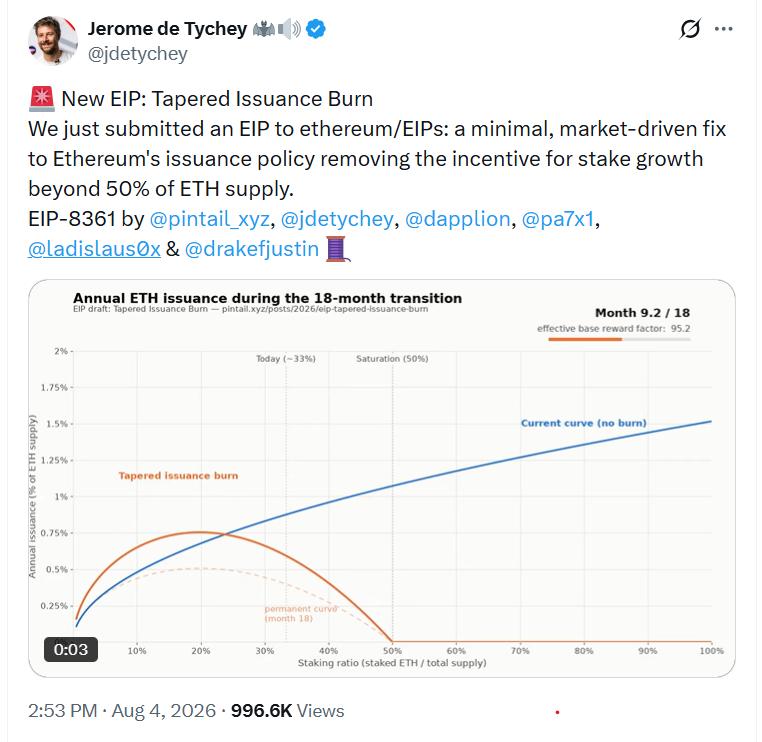
The Ethereum Improvement Proposal known as EIP-8363, alternatively called "Tapered Issuance Burn," proposes a progressive decrease in staking rewards as increasing amounts of Ether get committed to network security — ultimately bringing new protocol issuance down to zero when staked ETH reaches 50% of total supply.
The proposal's creators, which include Justin Drake from the Ethereum Foundation alongside Jerome de Tychey, co-founder of the Ethereum Community Conference (ETHCC), contend that Ethereum has arrived at a stage where extra staking delivers decreasing security benefits, all while diluting the value held by those who opt out of staking.
Put simply: Ethereum ought to cease compensating for security that's no longer essential.
The catch is that numerous stakeholders strongly oppose this concept.
Spanning DeFi developers to staking service operators and institutional participants, detractors contend the proposal could compromise decentralization, create disruptions across Ethereum's lending infrastructure, and damage trust in the network's monetary framework. Mike Silagadze, founder of Ether.fi, expresses his view this way:
"This is so disappointing on every level. [...] This is bad for decentralization, this is bad for Ethereum adoption, and this is bad for the credibility of the network."
"Institutional adoption requires certainty and playing with the issuance at the margin would cause uncertainty and institutions hate uncertainty."
The central question emerges: Does Ethereum truly spend excessively on security, or does EIP-8368 represent a fix for a nonexistent problem?
Is Ethereum over-staked?
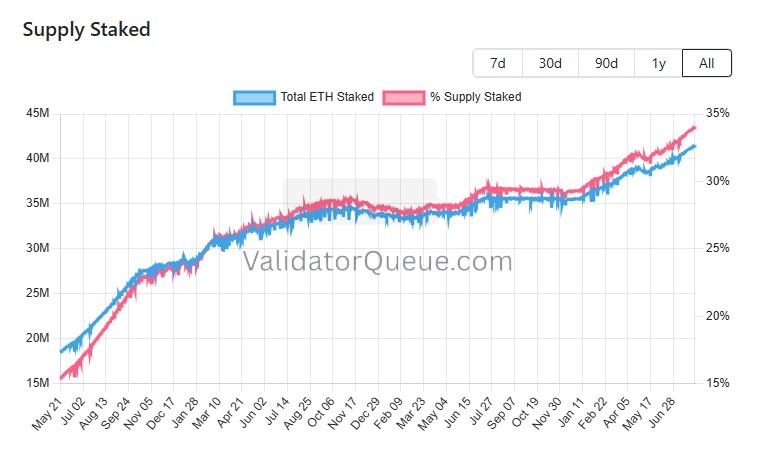
At present, Ethereum maintains approximately 41.5 million ETH in staking, generating returns of 2.67%, which accounts for 34.07% of total supply, based on data from the Ethereum Validator Queue.
Though increased ETH commitment typically strengthens the network's resistance to attacks, the creators of EIP-8368 maintain that these security improvements yield diminishing returns even as Ethereum maintains its reward distribution to validators.
The proposal under EIP-8363 aims to phase out this economic incentive, with proponents asserting that Ethereum ought to discontinue subsidizing further staking after achieving adequate security levels.
However, universal agreement on the existence of this issue remains elusive. The staked quantity has undeniably grown considerably throughout 2026, climbing 15% from the year's beginning.
Berryman contends that natural market dynamics are already moderating participation levels without requiring modifications to Ethereum's issuance framework.
"We will come to a natural ceiling probably by the end of this year," he says, maintaining that yields declining toward 2% are improbable to motivate substantially greater ETH lockup in staking. "People need a certain amount of liquidity," he says.
According to Berryman, the recent expansion has predominantly resulted from institutional participants including Bitmine and BlackRock, though he suggests that after these entities finalize their staking positions, participation levels will likely stabilize once more.
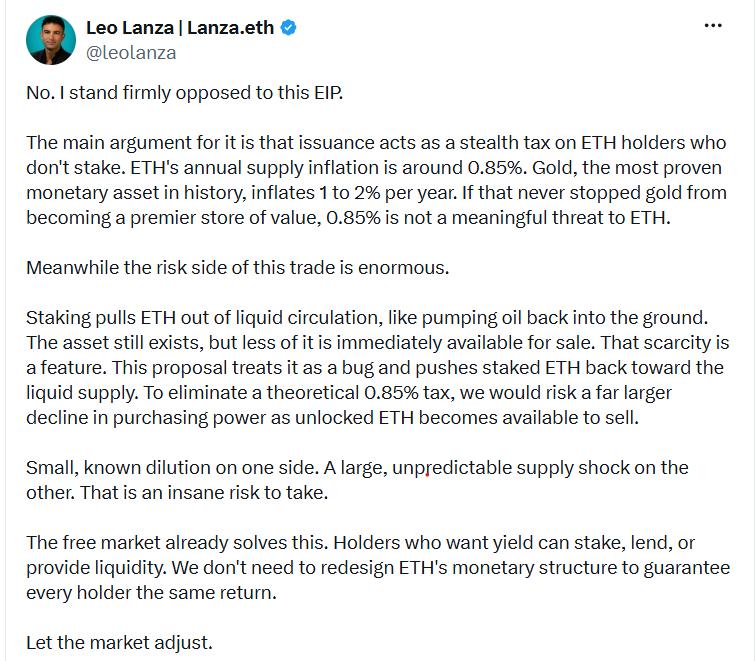
Leo Lanza, an Ethereum analyst who similarly opposes the measure, disputes the fundamental premise that Ethereum's issuance constitutes a significant "stealth tax" imposed on those not participating in staking.
The yearly inflation rate for Ethereum stays under 1%, he observes, noting that even gold, commonly regarded as the planet's foremost monetary store of value, increases its supply at approximately 1% to 2% per year:
"The free market already solves this [...] Let the market adjust."
Could the cure be worse than the disease?
Those backing EIP-8368 maintain the modification would reduce wasteful issuance and prevent staking from concentrating excessively within major custodians and liquid staking service providers. However, opponents assert the proposal threatens to generate more significant issues than those it attempts to resolve.
Greg Koumoutsos, who serves as technical research lead at the Lido Labs Foundation, observes that the current staking proportion of roughly one-third of ETH supply seems sustainable, although he acknowledges the value in considering excessive staking scenarios proactively.
Beyond that, he maintains the proposal reduces what Ethereum's issuance truly finances to an oversimplified model:
"Ethereum is not only paying for slashable ETH; it is paying for decentralization, operator diversity, censorship resistance, and network resilience."
According to Koumoutsos, reduced issuance doesn't automatically translate to superior security policy without accounting for these wider considerations.
An additional consideration involves the deep integration of liquid staking within Ethereum's DeFi infrastructure, where staking derivatives function extensively as collateral and within lending plus yield-generating strategies.
"It will obviously kill a huge chunk of DeFi which is built around the staking ecosystem," Silagadze argues.
Stani Kulechov, who founded Aave, Ethereum's premier decentralized lending platform, warns that diminishing staking rewards jeopardizes the foundation of this wider ecosystem.
"My concern is... those who are fine with ETH beta and yield might also sell ETH for other yielding assets [...] Ethereum should not be punished for its growth."
Smaller validators will bear the cost
An additional apprehension surrounding the proposal centers on how reducing staking compensation might paradoxically drive greater concentration among the largest network participants.
The rationale stems from independent validators lacking access to the operational efficiencies that benefit larger staking enterprises, exchanges, or institutional operators. Diminished protocol compensation could render solo staking financially unviable while bigger organizations maintain operations. Koumoutsos states:
"A solo validator has real costs: some ideological solo stakers may remain, but many marginal solo validators will not, and fewer new ones will enter, if any."
He further notes that centralized platforms pursue staking for motivations extending past yield generation, including customer retention strategies, regulatory compliance positioning, and product ecosystem integration, rendering them less susceptible to participation reduction.
Koumoutsos additionally cautions that within delegated staking arrangements, decreased rewards might advantage centralized custodial offerings over onchain staking mechanisms, which encounter elevated expenses related to maintenance, governance processes, and system upgrades.
A debate over more than staking
Advocates suggest reduced issuance would enhance Ether's long-term monetary characteristics. Yet opponents counter that repeatedly modifying Ethereum's monetary framework erodes its reputation for predictability and dependability.
Berryman maintains institutions prioritize consistency over incrementally improved yields, and that altering the reward curve introduces governance-related yield uncertainty. "Institutional investors will price accordingly," he says.
He further contends institutions appreciate staking not due to exceptionally attractive yields, but rather because it delivers consistent returns throughout their ETH holding periods:
"It's not broken, why try and fix it?"
Silagadze concurs, stating, "Any nation state or large institution looking at this will justifiably have a dramatic loss of confidence in the governance and stability of Ethereum."
The manner in which the proposal was introduced attracted criticism as well, having been released merely two days prior to the Aug. 6 cutoff date for proposals under consideration for Ethereum's forthcoming network upgrade.
Silagadze contends that a modification with "far reaching implications for all of DeFi" ought not to have been presented within such a compressed timeframe.
The intense opposition has demonstrated the increasing difficulty of modifying Ethereum's economic model, particularly when each alteration produces beneficiaries and those disadvantaged across staking operations, DeFi platforms, and institutional market segments.