ENS scraps layer-2 Namechain initiative as Ethereum scalability improves
Following a dramatic 99% reduction in transaction costs and significant Ethereum network improvements, the team has decided to launch ENSv2 natively on the Ethereum mainnet.
The Ethereum Name Service has withdrawn its proposal to develop a dedicated layer-2 network as part of the ENSv2 upgrade, choosing instead to roll out the enhanced protocol directly on the Ethereum mainnet.
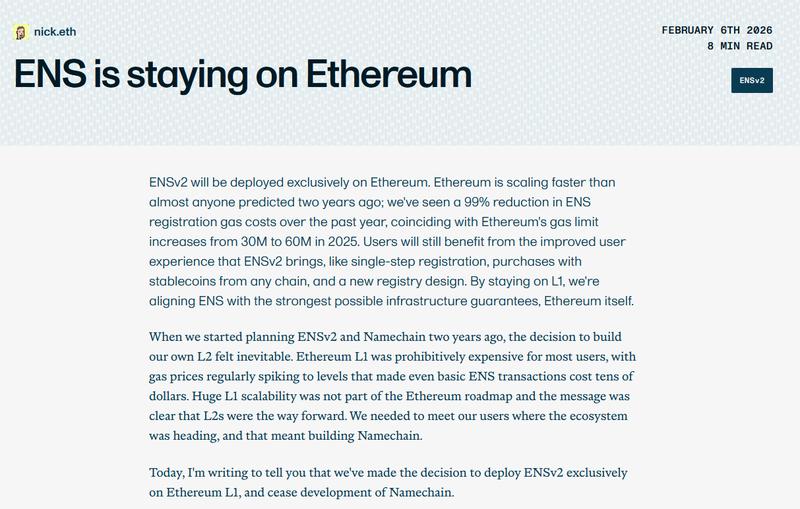
Through a Friday blog post, ENS lead developer nick.eth clarified that this strategic shift was influenced in part by a "99% reduction in ENS registration gas costs over the past year" following several critical improvements to the Ethereum blockchain.
"Put simply: Ethereum L1 is scaling, and it's scaling faster than almost anyone predicted two years ago. The recent Fusaka upgrade raised the gas limit to 60 million, a 2x increase from the beginning of 2025," nick.eth said, adding:
"Now Ethereum core developers are targeting 200 million gas limit targets in 2026, a 3x increase from today, and that's before any ZK upgrades land."
The Fusaka upgrade, among the latest Ethereum network enhancements that became operational in early December, has contributed to Ethereum's ability to reduce transaction fees thanks to its substantial scaling improvements for both the mainnet and the surrounding L2 ecosystem.
The ENS team originally unveiled its layer-2 solution Namechain in November 2024, with the initiative promising to deliver a more accessible and cost-effective domain name registration experience through rollup technology.
Nick.eth highlighted that circumstances have transformed significantly since then, making it practical to develop directly on the mainnet rather than pursuing a complete L2 solution to achieve cost reductions.
"Huge L1 scalability was not part of the Ethereum roadmap, and the message was clear that L2s were the way forward. We needed to meet our users where the ecosystem was heading, and that meant building Namechain," he said.
Despite abandoning the Namechain roadmap, the ENS lead developer explained that the team remains committed to delivering substantial performance enhancements and utility upgrades through ENSv2, with the protocol maintaining robust interoperability capabilities with layer-2 networks.
"The vast majority of our engineering effort has gone into ENSv2 itself: the new registry architecture, the improved ownership model, better handling of name expiration, and the flexibility that comes from giving each name its own registry," he said, adding:
"Deciding to stay on L1 doesn't mean we're closing the door on L2s entirely. The flexibility of the ENSv2 architecture makes L2 names more interoperable. Our new registration flow abstracts the complexity crosschain transactions."