Election Concerns Prompt Brazil's Finance Chief to Delay Cryptocurrency Tax Reform: Sources
Fernando Haddad's successor at Brazil's Finance Ministry has decided to delay proposed changes to cryptocurrency taxation regulations until the 2026 presidential race concludes to steer clear of politically divisive matters.

Dario Durigan, who serves as Brazil's Finance Minister, has made the strategic decision to postpone cryptocurrency taxation policy initiatives until the nation's presidential election cycle concludes in October 2026, aiming to sidestep potentially "divisive" fiscal reforms during a politically sensitive election period.
A public consultation process regarding cryptocurrency tax policy was initially scheduled by government regulators and officials to take place in the latter part of this year, though this timeline may now extend into 2027, while the initiative continues to "remain on the radar," according to individuals with knowledge of the situation who spoke to Reuters.
The country eliminated its previous tax exemption policy for profits generated from smaller cryptocurrency transactions and transfers in June 2025, implementing instead a uniform 17.5% flat tax rate on capital gains from cryptocurrency investments, which extends to earnings from offshore accounts and self-custodial wallet holdings.
The regulations that were in effect previously allowed Brazilian residents to sell cryptocurrency worth up to 35,000 Brazilian real, which equals approximately $6,587, on a monthly basis without incurring capital gains tax obligations on any resulting profits, while those who exceeded this monthly ceiling faced progressive taxation ranging from 15% to 22.5%.
The Banco Central do Brasil, which functions as the nation's central banking institution, released regulations in November 2025 that classify stablecoin transfers in the same category as foreign currency exchange transactions, thereby making them subject to identical tax legislation.
Brazilian governmental authorities are also examining potential proposals that would impose taxes on cryptocurrency assets utilized for cross-border payments and are working to harmonize their reporting requirements with standards established by the Crypto-Asset Reporting Framework (CARF), which serves as an international monitoring benchmark for cryptocurrency-related transactions.
This choice to temporarily suspend the cryptocurrency tax consultation process arrives at a moment when the South American nation is experiencing rapid cryptocurrency adoption, with the digital asset industry demonstrating substantial growth throughout Brazil.
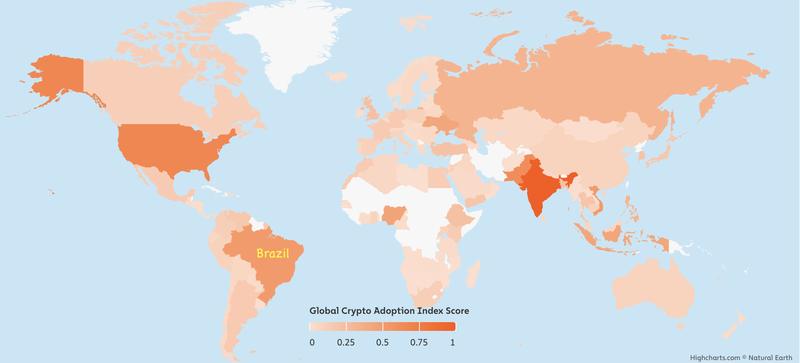
Brazil is one of the top countries in the world for crypto adoption
According to Chainalysis's crypto Global Adoption Index, Brazil holds the fifth position globally and claims the top spot for cryptocurrency adoption throughout the entire Latin America geographical region.
Brazil's population exceeds 213 million inhabitants, with a median age of 33.5 years among its residents, and more than 91% of its population resides in metropolitan and urban areas, based on information compiled by Worldometer.
According to findings from Chainalysis, in 2025, "Latin America's crypto adoption grew by 63%, reflecting rising adoption across both retail and institutional segments," demonstrating significant momentum in the region's digital asset sector.