Dual Blockchain Strategy Emerges for Real-World Asset Tokenization, RedStone Executive Reveals
According to RedStone co-founder Kaźmierczak, financial institutions are adopting a dual-track approach—leveraging permissioned blockchains like Canton for confidential internal operations and public chains like Ethereum for liquid tokenized asset markets.

The institutional embrace of real-world asset (RWA) tokenization is creating a clear bifurcation between public and permissioned blockchain infrastructures, revealing a fundamental tension between the liquidity benefits offered by networks like Ethereum and the confidentiality requirements that are pushing platforms such as Canton Network forward.
This split is growing increasingly evident as tokenized real-world assets continue to attract interest from leading asset management firms.
According to Marcin Kaźmierczak, co-founder of the blockchain oracle service RedStone, innovation and product creation are expected to take place primarily on public blockchain networks, whereas permissioned infrastructure proves more appropriate for institutional workflows that demand strict privacy controls.
"There are some operations between institutions that simply have to stay private, and this is the value proposition that Canton offers very effectively," Kaźmierczak told Cointelegraph.
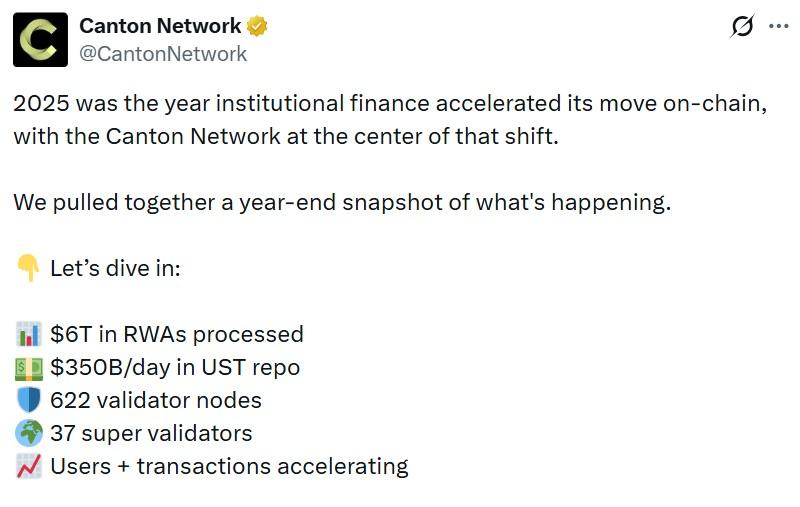
Canton Network, developed by Digital Asset, enables financial institutions and asset managers to tokenize and settle real-world assets while ensuring transaction information remains accessible exclusively to the parties directly involved. According to the network's claims, it handled $6 trillion in RWA value in 2025.
Instead of consolidating around a unified architectural model, banking institutions and asset management companies are constructing separate but parallel infrastructure designed to fulfill distinct roles within the tokenized finance ecosystem, Kaźmierczak explained.
The Merge marked a turning point for Wall Street's tokenization ambitions
The tokenization of traditional assets has emerged as a central theme driving institutional adoption of blockchain technology, extending beyond direct cryptocurrency exposure and exchange-traded funds (ETFs).
McKinsey projected in June 2024 that the value of tokenized assets could climb to approximately $2 trillion by 2030. More bullish estimates point to significantly higher figures, such as the $30.1-trillion projection for 2034 published by Standard Chartered and Synpulse.
Improved regulatory conditions in the United States have played a role in accelerating this transition. The GENIUS Act, which became law in 2025, established a comprehensive federal regulatory structure for stablecoins, which function as the settlement infrastructure for numerous tokenized real-world assets.
According to Kaźmierczak, institutional confidence in Ethereum started building even earlier, following the network's shift to proof-of-stake consensus in 2022.
"In 2022, when I was talking to institutions, the Merge was like a big question mark for those institutions," Kaźmierczak said. "They saw it worked without any hiccups, so it gave them this confidence."
Kaźmierczak noted that RWA initiatives within institutional organizations began during 2023 or 2024, but given that these institutions operate on annual budget cycles, project development and launches unfold over extended periods rather than the rapid timelines typical of cryptocurrency projects. This resulted in multiple institutions revealing their tokenization initiatives in December of last year, he explained.
"It's not that they started in Q4 last year. No, they started a year before, and now we are seeing the fruits."
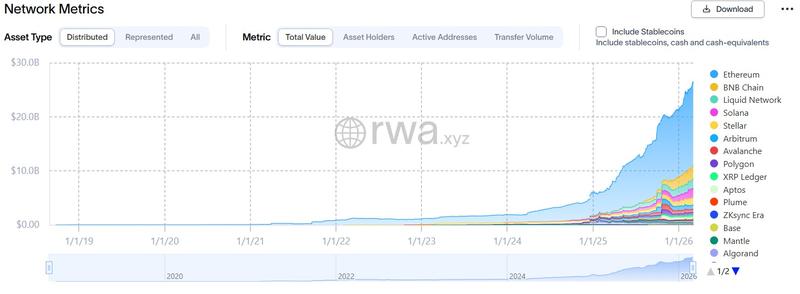
Currently, more than $26.4 billion in RWA token value relies on blockchain networks for distribution infrastructure, with Ethereum hosting over $15 billion of that total. The platform also maintains the most substantial liquidity pools as the most established smart contract blockchain, supporting more than $160 billion in stablecoin assets.
Financial institutions are dividing operations between public and permissioned blockchain networks
Institutional players draw a clear distinction between market-oriented activities and backend operational processes. Public blockchains deliver liquidity, interoperability with other protocols, and connectivity to decentralized finance (DeFi) applications including lending platforms and tokenized investment vehicles. Conversely, permissioned blockchain architectures are favored for settlement procedures, direct counterparty transactions, and internal asset management operations that cannot be conducted on open, transparent networks.
Platforms like Canton enable financial organizations to streamline and automate these workflows while maintaining transaction visibility solely among authorized counterparties. This configuration closely resembles the operational model of existing traditional financial (TradFi) systems.
This operational separation indicates that institutional blockchain implementation may not ultimately coalesce around a single network architecture. Rather, financial organizations appear to be developing dual-track infrastructure, with public chains managing liquidity provision and market access while permissioned platforms handle the confidential operational processes occurring behind closed doors, according to Kaźmierczak's assessment.
"There are some operations between institutions that just have to stay private, and this is the value proposition that Canton offers very effectively. That's the reason we want to be on both of those legs," he said.
A number of prominent financial institutions participated in Canton Network's development from the beginning. Digital Asset, together with a coalition including Microsoft, Goldman Sachs and Deloitte, revealed the network's public launch in May 2023. In September 2024, Digital Asset partnered with the Depository Trust & Clearing Corporation to successfully complete a pilot program for the US Treasury Collateral Network built on Canton.
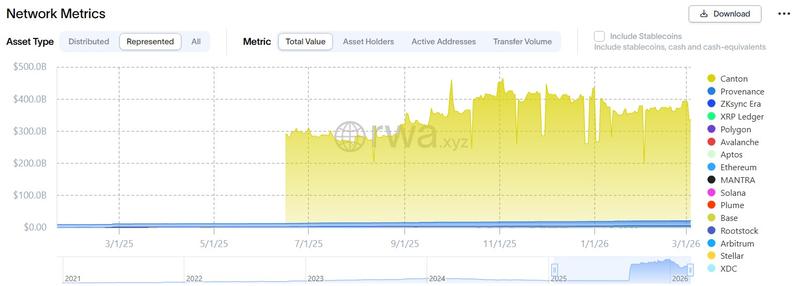
Data from RWA.xyz indicates that Canton Network currently has more than $313 billion in represented RWA tokens, which refers to traditional assets that utilize the blockchain primarily as a recordkeeping and tracking infrastructure.
Zero-knowledge proofs versus permissioned privacy approaches
Among the most significant differences between these two institutional blockchain strategies is the methodology employed to achieve transaction privacy. While numerous blockchain initiatives are pursuing confidentiality through sophisticated cryptographic mechanisms such as zero-knowledge (ZK) proofs, Canton takes a different approach by implementing permissioned data access controls, where transaction information is disclosed exclusively to participating parties.
Not all industry participants concur that this represents the optimal privacy model. Alex Gluchowski, CEO of Matter Labs, argued in a public social media discussion with Digital Asset's Yuval Rooz that ZK-based systems enhance blockchain security fundamentally by requiring cryptographic validation proving that every state modification adheres to the protocol's established rules. Even in scenarios where network operators or system administrators are compromised, malicious actors cannot inject fraudulent transactions into the distributed ledger without producing a mathematically valid proof of proper execution.
Rooz countered in a published blog post that completely opaque implementations of ZK technology could create challenges for auditing activities within financial markets. When transaction information becomes entirely concealed, mistakes or fraudulent activities might go unnoticed, potentially recreating the opaque "black box" environments that previously facilitated major corporate fraud cases like the Enron scandal.
This technical disagreement underscores a more fundamental architectural challenge facing institutional blockchain adoption, as Kaźmierczak emphasized.
Financial institutions are actively testing various methodologies for achieving the right equilibrium between privacy protection, transaction verifiability, and operational control. Public blockchain networks continue serving market-facing liquidity provision and DeFi integration, while permissioned systems mirror traditional institutional processes requiring confidentiality, effectively establishing parallel infrastructure rails for the emerging tokenized financial ecosystem.