DOJ's Blanche Declares 'Code Is Not Criminal' in Major Policy Shift
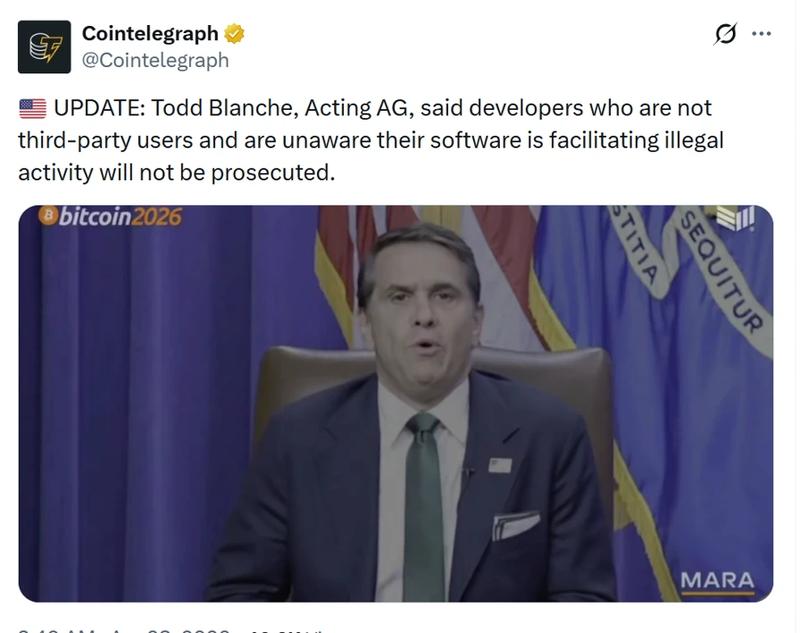
In a significant policy reversal, Acting Attorney General Todd Blanche announced that software developers face no prosecution risk unless they knowingly assist third parties in criminal activities.

In a major policy announcement, Acting US Attorney General Todd Blanche revealed that the US Department of Justice and FBI have ended their practice of pursuing blockchain developers whose platforms are exploited for criminal purposes, choosing instead to concentrate enforcement efforts on actual perpetrators of financial crimes.
During a Bitcoin conference held in Las Vegas on Monday, Blanche appeared alongside FBI Director Kash Patel and Coinbase chief legal officer Paul Grewal, where he discussed the substantial transformation in enforcement strategy that has occurred under the Trump administration's leadership.
Blanche clarified that developers who maintain no connection to illegal activities will face no scrutiny from the DOJ and FBI, emphasizing that "we have fundamentally changed the game when it comes to our investigations."
"The basic principle is that if you are developing software, if you are a coder, if you are part of that process and you are not the third-party user, and you are not helping and knowing the third party is using what you developed to commit crimes, you are not going to be investigated and not going to be charged," he said.
These remarks represent a notable departure from previous US government positions, which had pursued aggressive legal action against developers behind platforms such as Tornado Cash. The cryptocurrency mixing service and privacy-focused protocol became subject to extensive enforcement measures due to criminal activities enabled through the platform, including sanctions violations and money laundering operations.
The Office of Foreign Assets Control imposed sanctions on Tornado Cash in August 2022, which remained in effect until they were removed in November 2024. Criminal charges were filed against developers Roman Storm and Roman Semenov in August 2023; Storm received a conviction in August 2025, whereas Semenov's whereabouts remain unknown. Storm has maintained his innocence throughout the proceedings.
Doubts remain over DOJ's approach
While the crypto community received Blanche's statements favorably, certain voices within the industry contended that additional measures are necessary to offer developers unambiguous legal protection.
In a response posted to X, Peter Van Valkenburgh, executive director of Coin Center, characterized the statement as a "better message than developers have heard from DOJ in recent years," though he noted the message continues to contain ambiguous elements.
"But the real question is where [the] DOJ draws the line between publishing noncustodial software and 'helping' or 'knowing' about a bad user," he said.
Van Valkenburgh referenced a legal proceeding involving developer Michael Lewellen, who initiated litigation against the DOJ seeking pre-enforcement guidance regarding whether releasing his Ethereum-based crowdfunding application qualified as money transmission.
A Texas court dismissed the lawsuit in late March, determining that Lewellen had not successfully established the existence of a legitimate enforcement threat from the DOJ.
"DOJ is publicly acknowledging that developers are still sleeping with one eye open. At the same time, DOJ is telling the courts that Lewellen should not be allowed to ask for legal clarity because there is no credible threat," he said, adding:
"If the law is so clear why are devs sleeping with one eye open? If the law is so clear why fight to have the case dismissed?"
The transformation in the DOJ's enforcement philosophy has been developing over more than twelve months. In April 2025, Blanche issued a memorandum detailing the department's revised approach to enforcement activities moving forward.
The memorandum establishes a pledge to "ending regulation by prosecution," a framework under which developers will not face legal action for the conduct of their platform users or for unintentional regulatory infractions.
"I do not want any platform to look at the Department of Justice or the FBI as somebody who's going to just cause them a lot of problems," Blanche said at the Las Vegas conference.