Despite ETH Plunging 60% From Peak, Traditional Finance Continues Ethereum Investment: The Reasons
Despite price volatility, Ethereum maintains its position as the foundation of global onchain finance through dominant total value locked metrics and increasing traditional finance institutional adoption. Can the ETH price recover?

Primary highlights:
Traditional finance institutions continue accelerating their adoption of Ethereum infrastructure despite underwhelming Ether price performance. The Ethereum ecosystem, including its layer-2 networks, commands 65% of the total value locked market share.
Ethereum co-founder Vitalik Buterin is redirecting attention to base layer scalability improvements and ZK-EVM implementation to guarantee long-term onchain security and efficiency.
The price of Ether (ETH) has experienced a 36% drop throughout 2026, creating disappointment among investors as the $3,000 price point appears increasingly distant. Even as the cryptocurrency has pulled back to approximately $1,900, Ethereum's underlying fundamentals demonstrate strength. The development team maintains an aggressive pace of innovation, with particular emphasis on base layer scalability enhancements, privacy features, and quantum resistance capabilities.
Those critics suggesting that Ether faces a poor market position might find themselves caught off guard should overall cryptocurrency market sentiment experience a positive reversal.
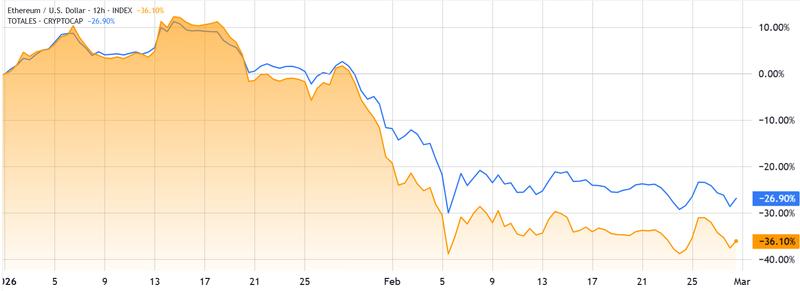
Throughout the opening two months of 2026, Ether has lagged behind the wider cryptocurrency market by 9%, undermining the narrative that external market forces represent the only factors driving this price correction. Trading volumes on decentralized exchanges (DEX) operating on the Ethereum network experienced a 55% contraction over the previous six-month period, whereas its primary competitor Solana witnessed a comparatively moderate 21% reduction across the identical timeframe.
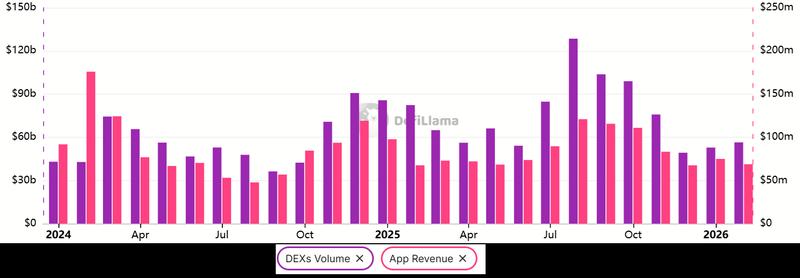
February 2026 saw Ethereum DEX volumes decline to $56.5 billion, representing a substantial decrease from the August 2025 peak of $128.5 billion. Throughout that identical period, Solana's monthly trading volumes reached $95.5 billion, compared to $120.6 billion during August. This reduction in network activity has created downward pressure on transaction fees and decentralized application (DApp) revenue generation, ultimately diminishing the short-term financial incentives for maintaining Ether positions.
Traditional financial institutions select Ethereum over competing blockchains
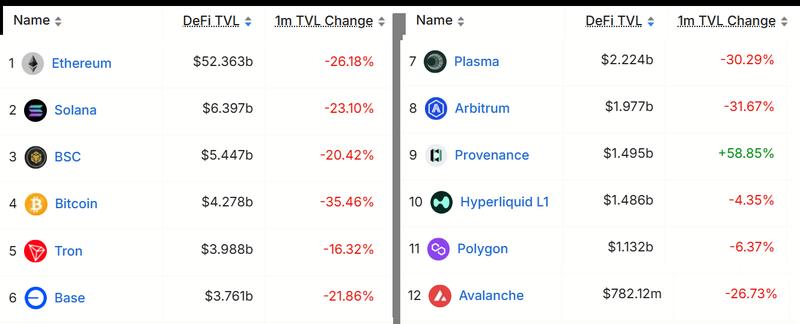
Focusing exclusively on trading volume overlooks the reality that Ethereum controls a 57% share of total value locked (TVL) across the industry, representing $52.4 billion. Expanding the analysis to incorporate layer-2 scaling solutions including Base, Arbitrum, Polygon, and Optimism elevates Ethereum's market dominance to 65%. In contrast, Solana's TVL stands at $6.4 billion, while BNB Chain maintains an aggregate $5.5 billion secured within smart contracts.
Prominent financial institutions, including JP Morgan Asset Management, Citi, Deutsche Bank, and BlackRock, have all recently deployed onchain initiatives utilizing Ethereum infrastructure. Spanning tokenized investment funds to proprietary layer-2 rollup solutions and bank-backed stablecoins, Ethereum continues serving as the preferred platform for decentralized finance (DeFi) advancement, controlling a 68% market share in Real World Assets (RWA).
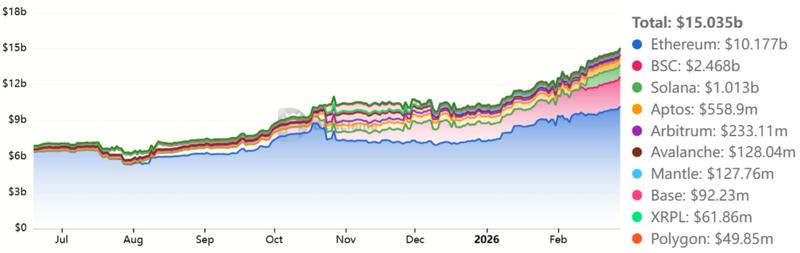
The strategic choice by Ethereum to emphasize layer-2 scalability through rollup technology has been characterized by some critics as unsuccessful, given that rival blockchains like Tron and Solana presently generate higher network fee revenue. Independent of how detractors evaluate the strategy to subsidize rollup infrastructure costs, no purported "Ethereum killer" has succeeded in matching its locked monetary value. Even the remarkably successful Hyperliquid platform operates with a relatively conservative $1.5 billion in TVL.
Ethereum's co-founder and principal architect Vitalik Buterin has recently articulated plans to decrease reliance on rollup solutions through enhanced base layer scalability initiatives. Based on Buterin's statements, the planned modifications encompass parallel block verification capabilities, realignment of gas costs with actual computational execution time, and deployment of a zero-knowledge Ethereum Virtual Machine (ZK-EVM).
The rollout of these upgrades will occur incrementally. Buterin advocates for initial participation by a minority segment of the network before transitioning toward mandatory block confirmation mechanisms that depend on ZK-EVM technology. Furthermore, Ethereum has established a comprehensive roadmap for addressing challenges presented by the quantum computing era, incorporating consensus-layer signatures built upon privacy-centric proof systems.
Buterin has acknowledged that quantum-resistant signature schemes present substantial challenges due to their significantly larger size and verification complexity, observing that lattice-based approaches currently lack efficiency. As a result, the recommended solution encompasses implementing protocol-layer recursive signature and proof aggregation while creating vectorized math precompiles designed to minimize gas costs. Although the Ethereum network has not achieved perfection, a practical pathway toward scalability has been established.
Prior to categorizing ETH as unsuccessful, a thorough examination of what has driven the network's competitive success relative to other DApp-oriented blockchains becomes essential. Building genuine decentralization and establishing trust demands years, potentially decades, of consistent operation. ETH retains a considerable first-mover advantage and demonstrates strong positioning to capitalize on any future expansion in demand for institutional-quality onchain operations.
This article does not contain investment advice or recommendations. Every investment and trading move involves risk, and readers should conduct their own research when making a decision. While we strive to provide accurate and timely information, Cointelegraph does not guarantee the accuracy, completeness, or reliability of any information in this article. This article may contain forward-looking statements that are subject to risks and uncertainties. Cointelegraph will not be liable for any loss or damage arising from your reliance on this information.