Democratic Legislators Demand Action from CFTC and Ethics Officials on Prediction Market Insider Trading Concerns
A coalition of over 40 Democratic members of Congress has called on federal regulators to issue guidance preventing government workers from exploiting privileged information in prediction markets, pointing to questionable trading activity and possible STOCK Act infractions.

A group of no fewer than 42 Democratic members of Congress have sent correspondence to the nation's commodities oversight body and the US Office of Government Ethics, calling for the issuance of warnings to federal workers prohibiting the exploitation of privileged information for trading activities in prediction markets.
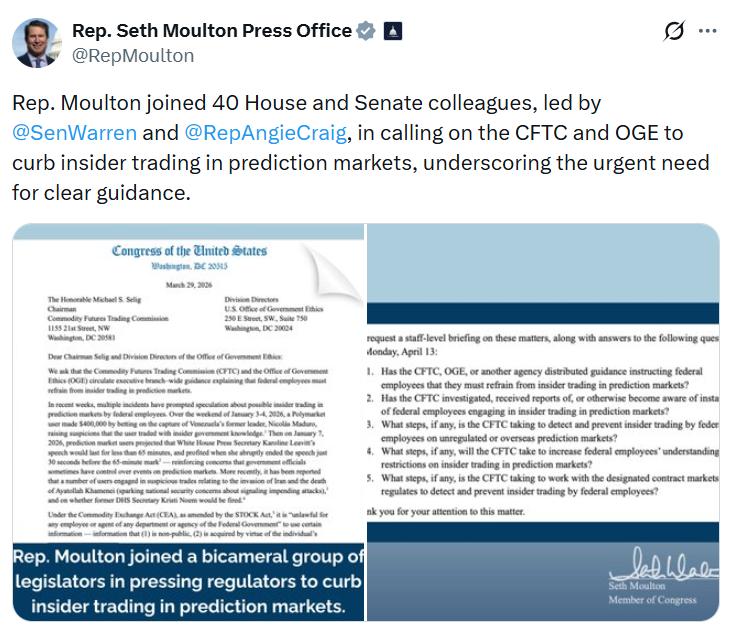
The correspondence, directed to Commodity Futures Trading Commission Chair Mike Selig and officials at the Office of Government Ethics, was triggered by "multiple incidents" that have generated "speculation about possible insider trading in prediction markets by federal employees," the letter states.
"We ask that the Commodity Futures Trading Commission and the Office of Government Ethics circulate executive branch–wide guidance explaining that federal employees must refrain from insider trading in prediction markets," they wrote.
Platforms for prediction markets, which enable participants to trade contracts based on future event outcomes, have come under growing examination regarding claims of insider trading and possible infractions of gambling regulations. The two dominant platforms in this space, Kalshi and Polymarket, have revealed intentions to implement protective measures designed to prevent such potential occurrences.
Venezuela capture bet, White House speech contracts flagged
The letter highlighted several specific instances of concern, including market participants who placed wagers on the apprehension of Venezuelan leader Nicolás Maduro and additional traders who made bets concerning the duration of White House press secretary Karoline Leavitt's speech on Jan. 7.
"More recently, it has been reported that a number of users engaged in suspicious trades relating to the invasion of Iran and the death of Ayatollah Khamenei, sparking national security concerns about signaling impending attacks, and on whether former DHS Secretary Kristi Noem would be fired," the lawmakers wrote.
The congressional group is demanding a comprehensive briefing along with responses to multiple inquiries by April 13, which include questions about whether the CFTC has launched investigations or been notified of any instances involving federal employees participating in insider trading activities on prediction markets.
Additionally, they are requesting detailed information regarding the current measures the CFTC is implementing to identify and prevent insider trading activities by individuals employed by the federal government.
Lawmakers argue the STOCK Act is being violated
The STOCK Act was enacted into law by former President Barack Obama in 2012 with the purpose of clarifying and establishing that government officials are prohibited from utilizing material, nonpublic information to benefit themselves financially.
Within the most recent correspondence, the congressional lawmakers contended that since the CFTC has established that contracts traded on prediction markets qualify as regulated derivatives, these instruments fall within the scope of protections outlined in the STOCK Act.
"The CFTC has determined that event contracts are derivatives that depend on the occurrence or non-occurrence of an event with a potential financial, economic, or commercial consequence," they wrote.
"Thus, the CEA's prohibition on government officials engaging in insider trading also applies to such activity in prediction markets."