Delaware Unveils Banking Framework to Supervise Stablecoins Through New Legislation
Delaware lawmakers have proposed new stablecoin legislation designed to establish licensing requirements for issuers, marking the state's most significant overhaul of banking regulations since 1981.

A pair of Delaware legislators are pursuing the creation of comprehensive stablecoin oversight mechanisms through a multi-faceted set of regulatory measures designed to bring the state's financial industry into the modern era.
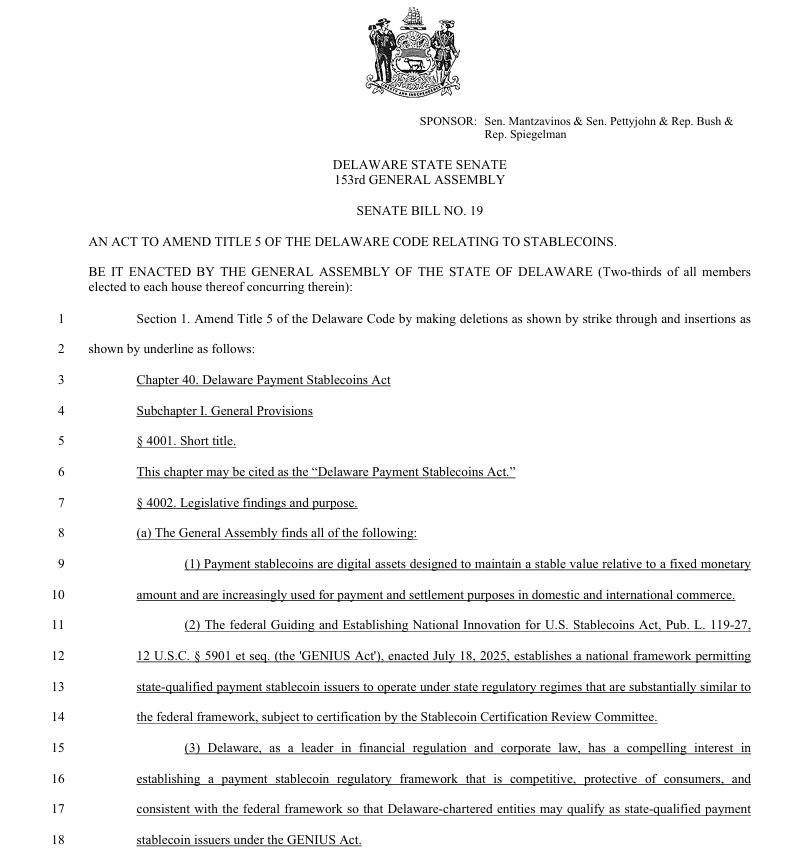
According to a Monday announcement from the Delaware Senate Democrats, Senator Spiros Mantzavinos alongside Representative Bill Bush have submitted two key pieces of legislation: the Delaware Banking Modernization Act (Senate Bill 16) and the Delaware Payment Stablecoin Act (Senate Bill 19).
This legislative package sends a signal loud and clear: here in Delaware, we're democratizing our financial services and lowering the barriers to entry, making it easier for all residents to send, receive and save money with just an internet connection.
Delaware Governor Matt Meyer
The state of Delaware has historically maintained a welcoming and forward-thinking stance on cryptocurrency and distributed ledger technology. Dating back to 2016, then-Governor Jack Markell initiated the Delaware Blockchain Initiative with the goal of drawing blockchain companies to the state. Delaware has additionally implemented smaller-scale regulatory changes to accommodate this industry.
Despite this history, several technology and cryptocurrency companies departed from Delaware in the previous year, among them Coinbase, which chose to reincorporate in Texas following public criticism of Delaware's Chancery Court, the venue responsible for adjudicating corporate legal matters.
This pair of proposed bills may assist the state in regaining the business of some of these departed companies.
Our administration is focused on attracting the jobs of the future to the First State, and that includes continuing to foster an innovative banking ecosystem that will open doors not just for workers and companies, but for every single person who participates in our economy.
Governor Meyer
Stablecoin Act proposes a licensing framework
The legislation targeting stablecoins seeks to establish a comprehensive licensing system for entities that issue stablecoins and digital asset service providers conducting operations within Delaware's borders.
The proposed legislation incorporates terminology and definitions drawn from the federal government's Stablecoins Act (GENIUS Act) along with "other federal models."
The proposed legislation details various protective measures, such as reserve deficiency remediation procedures, required redemption timeframe requirements, capital requirement standards and compliance obligations related to anti-money laundering protocols.
Should the bill receive approval, the State Bank Commissioner would receive direction to execute the regulations within an established timeframe.
At the same time, the Delaware Banking Modernization Act concentrates predominantly on conventional finance, revising corporate governance structures and organizational stipulations for banking institutions operating within the state. The bill, however, also addresses digital assets.
The legislation additionally aims to modernize Delaware's banking code through the provision of digital asset definitions in an effort to deliver regulatory clarity concerning the sector and its relationship to conventional financial services.
It's been more than four decades since we've made any meaningful updates to our state's banking laws, and in that time, the way people bank and conduct transactions has changed significantly. We need to make sure our laws are keeping up with those changes.
Rep. Bush
Neither bill is close to being enacted into law at this stage. The subsequent phase in the legislative process will involve examination by the Senate Banking Committee followed by full deliberation and voting by the entire Delaware Senate.
The announcement further indicated that the legislators will submit an additional regulatory measure in the upcoming days titled the Delaware Money Transmission & Virtual Currency Modernization Act.
This forthcoming legislation principally seeks to establish consumer protection measures and create standardization around the categories of activities that require licensing.
US politicians push for crypto regulation and clarity
The Delaware legislators are not alone in expressing their intention this week to advance cryptocurrency-related legislative measures.
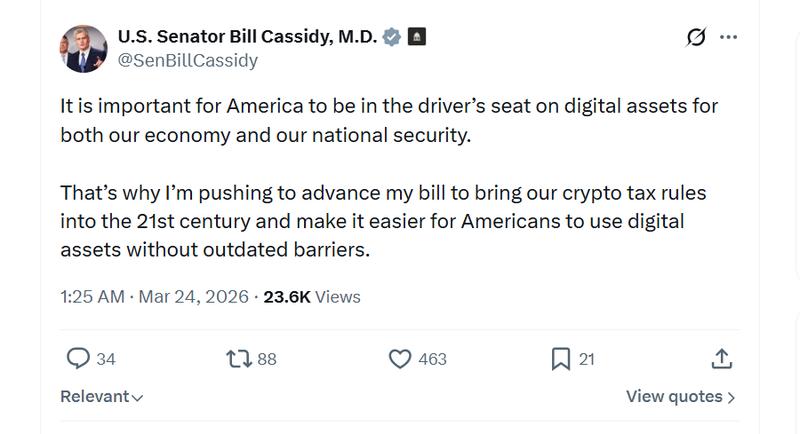
Through a Monday post on X, United States Senator Bill Cassidy indicated his plan to move forward with his federal-level legislation designed to modernize American "crypto tax rules into the 21st century."
The legislation, which was introduced in collaboration with Senator Cynthia Lummis during September, aims to tackle cryptocurrency taxation difficulties and facilitate the broader acceptance of digital assets throughout the United States.
The proposed bill includes a $300 de minimis threshold for cryptocurrency transactions, the elimination of double taxation affecting miners and stakers, and the establishment of taxation equivalence with other categories of financial assets, in addition to other provisions.
It is important for America to be in the driver's seat on digital assets for both our economy and our national security.
Senator Cassidy on X
Last Friday, the United States Securities and Exchange Commission (SEC) transmitted two proposed regulatory rules to the Office of Management and Budget at the White House for evaluation, among which is a proposal that would result in the majority of crypto assets available in the marketplace not being classified as securities under federal legislation.
The proposed rule would potentially result in the SEC modifying its regulatory approach toward the industry, while simultaneously transferring primary regulatory authority over crypto non-securities to the Commodities Futures Trading Commission (CFTC).
Responding to this development through X on Monday, CFTC chairman Mike Selig stated that both his agency and the SEC are committed to ending the period of cryptocurrency being stuck in "limbo" while delivering "clarity for the crypto markets."