Cybrid report reveals stablecoin adoption among businesses set to skyrocket
A recent survey shows that most companies plan to integrate stablecoins into their operations over the coming year, though lack of clear regulations continues to be the primary obstacle to broader implementation.

The upcoming year is expected to witness a dramatic increase in corporate stablecoin adoption as these digital currencies move into mainstream business applications, a newly released report from payments infrastructure company Cybrid reveals.
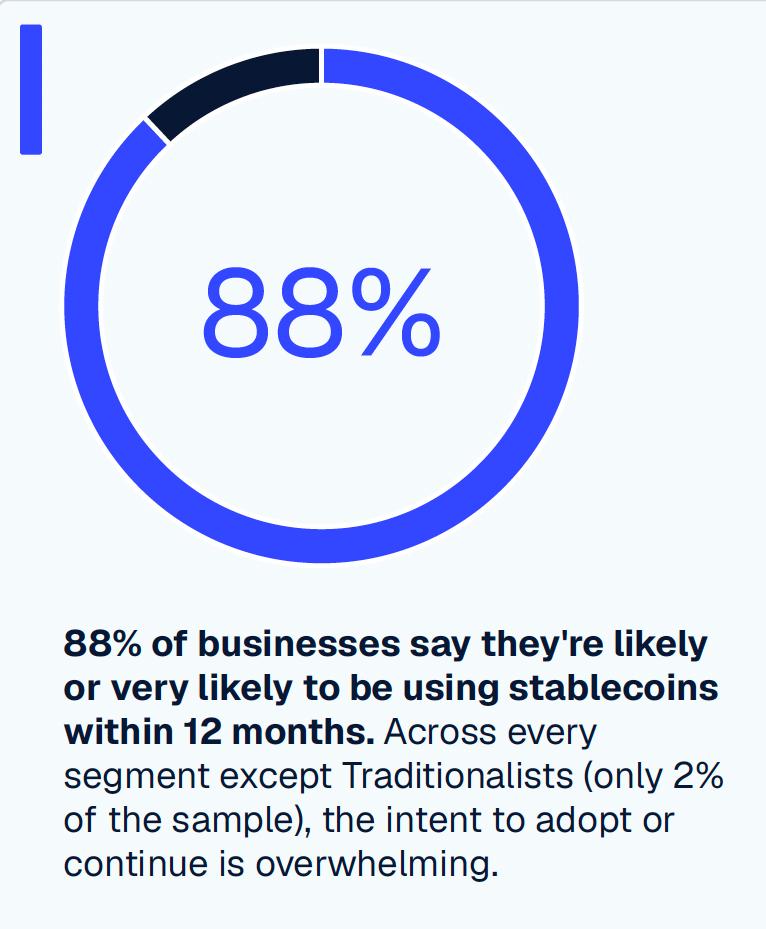
According to the findings, 42% of surveyed businesses currently utilize stablecoins for international payment transactions, while an impressive 88% of those polled indicated they would likely or very likely integrate stablecoins into their operations during the coming 12 months. Meanwhile, just 2% characterized themselves as dedicated users of conventional payment systems.
Companies that have adopted stablecoins for international transactions documented average cost reductions of 35%, with organizations handling upward of $100 million in monthly payment throughput achieving average cost savings as high as 47%, the survey data indicates.
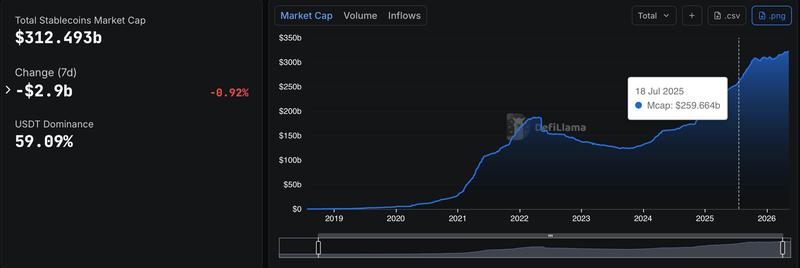
Current data from Coingecko indicates the worldwide stablecoin market capitalization stands at $307.64 billion, with Tether's USDT commanding the largest share at $184.7 billion, followed by Circle's USDC at $73.51 billion. Propelled by recently enacted legislation, stablecoins compliant with the GENIUS Act have achieved a combined market capitalization exceeding $76 billion. This legislation created the initial federal regulatory structure for payment stablecoins within the United States.
Survey data was gathered from 468 business leaders and executives through questionnaires administered between April 28 and May 4.
Diverse user base seeks regulatory clarity for enhanced confidence
Among survey participants, payroll and contractor payment processing emerged as the predominant application for stablecoins, with supplier payments, customer payments, investment and yield generation, vendor payments, and treasury and liquidity management following as additional use cases.
When asked about factors that would strengthen their confidence in scaling stablecoin adoption, regulatory clarity emerged as the leading priority, with 71% of respondents rating it as more critical than reliable infrastructure providers or compatibility with current systems.
Survey participants represented the technology, financial services and ecommerce industries across the United States, Canada and the United Kingdom, encompassing C-suite executives, finance and treasury managers, and payments and operations leaders.
Organizations build out infrastructure to support stablecoin payment systems
Additional industry metrics corroborate this emerging pattern. Last June, payments infrastructure company Paybis reported that business customers represented nearly 98% of stablecoin payout volume handled through its platform throughout the initial four months of 2026, a significant increase from 36% in 2023.
Paybis additionally referenced McKinsey research projecting that business-to-business transactions comprised approximately 60% of the $390 billion in worldwide stablecoin payment volume documented in 2025.
Organizations have persistently expanded their infrastructure capabilities to accommodate rising business requirements. This past May, Falcon Finance introduced the dollar-backed stablecoin fUSD via Anchorage Digital Bank's federally regulated issuance platform, designed specifically for institutional trading, collateral and treasury workflows.
This Monday, BNY broadened its digital asset custody platform capabilities to include support for Circle's USDC, enabling institutional clients to store, transfer, mint and redeem the stablecoin directly through the banking institution.