Cryptocurrency Markets Emerge as 24/7 Barometer for Global Geopolitical Tensions
While traditional exchanges remained shuttered, Bitcoin's response to escalating Iran conflict demonstrated cryptocurrency's evolution into a continuous indicator of macroeconomic risk.
Digital asset markets emerged as the primary venue for investor reactions following weekend military strikes against Iran by the United States and Israel, which disrupted global sentiment while conventional markets remained offline.
On Saturday at approximately 7:30 am (UTC), corresponding to the early morning hours for Wall Street, US President Donald Trump released a video statement announcing that joint US-Israeli military operations against Iran had commenced. The announcement triggered an immediate response in Bitcoin (BTC), with prices declining to approximately $63,000.
During this period, market participants flocked to cryptocurrency-based platforms to execute commodities futures transactions while conventional market infrastructure remained inaccessible.
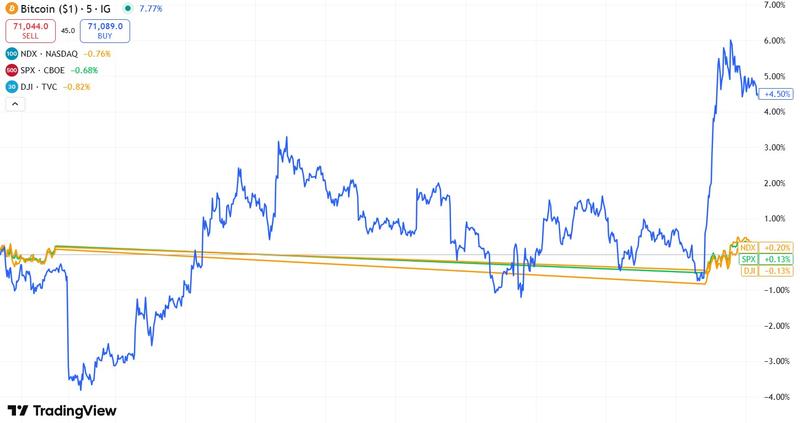
This latest conflict outbreak represents part of a broader pattern where significant geopolitical developments have regularly emerged during weekends or late Friday trading sessions. With cryptocurrency becoming more interconnected with macroeconomic conditions, Bitcoin's round-the-clock trading activity is transforming into an indicator for equity market sentiment during traditional market closures.
"The initial [weekend] move to the downside was sharp but contained, [and] Bitcoin never broke its broader market structure. When confirmation came that [Supreme Leader Ayatollah Ali Khamenei] had been killed and the immediate escalation risk appeared limited, price retraced quickly, and Bitcoin held its footing," Jonatan Randin, senior market analyst at PrimeXBT, told Cointelegraph.
"By Monday morning, traditional market participants who had been watching crypto through the weekend already had a clear read on sentiment: This was a significant geopolitical event, but not a systemic one," he added.
Real-time absorption of geopolitical developments by Bitcoin
While exceptions exist, governmental bodies and publicly traded corporations frequently choose to disseminate significant announcements outside of regular trading hours. Among the official guidelines addressing this practice is documentation from New Zealand regarding financial product disclosures:
"Unless compelling reasons exist to release the announcement or media release while the affected market is open, it should be made when the market is closed to give investors time to consider the information before the market opens."
Given the continuous nature of cryptocurrency trading, digital asset investors frequently lack the opportunity to carefully evaluate information and instead must respond instantaneously, as demonstrated during the weekend military escalation.
"While liquidity can be thinner during these periods, occasionally amplifying short-term volatility, the uninterrupted market ultimately enhances real-time price discovery and accelerates the adjustment process," Iliya Kalchev, analyst at Nexo Dispatch, told Cointelegraph.
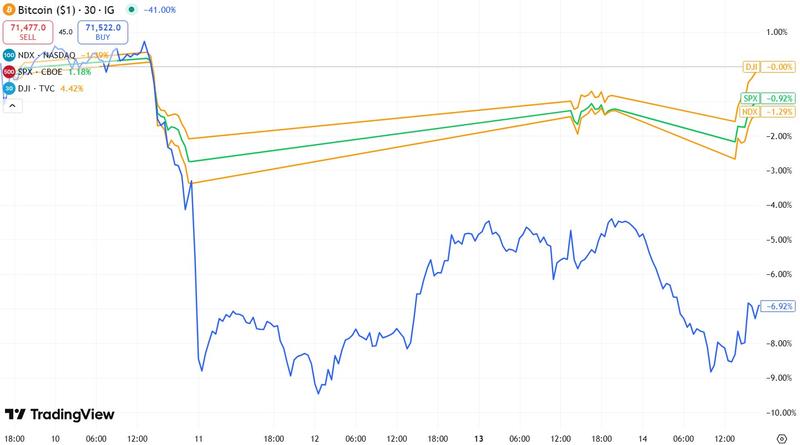
This dynamic was particularly evident on Oct. 10, 2025, when cryptocurrency markets witnessed their most substantial liquidation episode on record. Trump issued warnings of significant tariffs targeting China, which proved sufficient to collapse market valuations.
The announcement came prior to the US market closing bell, resulting in Bitcoin declining in tandem with prominent equity market benchmarks. Nevertheless, cryptocurrency markets maintained operations following the close, with liquidations persisting and ultimately reaching approximately $19 billion.
For participants focused on macroeconomic trading, this development positions cryptocurrency as a continuous sentiment indicator during periods of geopolitical turbulence. When significant developments occur beyond conventional trading windows, market participants increasingly utilize digital asset platforms to articulate their perspectives on risk exposure, liquidity conditions, or inflation projections before equity, fixed income, or commodity markets resume operations.
The always-available nature of cryptocurrency markets extends well beyond Bitcoin or other direct asset purchases. Substantial portions of current activity flow through perpetual futures instruments across both centralized and decentralized trading platforms, while institutional participants are simultaneously exploring tokenized real-world assets (RWAs) that migrate conventional financial products onto blockchain infrastructure.
Continuous trading availability extending beyond direct cryptocurrency purchases
According to Bloomberg's reporting, the perpetual futures decentralized exchange Hyperliquid emerged as a favored trading destination for commodities and conventional assets, including petroleum products and precious metal instruments.
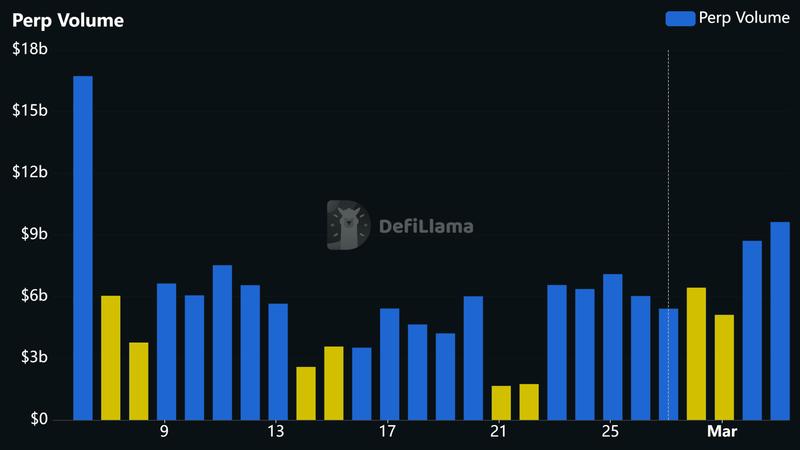
Data from DefiLlama indicates that Hyperliquid's transaction volume typically experiences weekend declines. However, during the recent weekend characterized by geopolitical instability, transaction volumes remained elevated and comparable to standard business day activity.
Matt Hougan, chief investment officer at Bitwise, noted that Tether's tokenized gold product XAUT experienced elevated trading volume throughout the weekend period, while prediction market platforms established new volume benchmarks.
Demand for weekend trading capabilities is progressively manifesting in traditional finance through expanding institutional engagement with RWAs. Assets that have been tokenized inherit certain characteristics of cryptocurrency markets, including international accessibility and the ability to trade beyond standard market operating hours.
Consulting firms McKinsey and Standard Chartered project that tokenized assets could attain valuations approaching $2 trillion by 2030, while Boston Consulting Group forecasts the sector could expand to valuations ranging between $16 trillion and $30 trillion during the identical timeframe.
Conventional market infrastructure is also pursuing extended operating schedules. During December, Nasdaq submitted regulatory applications for a 23-hour trading framework, incorporating daytime and nighttime sessions separated by a maintenance interval, which encountered skepticism from financial services organization Wells Fargo.
"I cannot think of an action that single-handedly gamifies the stock market even more than it has already become. This is the epitome of making trading even more like gambling," Wells Fargo's trading desk said in a note to clients, as reported by CNBC.
During January, the New York Stock Exchange announced development initiatives for a continuous blockchain-based platform designed to facilitate equity securities and exchange-traded funds.
Digital asset markets processing international disruptions instantaneously
Geopolitical disruptions occurring during weekends increasingly challenge the architecture of international financial systems. As conventional financial infrastructure pauses between designated trading periods, cryptocurrency continues processing information flows and representing investor sentiment instantaneously.
"Bitcoin has evolved into a highly sensitive macro asset, reacting not only to technology-sector dynamics but also to shifts in liquidity conditions, monetary policy expectations and geopolitical tensions," Kalchev said.
Hougan from Bitwise characterized the weekend trading patterns as rendering traditional stock exchange infrastructure "archaic."
As additional traditional finance institutions investigate extended or continuous trading frameworks, Hougan indicated that blockchain market performance throughout the recent weekend's military escalation suggested the migration toward blockchain infrastructure may materialize more rapidly than his earlier projections. He disclosed that his previous forecasts anticipated traditional finance transitioning to blockchain platforms within a 10-year horizon.