Cryptocurrency Markets Begin Attracting Capital Away from AI Sector: Raoul Pal
According to Real Vision's founder Raoul Pal, the recent slowdown in AI stock performance may redirect investment flows toward cryptocurrency, with AI agents potentially driving increased usage of Ethereum and Solana networks.

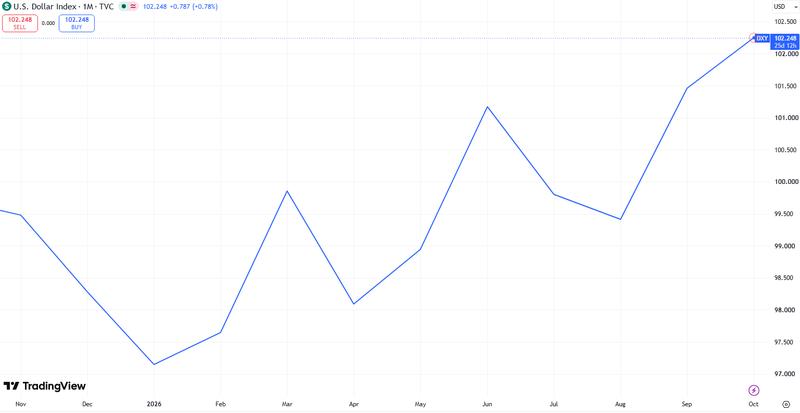
According to Raoul Pal, the founder of Real Vision, a declining US dollar could provide the cryptocurrency industry with a "green light" and contribute to extending the sector's ongoing rally.
In the most recent Trade Secrets episode with Cointelegraph, he explains that elevated bond yields combined with dollar strength are preventing liquidity from circulating without restrictions.
"If they can engineer the dollar lower, then we get a green light for further movement in crypto," he says. "I don't want to get overly excited, so I haven't got a full green light on everything."
Nevertheless, he anticipates that Bitcoin will capture a smaller portion of the cryptocurrency-related economic activity created by AI agents, with the bulk likely directed toward smart contract platforms such as Ethereum and Solana.
Among high-profile cryptocurrency analysts, Pal stands as one of the most seasoned, with a background that includes working at Goldman Sachs in hedge fund sales across Europe and serving as co-manager of a global macro fund at GLG Partners. In 2005, he established the research platform Global Macro Investor, and nine years later in 2014, he co-founded the financial media company Real Vision.
According to Pal, his initial Bitcoin purchase occurred in 2013, following his application of a gold-based framework for valuing the digital currency.
An AI pause could help crypto catch up
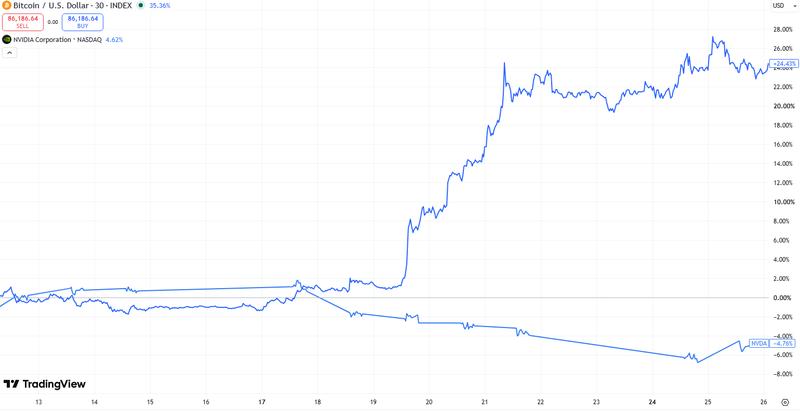
The cycle recovery for Bitcoin arguably occurred between Aug. 19 and Aug. 25, during which BTC climbed approximately 25% to reach $80,000. Notably, throughout this same timeframe, Nvidia, the AI sector's bellwether stock, experienced seven consecutive sessions of losses.
According to Pal, periods when the AI trade slows down have enabled capital to shift into cryptocurrency markets.
"You can tell there's this sort of rotation for liquidity that's around right now, which means it's not abundant yet," he says.
Although AI has been in competition with crypto for investment capital, a collapse in AI stocks would be an unwelcome development, since a bubble burst would signal that liquidity is being "sucked out of the system," while simultaneously jeopardizing the market conditions that crypto requires to appreciate.
"Things don't go bust if liquidity is plentiful," Pal says.
What Pal would prefer to see is a declining dollar, a yield curve that becomes steeper, and banks expanding the money supply by increasing their lending activities.
Instead, borrowing costs have been trending upward. September saw the US 10-year Treasury yield rise to 5.29%, while the Fed implemented a quarter-point increase to its benchmark rate.
Should those favorable conditions fail to emerge, Pal's "second best scenario" involves AI stocks moving sideways in a trading range, which would create opportunities for capital to flow into cryptocurrency.
AI agents could bring more business to Ethereum and Solana
Through a feature that Amazon Web Services launched in June, AI agents now have the capability to pay for access to web content using stablecoins. Coinbase manages payment verification and settlement via its x402 protocol, with USDC on Base included among the available payment options.
Pal envisions a future where agents could secure the funding necessary for their operations by creating tokens to finance projects with durations ranging from "a week, a month, a year," before executing the work and producing returns.
According to him, Ethereum and Solana stand to gain increased activity as software applications utilize their smart contracts for conducting transactions.
"My guess is they'll get more adoption over time as AI uses them," he says.
Solana needs more than activity to overtake Ethereum
Despite his positive outlook for both networks, Pal remains skeptical about assertions that Solana will surpass Ethereum in market value, primarily due to Ethereum's significantly larger concentration of capital.
Last month on Trade Secrets, Kyle Samani, co-founder of Multicoin Capital, made the prediction that SOL would exceed Ether's market capitalization "this market cycle."
Samani "needs to hold his horses a little bit," Pal says, even though he acknowledged that it is possible.
Different metrics show each network leading in various areas. According to DefiLlama, Solana registered approximately 3.2 million active addresses in the 24 hours preceding Monday, while Ethereum recorded 387,000. However, Ethereum maintains roughly $54.4 billion locked in decentralized finance protocols, substantially exceeding Solana's $6.7 billion.
Pal analyzes the networks using his concept of "economic density," which involves dividing total value locked by the number of active users. According to his analysis, Ethereum draws more capital in proportion to its user base, while Solana's activity represents smaller transaction amounts.
"Solana's core activity is speculation," he says. "It's just smaller clip sizes."
According to Pal, he has discontinued providing public price predictions because his forecasts are extracted and redistributed across the internet. He characterizes the million-dollar Bitcoin by 2030 concept as a "meme" that represents increasing adoption, growing ETF interest, and Bitcoin's utilization as collateral.
"Does it make a million bucks? I don't know, but certainly by 2032, yeah, I don't have an issue with that."