Crypto Biz: Wall Street Handles the Paperwork as Bitcoin Surges
Circle, Strategy, and Solana demonstrate how stablecoins, capital markets, and onchain expansion fuel crypto's resurgence as Bitcoin's climb past $80,000 elevates crypto-related equities.

The move by Bitcoin back above the $80,000 threshold is revealing the extent to which the cryptocurrency sector now operates through conventional capital markets. Strategy, under Michael Saylor's leadership, requires favorable market conditions to sustain its Bitcoin accumulation strategy (BTC), while Circle's future prospects increasingly appear to be a wager on the expansion of dollar-based financial infrastructure. Meanwhile, Treasury bond repurchases have contributed to creating favorable conditions for the recent surge in cryptocurrency-related stocks.
In this week's edition of Crypto Biz, we examine how this dynamic is transforming the enterprises, financial statements, and blockchain networks underlying the market's comeback.
Crypto-related equities soar as Bitcoin rallies
The surge in Bitcoin beyond $80,000 propelled cryptocurrency-linked stocks higher as mining operations and companies holding digital assets in their treasuries recorded gains in the double digits, mirroring a wider recovery spurred by the United States Treasury's announcement to increase certain long-term bond repurchase programs by a factor of two.
Among the most significant gainers during the previous seven days were Canaan, MARA Holdings, and Strive, with Coinbase and Robinhood experiencing rallies as well. Bitcoin's weekly climb exceeded 23%, while Ether saw gains approaching 30% to reach trading levels above $2,500, based on data from CoinMarketCap.
Additional momentum came from President Trump's renewed push for Congressional approval of the CLARITY Act, although the legislation continues to face obstacles following lawmakers' inability to move it forward prior to the August recess. Should it pass, the bill would create more defined regulatory frameworks for cryptocurrency markets in the United States, while Trump has also reiterated the possibility of government acquisitions of Bitcoin, though neither development is guaranteed.
Bernstein forecasts new growth phase for USDC
Analysts at Bernstein have expressed optimism regarding Circle, suggesting that a fresh expansion cycle for its USDC stablecoin has the potential to deliver substantial gains during the coming 12 months as the rate of supply growth accelerates once more.
According to a research note released on Monday, the firm reported that USDC supply expanded by approximately $2 billion within a seven-day span, bringing to a close a six-month stretch characterized by flat or declining growth. Bernstein continued to maintain its Outperform rating for Circle (CRCL) alongside a price target of $140, suggesting potential upside of around 60%. Over the previous month, Circle's stock price has climbed approximately 40%.
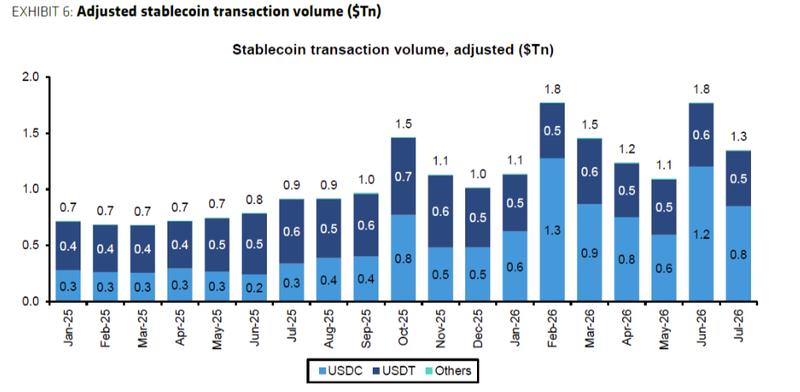
The analysts indicated that the upcoming phase of expansion might be propelled by revitalized cryptocurrency market momentum, regulatory clarification in the United States, tokenization of capital markets, and wider adoption in payment systems, with emerging indications of demand stemming from AI agents. When measured by adjusted transaction volume, USDC's market share climbed from approximately 40% during 2025 to more than 60% thus far in 2026, surpassing Tether's USDt on this metric.
Since Circle's initial public offering in June 2025, when shares were priced at $31, the company's stock has experienced significant volatility. Following an initial climb after the IPO, the share price retreated toward that initial level by November 2025 when the cryptocurrency market downturn commenced.
Access to capital markets poses greater risk to Strategy than Bitcoin's price
According to a report from Regime Intelligence, the primary vulnerability facing Strategy is not a collapse in Bitcoin's price but rather the potential loss of access to capital markets, which would jeopardize its capacity to meet $1.76 billion in yearly financial obligations without liquidating BTC holdings.
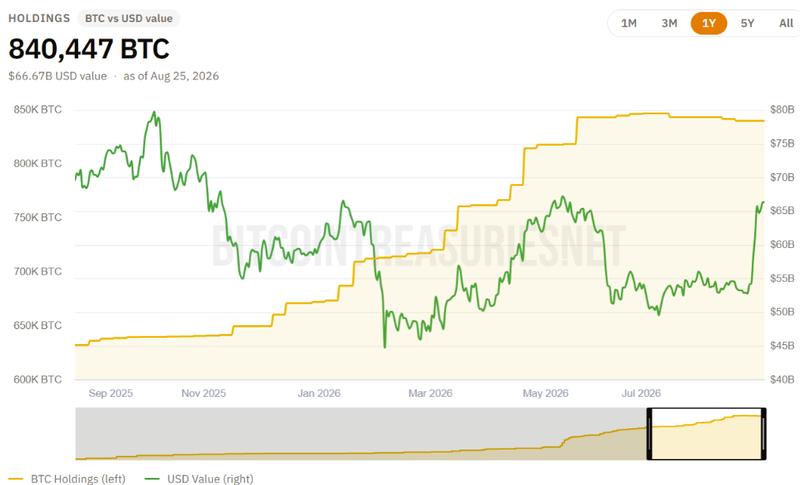
The company's 840,447 BTC serves as backing for $22 billion in debt and preferred claims, with Bitcoin's price fluctuations triggering no margin calls, the report indicates. Stress testing scenarios suggest that Bitcoin's value would need to decline by 96% before Strategy's holdings would fail to cover its convertible note obligations. Additionally, Strategy maintains cash reserves equivalent to 2.6 times its yearly obligations, while the current value of its Bitcoin portfolio stands at $66.7 billion against an acquisition cost basis of $63.36 billion.
Even if equities unraveled, Strategy's Bitcoin holdings put it in a good situation to weather most any storm. The company is holding far more Bitcoin than its annual cash obligations.
Kadan Stadelmann, Komodo Platform co-founder
The more substantial risk materializes when financing conditions worsen. An extended Bitcoin decline, accompanied by a deteriorating Strategy stock price and diminishing mNAV, could render the raising of additional capital progressively more challenging, potentially compelling the company to deplete its reserves or liquidate Bitcoin holdings.
Strategy's weakness lies in the need to issue capital to service the structure. If equities markets collapse, the company could have to part ways with Bitcoin as part of its operating structure.
Kadan Stadelmann
Since May, Strategy has engaged in BTC sales on four occasions, although CEO Phong Le stated that the company has acquired 25 times that amount during the identical timeframe and intends to continue purchasing.
SOL surges 40% as Solana network activity reaches all-time high
During July, Solana's network processed an unprecedented 4.2 billion onchain transactions, a milestone that preceded a 40% price rally propelling SOL beyond $100 for the first time since February, based on onchain data highlighted by The Kobeissi Letter.
Compared to June, transaction volumes increased by 13.5%, and when measured against December, they rose by 91%, representing an addition of approximately 2 billion transactions during that span. The Kobeissi Letter additionally referenced data from RWA.xyz indicating that the value of real-world assets tokenized on Solana has now reached nearly $4 billion, representing an 11.8% increase during the past month. When considering all monitored networks, the total value of distributed RWAs has crossed the $38 billion threshold.
The price rally gained momentum following the United States Treasury Department's announcement regarding plans to increase certain long-term bond repurchase operations to a minimum of $4 billion per operation, contributing to declining yields and enhanced appetite for risk throughout cryptocurrency markets. Nevertheless, SOL's price appreciation occurred as part of a more comprehensive market recovery, while sustained expansion in network activity may be contingent upon additional RWA adoption and prevailing macroeconomic circumstances.
Crypto Biz is your weekly pulse on the business behind blockchain and crypto, delivered directly to your inbox every Thursday.