Crypto Biz: The market's fragmented direction
Digital asset markets split in multiple directions as IREN pursues AI infrastructure expansion, BitMine increases ETH holdings, stablecoin transaction volume declines, and tokenized Treasury products see institutional adoption.

Throughout history, the cryptocurrency sector has moved in response to a single prevailing theme. That pattern appears to have shifted.
On one side, mining operations are working to escape the constraints of traditional four-year market cycles. IREN is undergoing a transformation into an artificial intelligence infrastructure provider, with market researchers highlighting data center operations and computational demand as the primary avenue for expansion. Simultaneously, BitMine is pursuing an entirely different path, committing billions of additional dollars into Ether (ETH) despite accumulating significant unrealized losses.
This fragmentation extends further across the market. While stablecoin total supply has surged past $300 billion, the actual transaction volume has experienced a notable decline. The situation signals dormant capital with no unified view on the market's next move.
At the same time, traditional financial institutions are constructing an alternative infrastructure. Tokenized Treasury products are now functioning as accepted collateral on cryptocurrency exchanges, creating tighter integration between conventional financial systems and digital asset markets than previously observed.
This edition of Crypto Biz examines a marketplace moving in conflicting directions.
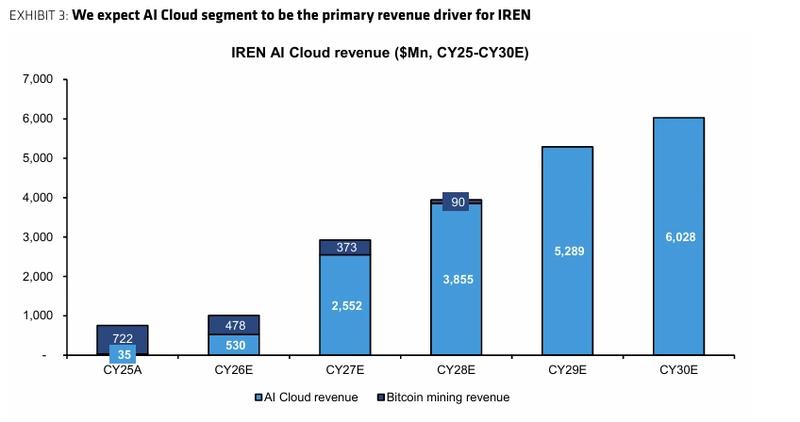
Bernstein sees IREN pivoting from Bitcoin mining to a $3.7B AI cloud business
Research analysts from Bernstein are restructuring their narrative surrounding IREN, making the case that the company's long-term prospects may rely less heavily on Bitcoin (BTC) mining operations and more substantially on developing artificial intelligence-oriented data center infrastructure.
According to a recent research report, Bernstein emphasizes IREN's established access to extensive energy infrastructure as a strategic differentiator, creating opportunities to accommodate demanding computational workloads associated with artificial intelligence applications.
The AI cloud division within IREN could evolve into a business worth several billion dollars in the years ahead, with projections indicating a possible $3.7 billion valuation. The organization has already initiated expansion of its data center operations and obtained funding to facilitate this strategic transformation, demonstrating a commitment to a long-range plan that reaches beyond cryptocurrency mining activities.
This strategic pivot mirrors a wider movement among mining companies pursuing revenue sources that offer greater stability and diversification as the mining sector faces challenging economic headwinds.
BitMine stacks another 101,000 ETH as unrealized losses grow
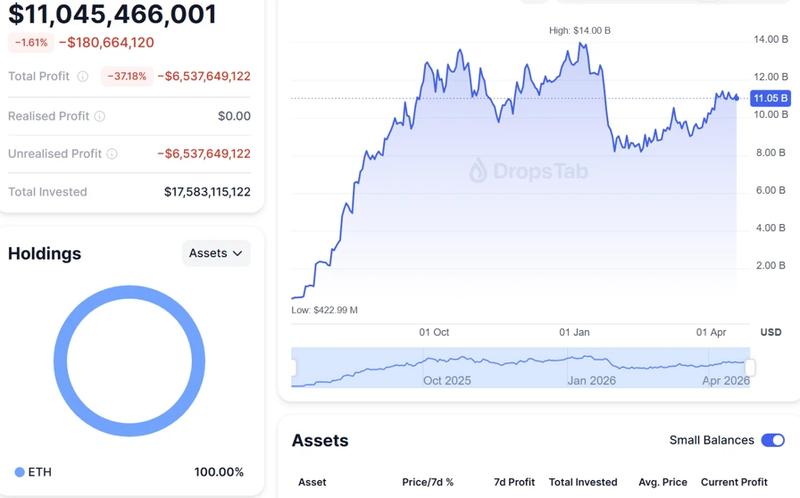
Tom Lee's BitMine has acquired an additional 101,000 ETH for its corporate treasury, intensifying its accumulation approach despite existing holdings that remain significantly below cost basis. This most recent acquisition pushes the total capital deployment to approximately $17.6 billion, solidifying the company's status as the largest corporate Ether holder worldwide.
This continuous purchasing activity occurs while the company faces more than $6.5 billion in unrealized losses, a consequence of Ether's market price trading substantially beneath BitMine's average acquisition cost, $2,248.55 at the most recent assessment compared to the average purchase price of $3,621.34, based on DropsTab data.
The magnitude of these paper losses highlights the inherent dangers of concentrating corporate balance sheets in a single highly volatile digital asset, particularly when acquisitions persist throughout periods of price deterioration.
Stablecoin supply rises as transfer volume drops nearly 20%
Transaction activity involving stablecoins experienced a significant decline during the previous month, with aggregate volume decreasing 19% to approximately $8.3 trillion, despite ongoing expansion in the broader market, according to data from RWA.xyz. Concurrently, total stablecoin supply pushed above $305 billion, while both the count of holders and active wallet addresses registered modest increases.
This divergence indicates an accumulation of idle capital. Greater amounts of dollar-denominated value are flowing into or remaining within stablecoins, yet fewer transactions are occurring across blockchain networks. From a practical perspective, available liquidity is increasing while actual usage is contracting, implying that participants are choosing to hold assets rather than actively deploying capital.
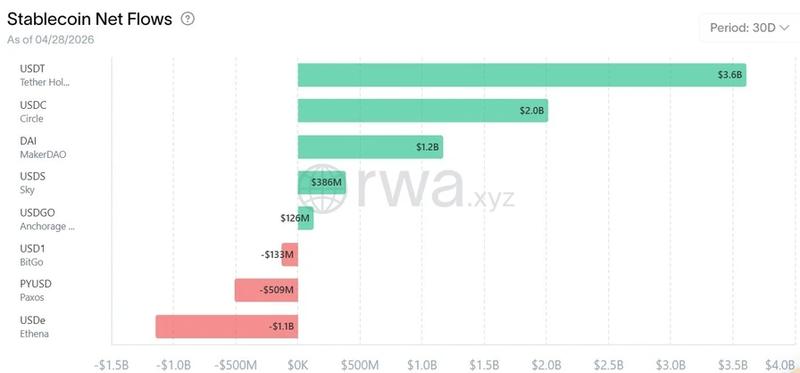
Movement patterns for individual stablecoin products reveal comparable dynamics. Tether's USDt (USDT) captured the largest inflows with approximately $3.6 billion in net additions, with USDC (USDC) following behind, whereas USDe (USDE) and PayPal USD (PYUSD) experienced net outflows.
OKX brings BlackRock's tokenized Treasurys fund into trading collateral
OKX has incorporated BlackRock's tokenized United States Treasury fund, BUIDL, into its exchange infrastructure, enabling institutional trading participants to utilize the asset as acceptable collateral for trading operations. This integration represents one component of a newly developed framework created in collaboration with Standard Chartered, whereby the fund can be pledged as margin while simultaneously remaining under regulated custody with the banking institution.
This arrangement fundamentally alters the mechanics of collateral management on cryptocurrency trading platforms. Rather than allocating cash reserves or stablecoins that generate no return, institutional clients can maintain positions in a yield-generating Treasury-backed instrument while simultaneously utilizing it to support active trading positions.
Under certain implementations, the collateral assets remain off the exchange under Standard Chartered's custodial control, while OKX creates a mirrored representation for trading purposes — an architectural approach designed to minimize counterparty exposure without disrupting trade execution capabilities.
Crypto Biz is your weekly pulse on the business behind blockchain and crypto, delivered directly to your inbox every Thursday.