Crypto Biz: The digital asset industry's transformation into a banking-like ecosystem
The cryptocurrency sector is mirroring traditional banking operations as reserve management for stablecoins, tokenized investment vehicles, income from Treasury securities and corporate financial management emerge as primary revenue sources.

Looking at the week's top business developments, one might think these headlines originated from traditional financial institutions on Wall Street. BlackRock unveiled tokenized money market vehicles designed for stablecoin reserve backing. Tether reported an additional $1.5 billion in earnings derived from its holdings of US Treasury securities. The market for tokenized gold saw continued growth, although its integration into decentralized finance protocols remains constrained. Meanwhile, Bitcoin (BTC) mining operations were characterized by discussions of production expenses, profit margins and corporate treasury strategies rather than cryptocurrency valuations.
The cryptocurrency sector's operational framework is progressively aligning with conventional financial services. Reserve assets backing stablecoins, tokenized money market instruments and blockchain-based collateral mechanisms are becoming some of the sector's most significant sources of income, suggesting that blockchain technology's evolution may be influenced as heavily by financial system infrastructure as by the digital currencies themselves.
BlackRock unveils tokenized reserve products targeting stablecoin issuers
Global investment firm BlackRock has rolled out two tokenized money market instruments specifically engineered to assist stablecoin providers in satisfying reserve mandates under the United States GENIUS Act, furthering its expansion into blockchain-powered financial infrastructure.
The first product tokenizes shares from BlackRock's current Treasury liquidity program on the Ethereum blockchain, enabling qualified investors to conduct onchain ownership transfers while the backing assets continue to be held in cash equivalents and short-duration US government debt instruments. The second product represents a newly created institutional money market fund purpose-built for digital asset ecosystems that operates across several blockchains and features automatic income reinvestment capabilities, positioning it as an ideal solution for stablecoin reserve requirements.
This product launch strengthens BlackRock's foothold in the swiftly expanding tokenized Treasury sector, where the firm currently manages BUIDL, recognized as the largest tokenized Treasury fund in the industry. This strategic initiative also represents a significant transition by traditional Wall Street firms toward blockchain-based financial instruments following the enactment of the GENIUS Act, which created a federal regulatory structure for payment stablecoins.
Tokenized gold maintains minimal DeFi presence despite hitting record trading activity
According to a RedStone analysis, tokenized precious metal products demonstrated stability throughout gold's significant price correction, yet adoption within DeFi lending protocols continues to lag despite expanding market capitalization and transaction volumes.
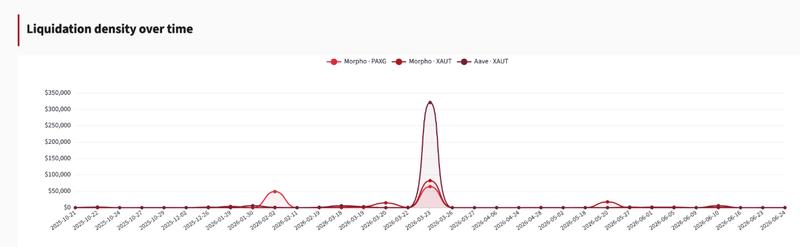
Spot market trading activity totaled $90.7 billion during the first quarter as gold futures climbed beyond $5,600 per troy ounce, however only approximately $63 million worth of Tether Gold and PAX Gold serves as collateral across Aave v3 and Morpho platforms — representing merely 1.5% of their aggregate $4.2 billion market capitalization, RedStone data shows. On March 23, Aave successfully handled its most substantial wave of XAUT liquidation events without experiencing operational issues following gold's 10% weekly decline, marking the worst seven-day stretch in over four decades; according to JPMorgan's Greg Shearer, it represented an "extremely brutal flush."
Gold futures contracts have subsequently dropped more than 20% from their January highs amid anticipations of elevated US interest rates, and RedStone's analysis indicated tokenized gold demonstrated resilience while highlighting an infrastructure deficit as tokenized real-world assets continue scaling.
Trump-affiliated American Bitcoin achieves record mining output, reduces Q2 deficit
The Bitcoin mining operation with Trump family connections disclosed record production levels for the second quarter, mining 932 BTC while reducing its net quarterly loss compared to the preceding period.
American Bitcoin, trading on Nasdaq and co-established by Eric Trump and Donald Trump Jr., announced record quarterly output of 932 BTC, contributing to an 8% increase in mining revenue to $67 million from the previous quarter's $62.1 million. The operation registered a net loss of $57.2 million, representing an improvement over the $81.8 million loss recorded in Q1.
In the previous month, the company executed a 1-for-15 reverse stock split to preserve its Nasdaq listing status following a decline in its share price beneath the exchange's minimum bid threshold. The miner, which is majority-controlled by Hut 8, maintained holdings of approximately 8,002 BTC as of June 30 and had committed roughly 3,090 BTC as collateral under equipment acquisition contracts with Bitmain.
Despite improvements in production metrics and revenue generation, American Bitcoin continues operating at a loss. The reverse stock split highlights the obstacles confronting its public market presence, while its collateralized Bitcoin positions create additional vulnerability should BTC valuations decrease.
Tether reports $1.5 billion Q2 earnings as income from US Treasury holdings strengthens reserves
Tether produced a $1.5 billion net operating profit during the second quarter, fueled predominantly by interest income generated from its US Treasury portfolio and reverse repurchase operations, its most recent quarterly attestation reveals.
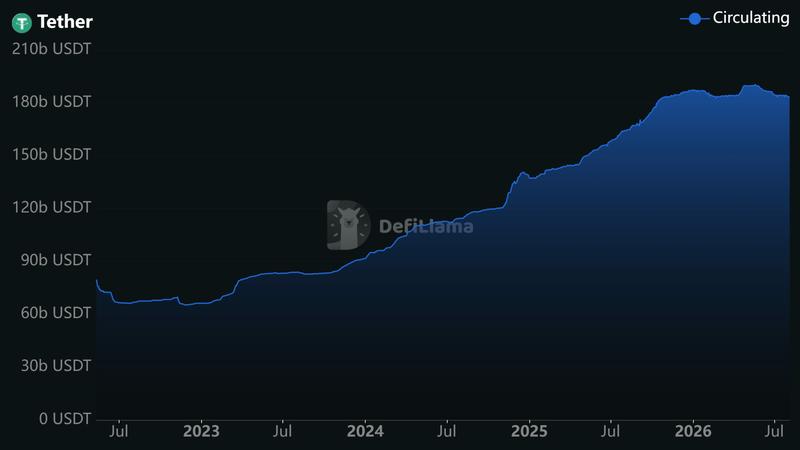
The attestation documented a reserve surplus of $4.11 billion as of June 30, representing the amount by which assets surpass liabilities. Notwithstanding a general stablecoin market decline, USDT's circulating supply increased by $446 million to reach $184.6 billion, maintaining Tether's dominance of more than 60% of the worldwide market, which DeFiLlama estimated at approximately $307 billion. Tether continues ranking among the largest institutional holders of US Treasury securities.
The organization's profitability continues benefiting from persistently high short-term interest rates, which amplify returns from Treasury bills and cash-equivalent instruments. Nevertheless, the enhanced earnings and reserve cushion emerge against a backdrop of sustained pressure throughout the cryptocurrency industry and a contracting stablecoin marketplace, circumstances that may constrain future expansion if interest rate conditions change or market contraction intensifies.
Crypto Biz serves as your weekly overview of the commercial developments underlying blockchain technology and cryptocurrency, arriving in your inbox every Thursday.