Court Reverses $12.5M USDC Freeze on Zama, Protocol Fast-Tracks Compliance Program
Following a court's decision to reverse a $12.5 million USDC asset freeze linked to separate litigation, privacy protocol Zama announces plans to expedite its compliance framework implementation.
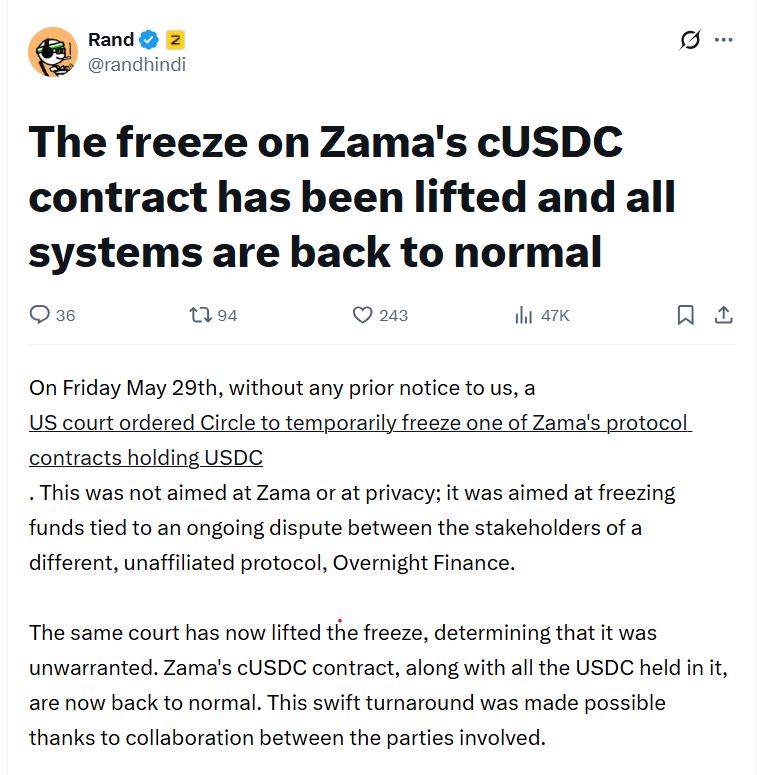
Blockchain privacy protocol Zama announced plans to fast-track its compliance infrastructure and move forward with launching confidential USDC following a United States court's decision to remove a temporary asset freeze affecting approximately $12.5 million in USDC within its cUSDC smart contract, as detailed in a Tuesday post on X by co-founder Rand Hindi.
The asset freeze, which Cointelegraph initially disclosed on Saturday, originated from a temporary restraining order secured in relation to an active legal matter concerning parties associated with a separate project known as Overnight Finance. Circle implemented the freeze upon receipt of the judicial order, despite Zama having no involvement in the legal proceedings, as explained by Hindi's statement.
"The same court has now lifted the freeze, determining that it was unwarranted," Hindi wrote. He further noted that the protocol's cUSDC contract along with all the underlying USDC had been restored to standard operational status.
The situation underscores existing friction points between privacy-oriented blockchain technology and centralized stablecoin systems where issuers maintain the authority to freeze holdings in compliance with judicial directives.
Hindi contended that this occurrence "could have happened to any protocol holding freezable assets," citing examples such as decentralized exchanges, lending protocols and bridges.
As Hindi detailed, roughly $12.5 million worth of USDC was placed into Zama's confidential USDC wrapper on May 11.
He explained that the deposit address subsequently became entangled in legal proceedings and a temporary restraining order associated with a dispute concerning Overnight Finance. Given that the deposit constituted over 99% of the contract's total shielded value, plaintiffs requested a comprehensive freeze order through Circle, according to his account.
Jeremy Bradley, serving as Zama's chief operating officer, informed Cointelegraph that the court eventually determined that freezing an entire smart contract pool created disproportionate harm for uninvolved participants. He explained that Zama successfully demonstrated that, due to the protocol's architecture which maintains visible sender and recipient addresses while encrypting balances and transaction amounts, the disputed account could be separately isolated and frozen without impacting other participants.
Bradley noted that the case demonstrates how protocols maintaining centralized stablecoins within pooled contracts could face comparable vulnerabilities. "Automated market makers, lending protocols, bridges, and anyone holding USDC in a pooled contract is effectively one court order away from this exact situation," he stated.
Zama to accelerate compliance roadmap
As a result of this incident, Zama announced it would expedite its compliance development timeline, which includes implementing automatic enforcement of compliance actions initiated by the underlying asset issuers.
According to the proposed framework, when Circle freezes a USDC address, the associated confidential USDC controlled by that address would simultaneously be frozen. The protocol additionally intends to form a compliance council and incorporate supplementary compliance mechanisms and transaction-monitoring tools.
Bradley indicated that these measures represent an acceleration of a pre-existing roadmap rather than a fundamental strategic shift. "We always designed the protocol with programmable compliance in mind," he stated, noting that the incident elevated the urgency of deploying those tools and would assist in providing institutions with enhanced confidence in the protocol's capacity to address legal requirements.
Notwithstanding the incident, Hindi stated that Zama continues to be dedicated to building on USDC and intends to introduce its cUSDC product within the current month, which includes shielding $5 million of USDC from its own treasury.
Bradley suggested that the episode has actually strengthened interest from institutional users rather than diminishing it, maintaining that the court's determination to reverse the freeze proved that the protocol can function within prevailing legal structures while maintaining privacy capabilities.
He further noted that Circle was operating in accordance with a court order and that the underlying problem was the absence of mechanisms for executing targeted freezes without impacting entire smart contract pools.