Could Trump's Iran Deadline Trigger a Bitcoin Rally to $75K?
A potential Iran ceasefire may boost equities, but Bitcoin's journey toward $75,000 hinges on sustained market confidence amid Trump's unpredictable diplomatic approach.
Key takeaways:
- The Tuesday deadline set by President Trump for Iran represents a critical juncture for Bitcoin as it continues its divergence from gold.
- A ceasefire agreement might elevate equity markets, yet Bitcoin's trajectory to $75,000 relies on its function as protection against fiscal uncertainty.
BTC may benefit from (no) US-Iran ceasefire
A strong possibility exists that US President Donald Trump's Tuesday ultimatum directed at Iran could serve as the necessary trigger for a Bitcoin (BTC) surge beyond $75,000.
In the event negotiations collapse, Bitcoin's perception as a risk asset could be reinforced through its distinctive decentralized characteristics. On the other hand, a favorable diplomatic resolution would presumably drive risk assets upward, Bitcoin included.
On Sunday, President Trump delivered an ultimatum to Iran, cautioning that the nation would be "living in Hell" unless the Strait of Hormuz is reopened by Tuesday at 8:00 pm ET. CNBC has reported, however, that Trump has been "vacillating" between constructive diplomatic talks and the escalation of military intervention.
High-ranking Iranian officials have allegedly declared the strait will stay blocked until Iran obtains compensation for damages suffered during the war.
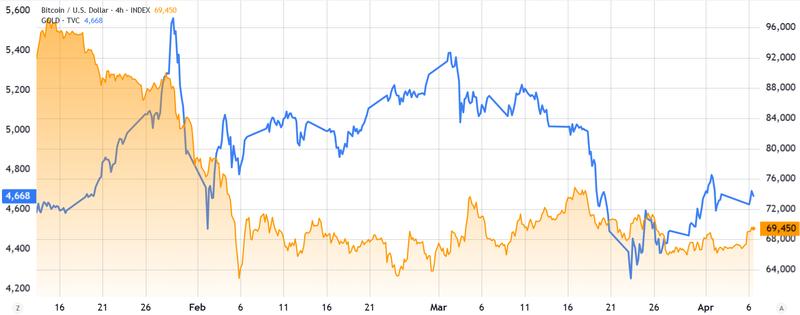
On Monday, these contradictory messages did not succeed in swaying market participants, with US equity markets finishing largely unchanged. By contrast, Bitcoin climbed beyond $69,000 for the first time in more than 10 days—a movement made especially significant given that gold prices remained near $4,650, representing a 17% decline from the $5,600 all-time high.
Bitcoin slowly catching up to gold
Market participants are growing increasingly worried that central banks may be compelled to liquidate portions of their gold holdings. Turkey's Central Bank disclosed the sale of 50 tonnes of gold during the week that concluded on March 20, marking the most dramatic reduction in more than seven years.
Reuters reports that Turkey has additionally divested $26 billion worth of foreign currencies in an effort to stabilize markets following the outbreak of the US and Israel-Iran conflict in late February. In a similar vein, Russian gold reserves measured by tonnage have fallen to their lowest point in four years.
A ceasefire agreement with Iran, regardless of its duration, would almost undoubtedly strengthen risk markets, although the consequences for Bitcoin remain more ambiguous.
Conventional corporations continue to rely significantly on energy expenses and international logistics networks. Consequently, any decrease in geopolitical tensions is instantly manifested in stock valuations.
A diplomatic agreement between the US and Iran, however, would probably exert a more indirect influence on Bitcoin, since such a resolution would likely increase demand for US Treasuries.
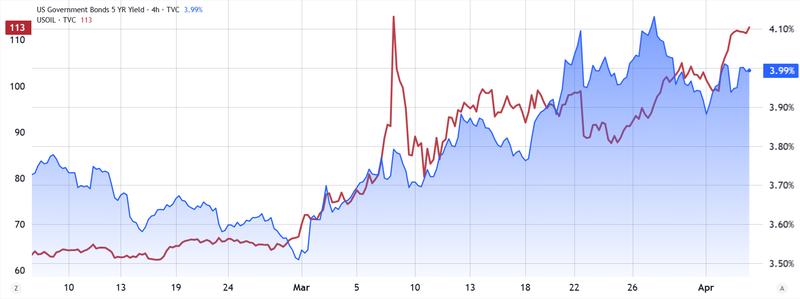
The US 5-year Treasury note's yields jumped to 4% from 3.55% in late February, indicating that investors are requiring higher compensation to maintain positions in those bonds. While a portion of this liquidation pressure originates from concerns about persistent inflation fueled by elevated oil prices, there exists also the additional strain on US fiscal debt resulting from heightened military operation expenditures.
A subsequent ceasefire and restored faith in the US Treasury diminishes the requirement for alternative protective instruments and independent monetary systems like Bitcoin.
Nonetheless, even in the scenario where the Strait of Hormuz reopens, Mohit Mirpuri, an equity fund manager at SGMC Capital, cautioned that "the damage to confidence and supply chains is already done — things don't just snap back to normal."
Forecasting that the Bitcoin price will climb 8% by Tuesday purely on the basis of a potential settlement to the US and Israel-Iran conflict appears somewhat unrealistic. Investors are progressively adapting to President Trump's typical oscillating behavior, particularly when diplomatic discussions include undependable external actors.
In this particular case, traders are improbable to extend the benefit of the doubt, meaning that enduring bullish momentum for risk markets may require additional time to develop. Nonetheless, the argument for a $75,000 Bitcoin rally continues to be viable should a positive resolution emerge by Tuesday.