Community Banking Association Challenges Coinbase's Federal Trust Charter Approval
A major community banking group raises concerns that the cryptocurrency exchange's newly approved trust charter doesn't meet standard regulatory requirements and may threaten consumer protection and financial stability.

The Independent Community Bankers of America has raised objections to the conditional approval granted by the Office of the Comptroller of the Currency (OCC) for Coinbase's national trust bank charter, raising alarms that the submission doesn't satisfy regulatory benchmarks and may introduce vulnerabilities to both consumers and the broader financial infrastructure.
In a statement released Thursday, ICBA highlighted that Coinbase's submission demonstrates inadequacies in areas including risk management controls, financial viability and contingency planning, while also contending that the OCC doesn't possess the legal authority to broaden trust capabilities for cryptocurrency-focused operations without implementing the complete spectrum of banking oversight measures.
According to the organization, this approval represents a wider pattern of financial technology firms attempting to obtain the advantages associated with banking charters while circumventing equivalent regulatory obligations. The group stated:
The sudden influx of applications demonstrates nonbank entities are seeking the benefits of a US bank charter without satisfying the full scope of US bank regulations.
The Americans for Financial Reform Education Fund joined in condemning the regulatory decision, cautioning that the approval represents a deviation from established banking legislation and may leave the financial infrastructure vulnerable to dangers associated with cryptocurrency market instability, fraudulent activities and illicit money transfers.
These criticisms arrive in the wake of the OCC's Thursday announcement granting conditional approval to Coinbase's request to create a national trust banking institution, following a half-year examination process conducted by the federal regulatory body.

In its Thursday announcement, Coinbase explained that the charter will place its asset custody operations and marketplace infrastructure under federal regulatory supervision, stressing that the company has no intentions to maintain customer deposits or participate in fractional reserve banking practices, while noting that "the right path forward for crypto is through the system — not around it."
Stablecoin yield dispute stalls crypto market structure bill
The pushback represents one element of an expanding disagreement between traditional banking institutions and cryptocurrency enterprises regarding the integration of digital assets into the mainstream financial infrastructure, with particular focus on stablecoins and products that generate yields.
During January, Bank of America CEO Brian Moynihan issued a warning that permitting stablecoin providers to pay interest might result in the withdrawal of up to $6 trillion in deposits from conventional banking institutions, diminishing their ability to extend credit and driving interest rates on loans upward.
Trade associations including the Bank Policy Institute have echoed these apprehensions in communications sent to members of Congress, maintaining that loopholes in current regulations might enable yield-generating stablecoin offerings to circumvent existing limitations and interfere with established credit distribution mechanisms.
This ongoing disagreement is now taking center stage in the nation's capital, where Coinbase has become actively involved in legislative negotiations surrounding the US Digital Asset Market Clarity Act, proposed legislation designed to create federal regulatory guidelines for cryptocurrency supervision.
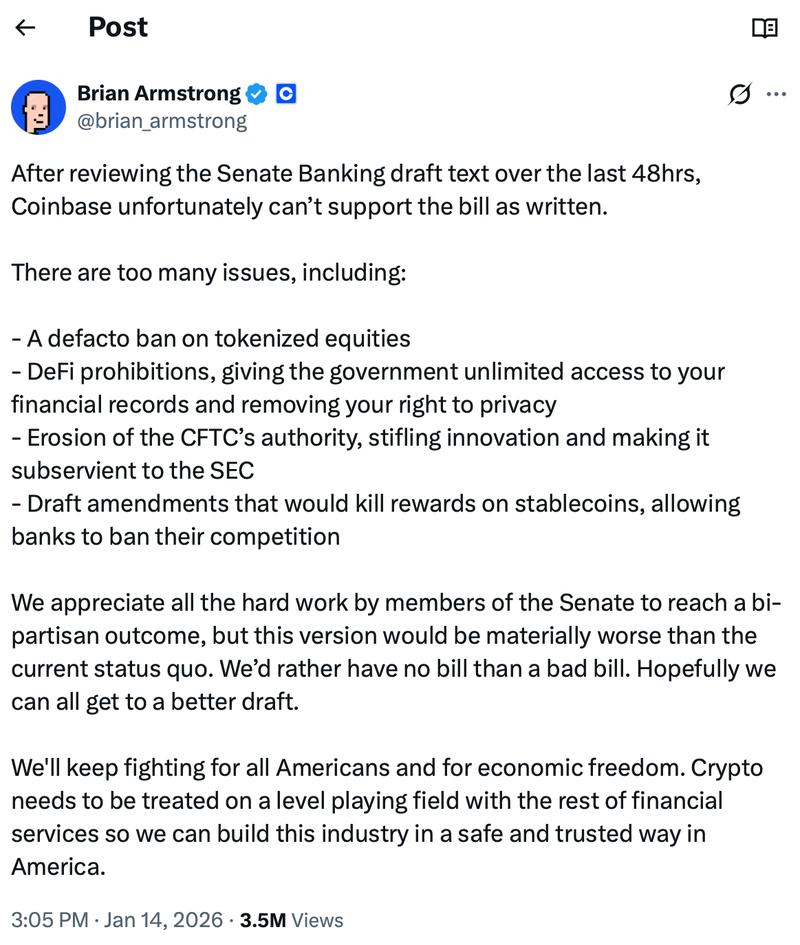
Although Coinbase CEO Brian Armstrong indicated in January that his organization was unable to endorse the proposed legislation in its current form because of limitations placed on stablecoin reward programs, Coinbase chief legal officer Paul Grewal announced on Thursday that members of Congress are approaching consensus on fundamental components of the proposed law, even as the yield compensation question continues to be a significant obstacle.
This disagreement has caused postponements in a Senate Banking Committee markup session, an essential procedural requirement before the legislation can proceed to consideration by the complete Senate body, resulting in continued uncertainty surrounding wider initiatives to create a comprehensive federal regulatory structure for digital asset markets.