Chainalysis Warns: Cryptocurrency Payments to Iran May Trigger Sanctions Violations for Shipping Companies
The transparent nature of blockchain technology enables authorities to more easily detect and monitor sanctions evasion attempts, with the capability to track and halt unauthorized transactions.
Maritime companies considering the use of digital currencies to remit prospective transit charges to Iran may be exposing themselves to substantial sanctions-related risks, warns Kaitlin Martin, who serves as a senior intelligence analyst at blockchain analytics firm Chainalysis.
In her conversation with Cointelegraph, Martin emphasized that within the existing sanctions regime, any form of payment directed toward the Iranian government, including fees associated with navigation rights through strategic maritime corridors, might be classified as providing "material support," thereby exposing corporations to the danger of breaching US and global sanctions protocols.
Doing so could carry significant sanctions violation risk, as the Iranian Revolutionary Guard Corps is sanctioned by multiple jurisdictions and Iran is subject to comprehensive sanctions by the United States.
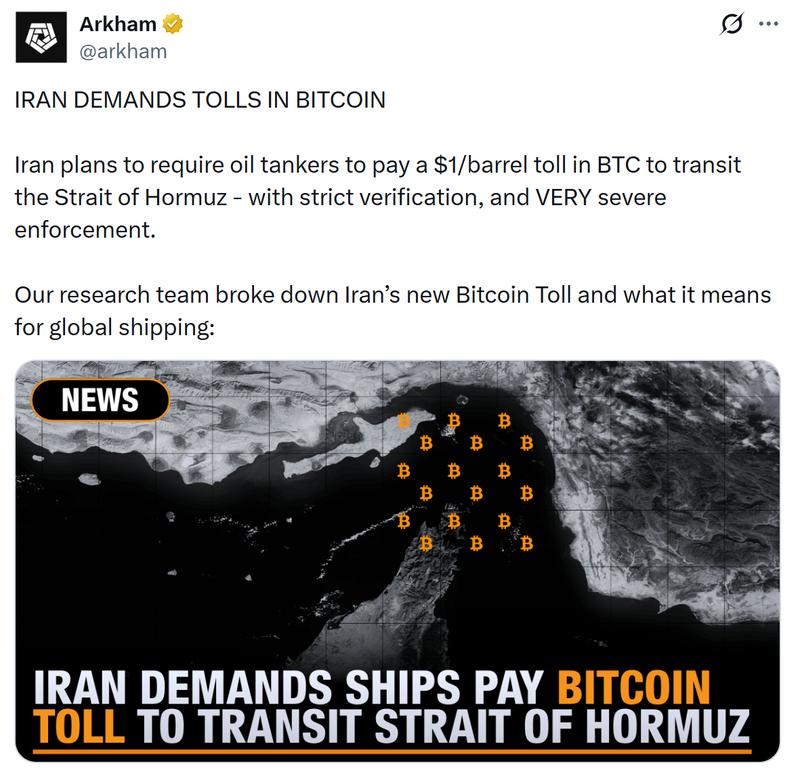
This cautionary statement emerges against the backdrop of emerging reports suggesting Iran might attempt to collect passage fees using cryptocurrency. Although no official announcement has been made to confirm these reports, US President Donald Trump has publicly stated his opposition to any efforts by Tehran to levy charges on maritime traffic traversing the strategically important waterway.
Iran expands crypto use
The Iranian government has already broadened its utilization of digital currencies, especially stablecoins, to enable commercial transactions involving oil, military equipment and various commodities, according to publicly accessible information analyzed by Martin.
Nevertheless, she emphasized that digital currency does not serve as a perfect solution for circumventing sanctions. Although it allows for international money transfers that bypass traditional banking infrastructure, transactions conducted on blockchain networks are by their very nature transparent and create an indelible audit trail.
In many ways, cryptocurrency is actually easier to trace than traditional methods of sanctions evasion.
Martin highlighted the capacity of law enforcement and compliance investigators to track the movement of funds to points where they are converted to fiat currency, locations where digital assets can be confiscated or immobilized.
Additional nations facing international sanctions have similarly investigated comparable strategies. The Russian Federation, as an example, has employed digital tokens including A7A5 to enable international commerce following the imposition of sanctions in response to its 2022 military invasion of Ukraine.
Iran's Bitcoin hashrate drops sharply
According to previous reporting by Cointelegraph, Iran's Bitcoin (BTC) computational mining capacity has experienced a substantial decline during the most recent quarter, shedding approximately 7 exahashes per second and declining to about 2 EH/s, occurring alongside intensifying geopolitical tensions with the United States and Israel.
Notwithstanding the regional turbulence, the worldwide Bitcoin network continues to demonstrate stability, maintaining total hashrate levels approaching 1,000 EH/s. Significantly, the disruption has been geographically limited to Iran, with adjacent nations including the United Arab Emirates and Oman experiencing no measurable effects.