CBDC prohibition in US becomes law despite Trump refusing to sign housing legislation
Despite President Donald Trump's refusal to provide his signature, bipartisan housing legislation that includes a prohibition on a digital dollar through the conclusion of 2030 will become law in the United States following 10 days of presidential inaction.
Bipartisan housing legislation that contains a prohibition on a central bank digital currency (CBDC) within the United States will become law as the time limit nears for President Donald Trump to affix his signature to the measure.
Shortly after the clock strikes midnight on Friday, the 21st Century ROAD to Housing Act will have sat on Trump's desk for a full 10 days, not counting Sundays, representing the longest period legislation can remain unsigned by the president without facing a veto or receiving approval. According to the United States Constitution, the measure will transform into law automatically without any action required from Trump, who pulled the plug on the bill's signing ceremony scheduled for Jun 24.
Through a social media post published on Friday, Trump made clear his intention not to sign the housing legislation, labeling Congressional Republicans who supported the measure as "dumb" while pushing the Senate to focus instead on a contentious voting measure, the SAVE America Act. This legislation, requiring individuals to present proof of United States citizenship in person for voter registration purposes, has faced substantial criticism over allegations that it would prevent citizens who already possess voting eligibility from exercising that right.
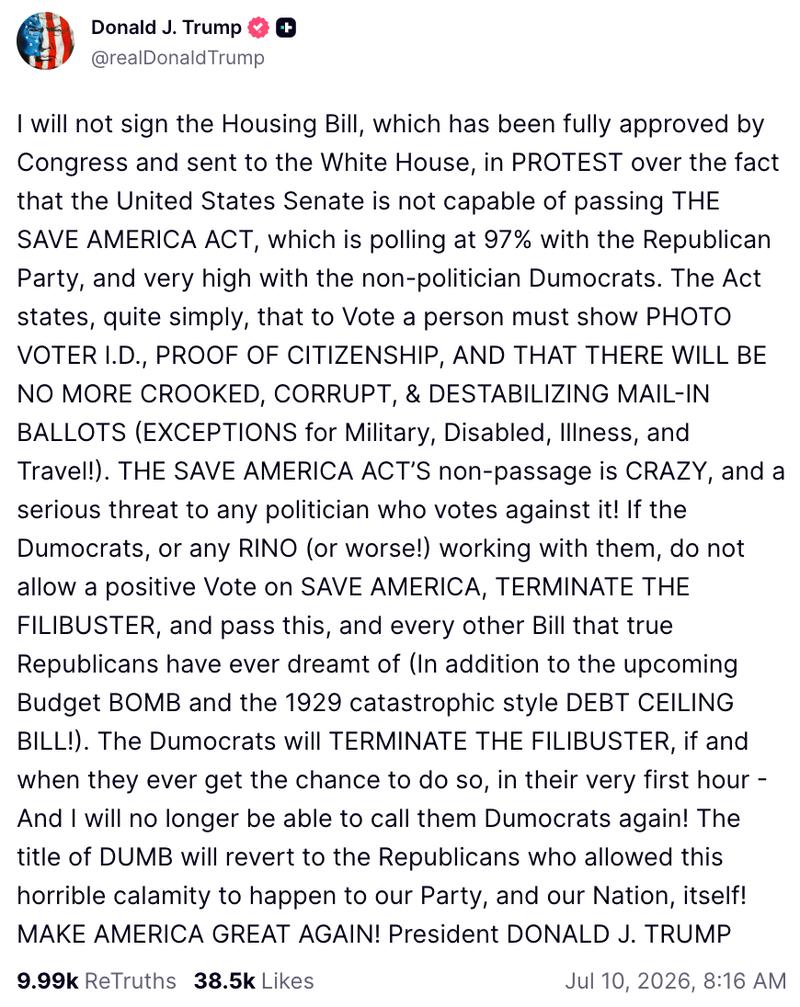
The housing legislation, which received approval from both the House of Representatives and Senate during June with backing from members of both major parties, contained provisions preventing the Federal Reserve from issuing or creating a CBDC "or any digital asset that is substantially similar" through Dec. 31, 2030. Numerous analysts interpreted the digital dollar prohibition as a political concession designed to secure Republican backing. Trump made no mention of the CBDC prohibition in his Friday social media statement.
[H]e's refusing to sign the biggest housing bill in 30 years. The good news: it's going to become law anyway.
Senator Elizabeth Warren
Could Trump's inaction also affect crypto market structure?
Despite the US president's statement in May regarding his plans to "future-proof" digital asset regulations, his unwillingness to sign legislation not connected to the SAVE America Act has sparked concerns about whether the Digital Asset Market Clarity (CLARITY) Act currently being considered in the Senate might encounter a similar fate as the housing legislation.
The CLARITY Act, viewed by many observers as among the most important pieces of legislation impacting digital asset regulatory frameworks, has successfully navigated passage through the House and two vital Senate committees. Congressional Republican leadership anticipates that the measure will proceed to the full chamber for a floor vote during July after lawmakers come back from state work periods on Monday.
Trump's connections to the crypto industry have already added complexity to negotiations between Democrats and Republicans concerning the market structure legislation. The president revealed earning in excess of $1.4 billion in income from his cryptocurrency-related ventures during 2025, including memecoins and the family's World Liberty Financial platform.