Can the CLARITY Act Still Be Rescued from Congressional Limbo?
Despite surviving a Senate cloture vote failure, the CLARITY Act now confronts an increasingly constrained timeline, challenging negotiations, and the daunting requirement of securing 60 votes.

The ancient mariner's lament about water everywhere with none to drink might resonate with cryptocurrency advocates, lobbyists and congressional representatives who've dedicated the past year to pushing the CLARITY Act across the finish line.
There's been plenty of negotiations, legislative amendments and behind-the-scenes political maneuvering; yet somehow insufficient momentum to push the legislation through the Senate chamber.
While the CLARITY Act encountered a significant Senate obstacle earlier this week, it hasn't reached its final demise just yet — think of it more as bruised and limping rather than dead.
The digital asset market structure legislation still has a fighting chance to assemble the necessary 60 votes required for Senate passage.
Republican Senator Thom Tillis's last-second vote switch from yes to no was executed for procedural reasons. Though it appeared to signal opposition to CLARITY, the move was actually a strategic parliamentary tactic, enabling him to submit a motion to reconsider and maintain a pathway back to the Senate floor for future consideration.
"Senator Tillis's motion to reconsider would provide an opportunity to revisit CLARITY's cloture vote at any point this session. Specific timing regarding next steps is not clear, but that desire to preserve that opportunity is in part due to the progress made over the past week."
However, the Senate calendar is rapidly depleting; both political parties continue clashing over ethics-related provisions concerning President Donald Trump, and even those championing the legislation acknowledge that a more collaborative bipartisan negotiation approach might now be essential.
The question remains: can CLARITY be brought back from the brink, and if revival is possible, how much of the original bill will require significant resuscitation efforts?
CLARITY's fate remains uncertain as time dwindles
The unsuccessful cloture vote, which is a procedural mechanism used to terminate debate on legislation and advance it toward final passage, hasn't completely terminated CLARITY's congressional journey. The measure needs 60 Senate votes, and CLARITY managed only 49-50 on Tuesday.
The motion to reconsider filed by Tillis creates an opportunity to revisit the vote during the ongoing session, though this option faces a far more pressing challenge: a rapidly diminishing timeframe.
Senate recess is scheduled to commence on October 2 ahead of the midterm elections, while the House of Representatives has already entered its election period recess, creating substantial obstacles for any legislative effort requiring passage through both chambers before year's end.
Congressman Shri Thanedar, a Democratic representative who backed CLARITY during its House passage in July 2025, informs Magazine that the compressed schedule creates a "major barrier" to achieving consensus:
"There are only 20 legislative days left in this Congress, all of them after the midterms, making odds of a 2026 compromise, unfortunately, very low."
"GENIUS came back from a failed cloture in 11 days. But GENIUS had a deal. This one has a calendar and no votes. Miss Jan. 3, and it restarts from zero in 2027 with a House that is probably Democratic."
Though a lame-duck congressional session following the November elections might offer CLARITY another opportunity, that scenario differs substantially from having a negotiated agreement ready for implementation.
Achieving 60 votes requires successful negotiations
Among the 49 votes supporting CLARITY, the Democratic caucus contributed absolutely zero. Chassé observes:
"Every one of the 49 was a Republican. Zero Democrats voted to even open debate."
Though this situation is obviously problematic, it doesn't automatically indicate that Democrats have completely written off the legislation.
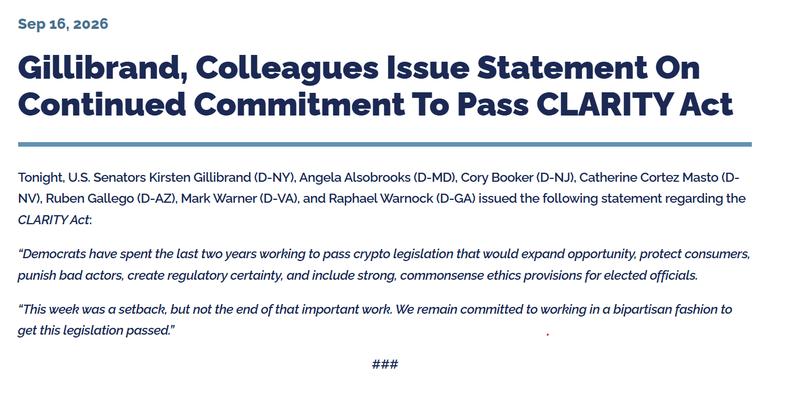
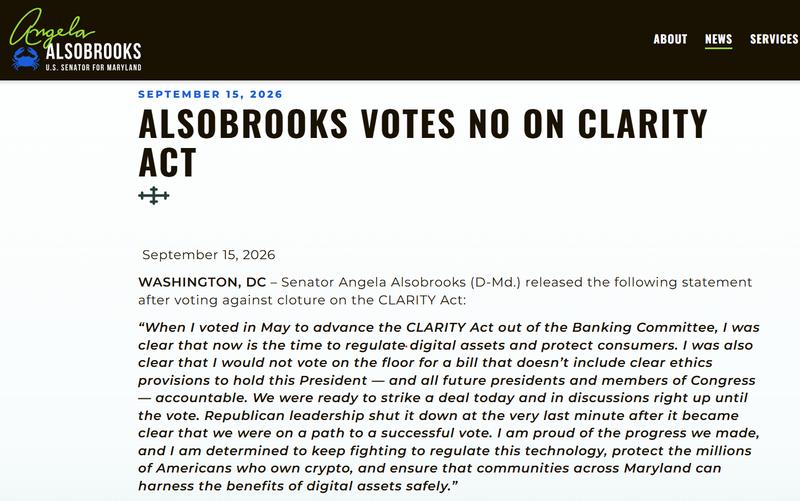
The following day, seven Democratic senators — each of whom had opposed advancing the bill just 24 hours earlier — publicly declared they "remain committed" to passing the legislation. This group included Sen. Angela Alsobrooks, who had previously supported moving the bill forward from the Banking Committee in May before opposing the cloture vote. She stated it's "clear that now is the time to regulate digital assets" and expressed willingness to negotiate regarding the ethics-related provisions, further noting:
"We were ready to strike a deal today and in discussions right up until the vote. Republican leadership shut it down at the very last minute after it became clear that we were on a path to a successful vote."
On Wednesday, Tillis expressed his intention to "convince the Democrats to get on board," and "put pressure on them to own it," with his procedural vote maneuver designed specifically to preserve that prospect. "I feel very strongly that this is an unregulated marketplace and that we need some guardrails on," he stated.
The fundamental disagreement no longer centers on whether Congress should create regulatory frameworks for cryptocurrency, but rather whether the existing legislative package contains sufficient provisions to garner bipartisan backing.
Though Congressman Thanedar expresses support for the legislation in its present form, he recognizes that Tuesday's outcome demonstrates the necessity for enhanced bipartisan collaboration on the legislative text:
"I do believe that the failed CLARITY vote on Tuesday demonstrates that a more bipartisan drafting process would lead to a higher likelihood of creating the bipartisan, supermajority coalition that passing this legislation into law would require."
What remains if rescuing CLARITY requires substantial revisions?
According to Chassé, the challenge has evolved beyond technical cryptocurrency policy formulation and now revolves around President Trump's financial interests in the crypto sector and the corresponding ethics safeguards:
"This stopped being a drafting problem. It's a referendum on the President's crypto holdings six weeks before an election, and the text as written can't survive that."
Prior to Tuesday's vote, Republicans had already incorporated 126 substantial modifications requested by Democratic lawmakers, including enhanced restrictions preventing public officials from profiting through crypto business ventures, and empowering state attorneys general with enforcement authority over certain ethics provisions.
Notwithstanding these concessions, Thanedar indicates that Democrats are seeking additional limitations "on the President's ability to use his office for personal gain." He argues that the minimum $1.4 billion in cryptocurrency earnings Trump disclosed for 2025 in his annual financial disclosure demonstrates that "guardrails are necessary to both hold the President accountable and protect the long-term health of the digital asset market."
Ethics isn't the sole potential dividing line, however, and Chassé argues the industry "should stop dying on that hill." He highlights stablecoin rewards instead, suggesting "some kind of cap or circuit breaker on yield" would probably represent "the price of the bank-side senators and a chunk of Democrats," alongside "tighter illicit finance and state enforcement language."
He contends that self-custody rights and developer protections represent areas where the cryptocurrency industry should resist making concessions. These protections have been fiercely contested throughout the negotiation process, with policymakers and industry organizations debating the appropriate scope of provisions shielding non-custodial developers from financial regulatory and anti-money-laundering (AML) obligations.
Crypto regulation can advance even if Congress reaches an impasse
Regardless of whether CLARITY remains stalled in Congress, cryptocurrency regulation in the United States isn't frozen in place. Eagan notes that the Securities and Exchange Commission (SEC) and the Commodity Futures Trading Commission (CFTC) have "demonstrated commitment to reduce uncertainty" by issuing guidance, implementing rulemaking, providing no-action relief and granting exemptions.
"CCI expects that agencies' crypto agenda will proceed in robust fashion regardless of the CLARITY Act," he states, noting that GENIUS Act implementation continues progressing at Treasury and among the banking regulatory agencies.
Strategy executive chairman Michael Saylor similarly emphasized that the SEC, CFTC and Treasury maintain the authority to advance regulatory frameworks under current statutory authority:
"Progress need not wait for Congress."
While this observation holds merit, agency regulatory actions don't equate to successfully enacting CLARITY into law. Administrative guidance can be reversed when new administrations take office, whereas enacted legislation proves significantly more difficult to dismantle.
CLARITY might still find a route to hobble back onto the Senate floor, but whether legislators can secure 60 votes without fundamentally transforming the bill remains highly uncertain.