Can $189M in crypto lobbying push the CLARITY Act across the finish line?
With the CLARITY Act moving forward, the cryptocurrency industry's expanding political clout in Washington faces examination. However, the substantial spending by crypto advocates tells only part of the complete narrative.

For years, the cryptocurrency sector has worked to persuade Washington that it merits recognition. Today, with Congress moving closer to approving the CLARITY Act, a highly anticipated crypto market structure legislation, it appears the industry has achieved that goal.
The conversation has evolved beyond whether policymakers pay attention to digital asset proponents, focusing instead on whether the extensive financial resources and electoral influence wielded by crypto lobbyists will prove sufficient to secure the bill's passage.
This discussion unfolds while Senate negotiators push toward a possible floor vote ahead of Congress's August recess break.
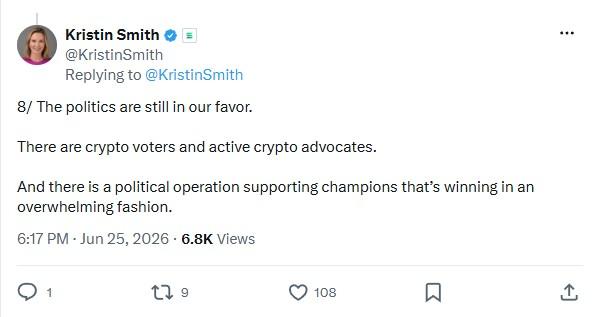
On June 25, Kristin Smith, president of the Solana Policy Institute and previously chief executive of the Blockchain Association, posted a thread on X asserting that crypto's advocacy machinery has reached unprecedented levels of strength and sophistication.
She cited bipartisan legislative negotiations, continuous meetings with members of Congress, and what she characterized as "a political operation supporting champions that's winning in an overwhelming fashion" as evidence supporting her assertion.
Data from Public Citizen, a consumer advocacy group, reveals that this "political operation" has deployed $189 million thus far to shape the 2026 midterm election outcomes. Critics of cryptocurrency view this financial arsenal as an improper effort to purchase influence and legislative support, whereas industry representatives contend it represents a necessary counterweight to the anti-crypto elements that have controlled the political narrative since 2022.
In conversation with Cointelegraph, Colin McLaren, who serves as head of government relations at the Solana Policy Institute, explained that the industry's political machinery wasn't constructed overnight.
"Fairshake, Cedar Innovation Foundation, Stand With Crypto, and the Blockchain Association built the political infrastructure that's moving pro-crypto legislation forward," he said.
"These groups, alongside the advocacy of companies and projects, created and supported allies in Congress, giving them the resources and cover to legislate and lead without fear of electoral reprisal from the anti-crypto army."
The tide begins to turn on CLARITY
Indications suggest that momentum supporting passage of the CLARITY Act is strengthening.
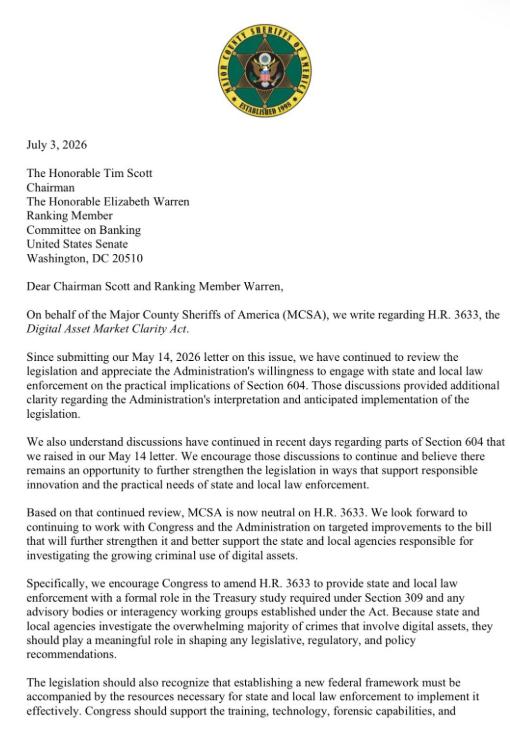
On July 3, the Major County Sheriffs of America (MCSA), a national association representing elected sheriffs from some of the largest counties in the US, announced that it had shifted from opposing the CLARITY Act to a neutral position following discussions over Section 604, also known as the Blockchain Regulatory Certainty Act. As Coinbase chief executive Brian Armstrong commented on X, that development is "huge."
Earlier that same day, the National Organization of Black Law Enforcement Executives (NOBLE) became the first major law enforcement body to endorse the bill.
However, the BRCA, which includes protections for developers decentralized smart contracts, remains a sticking point. Four other attorneys and law enforcement groups representing 70,000 members between them, warned the Acting U.S. Attorney General in late June that the bill's "broad exemptions could create gaps in oversight and accountability that sophisticated criminal actors may exploit."
Consequently, the outcome remains far from certain.
How is the crypto lobby campaigning?
Smith's observations illuminate the degree to which the industry's political machinery has merged with its legislative goals. Fairshake, the crypto-supported political action committee (PAC), financed by entities including Coinbase, Ripple and Andreessen Horowitz, epitomizes this transformation better than any other organization.
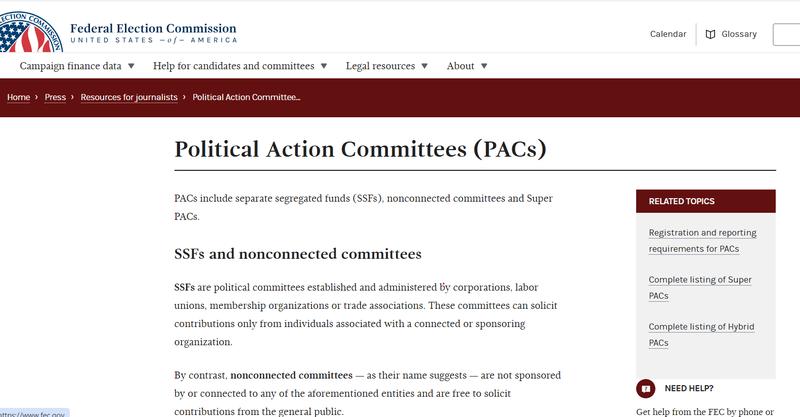
A PAC is an organization that raises and spends money to support or oppose political candidates and causes, and can pool contributions from multiple donors to fund campaign advertising and other political activity, subject to federal election rules.
During the 2026 US congressional primary election cycle, Fairshake along with affiliated PACs have deployed tens of millions of dollars backing candidates in numerous races who demonstrate favorable positions toward digital assets while opposing others perceived as antagonistic to the industry.
During May, affiliated PACs invested over $20 million supporting candidates in Republican congressional primaries throughout Georgia, Alabama and Kentucky, including more than $7 million backing Rep. Andy Barr in Kentucky's Senate primary.
Subsequently, the organization broadened its involvement into Democratic contests, deploying millions of dollars in Maryland and New York. Multiple crypto-supported candidates succeeded in these states, further cementing Fairshake's standing as the industry's most powerful political entity.
McLaren contended that the crypto lobby's readiness to support candidates in contested races produces tangible results. "Adrian Boafo was polling behind the field in Maryland before the crypto industry's ads ran. He won," he said.
"In Houston, the industry backed Christian Menefee, a young upstart challenging a sitting incumbent. He won. The industry supports its champions, even when that means taking risks."
In statements to Cointelegraph, Fairshake spokesperson Geoff Vetter explained that electoral wins represent just one metric of achievement.
"Our goal is to increase the number of members who understand and are willing to act on these issues in good faith," Vetter told Cointelegraph.
"The difference we make will be creating the largest crypto-literate caucus in history, ready to act on responsible regulation."
But is Fairshake's influence overstated?
Yet the question remains: how much of Fairshake's clout derives from actual election results versus merely the widespread perception that it possesses the power to influence them?
Journalist Veronica Irwin published an analysis through Brogan Law on June 30, examining Fairshake's participation in 40 concluded races during the present election cycle, cross-referencing Federal Election Commission filings against polling data and election outcomes.
Despite Fairshake-supported candidates prevailing in 38 of those contests, Irwin's examination determined that numerous races already tilted substantially toward the eventual victor prior to the PAC's involvement.
According to her analytical framework, merely 16 races appeared sufficiently competitive for Fairshake's expenditures to have credibly influenced the final outcome.
This nonetheless represents a substantial impact, and Irwin clarified her objective was never to suggest that Fairshake lacks influence, but rather to demonstrate that its approach proves more nuanced than many commentators recognize.
"I was reading a lot of stories that were basically just the press release," she told Cointelegraph. "That top-line narrative implies they are just buying up all of the elections outright and having these huge, huge wins. That kind of betrays the more complex strategy underlying it."
Instead of attempting to influence every race, Irwin noted Fairshake possesses sufficient financial capacity to "spray" campaign expenditures across a considerably wider spectrum of contests than most PACs could reasonably afford.
"They're in this position where they have so much money that they can pursue these costly strategies," she said.
Her examination introduces the sophisticated possibility that the organization's most significant political advantage may rest not in determining elections conclusively, but in fostering the perception that it possesses such capability.
Beyond campaign spending
Campaign expenditures by themselves don't necessarily advance legislation through Congress. The CLARITY Act's advancement also reflects extended negotiations involving legislators, industry organizations and external stakeholders.
The MCSA's transition to a neutral stance demonstrates that legislation continues to require coalition-building and negotiation, especially when addressing concerns surrounding financial crime, consumer protection and law enforcement priorities.
"It is a combination of factors," Ron Tarter, founder of self-custodial, multi-currency cryptocurrency wallet RockWallet and a former attorney, told Cointelegraph. "Adoption is the foundation… Lobbying translates that adoption into direct policy engagement… and campaign spending is the accelerant."
Irwin likewise contended that crypto's political influence extends beyond campaign expenditures alone. "Crypto occupies this space where it matters a lot to you and me, but to the average voter it isn't a top-five issue," she told Cointelegraph.
"That's the sweet spot where lobbying and election influence can really flex their muscles… It's pretty easy for a politician to switch to a more pro-crypto perspective without a lot of downside," she said.
"It's this one-two punch between lobbying being really effective and the potential to raise a bunch of money if you side with crypto."
McLaren maintained that campaign spending achieved success because it was constructed upon a comprehensive political strategy rather than serving as a substitute for one.
"Crypto didn't come to Washington because it wanted to," he said.
"The industry played defense for years, then decided to meet the threat at the ballot box and build the apparatus to advocate for the clarity needed."