C-Suite's AI Enthusiasm Meets Hard Truths About Employment Impact
Despite advocates predicting an AI-driven jobs explosion, current evidence shows suppressed entry-level recruitment and inconsistent productivity gains across organizations.

According to data from the Bureau of Labor Statistics, March saw the United States economy generate 178,000 additional jobs, representing minimal variation from February's figures.
This sluggish expansion in employment opportunities arrives during a period of erratic White House policy shifts, rising energy costs stemming from the ongoing US and Israeli conflict with Iran, and what recent studies suggest are AI-related disruptions affecting the workforce.
Advocates championing AI and large language model technologies have asserted these innovations will catalyze significant economic expansion, pointing to anticipated efficiency gains as the primary driver.
However, as artificial intelligence becomes increasingly woven into everyday corporate activities, an expanding disconnect emerges between these promises of enhanced growth and productivity, and observable reality on the ground.
AI dampens employment growth
Marc Andreessen, venture capitalist and Netscape co-founder, stated on March 6 via his X account that concerns surrounding AI-driven job losses were exaggerated.
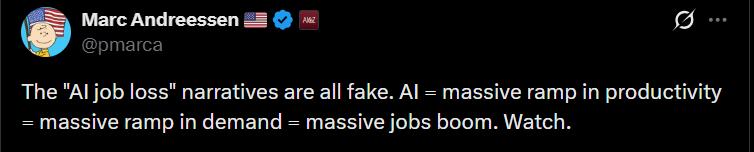
Andreessen also shared a Business Insider piece claiming that within the technology sector specifically, available positions were increasing. Referencing TrueUp, a platform tracking tech employment, Business Insider reported tech company job postings had climbed to 67,000, representing a doubling since 2023.
Yet posted positions don't automatically equate to actual hires. Bureau of Labor Statistics data reveals that March's employment expansion occurred predominantly outside technology. Breaking down the 178,000 newly created positions, healthcare accounted for 76,000, the construction sector expanded by 26,000, transportation and warehousing contributed 21,000, while social assistance employment rose by 14,000.
Although the report lacks dedicated tech industry tracking, associated services including computing infrastructure providers experienced a 1,500 job reduction, while web search portals remained essentially flat. Services related to computer systems design shed 13,000 positions.
Fortune recently cited a Goldman Sachs analysis indicating AI has actually eliminated 16,000 positions monthly throughout the preceding year. Entry-level position hiring has experienced particularly severe contraction due to AI adoption. SignalFire's 2025 research discovered new graduate hiring had plummeted 50% relative to pre-COVID-19 pandemic benchmarks.
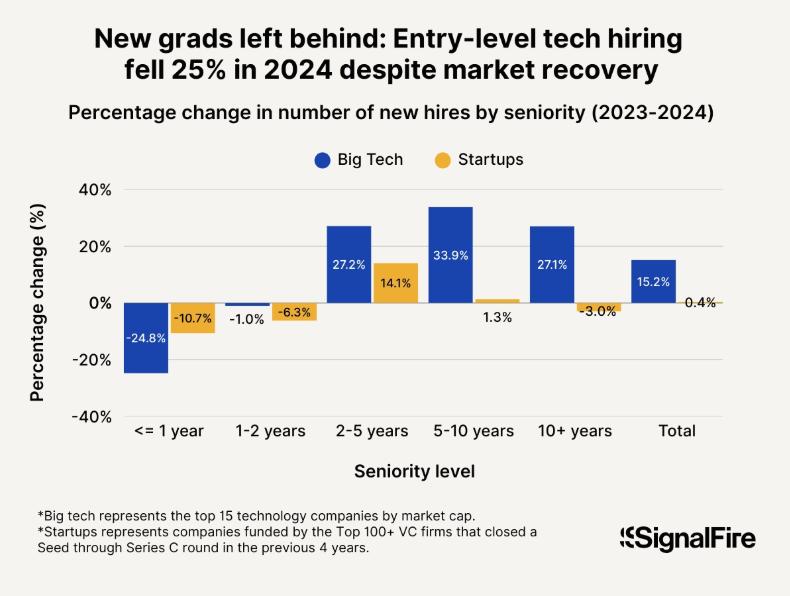
The door to tech once swung wide open for new grads. Today, it's barely cracked. The industry's obsession with hiring bright-eyed grads right out of college is colliding with new realities: smaller funding rounds, shrinking teams, fewer new grad programs, and the rise of AI.
SignalFire study
Such workforce disruption may generate consequences extending well beyond the immediate future. Goldman Sachs researchers note, "AI-driven displacement could impose lasting costs on affected workers, worsening labor market outcomes for several years."
A key mechanism behind these worse outcomes is occupational downgrading. Workers displaced by technology are more likely to move into more routine occupations requiring fewer analytical and interpersonal skills, likely because the same technological shifts that eliminated their positions also eroded the value of their existing skills.
Goldman Sachs
Organizations rationalize these workforce reductions through the premise that artificial intelligence will minimally boost workplace productivity. Yet even this assumption remains uncertain.
Reality of AI use clashes with C-suite expectations
Corporate leadership continues expressing strong AI support. Harvard Business Review findings indicate 80% of executives utilize AI on a weekly basis, while 74% claim their initial implementations have generated favorable returns.
Employees, however, hold contrasting views. Research conducted by Mercer, an HR consulting organization, revealed that 43% of workers find their positions increasingly frustrating.
A significant challenge involves the volume of errors produced by generative AI systems. According to a Workday report, "For every 10 hours of efficiency gained through AI, nearly four hours are lost to fixing its output."
Additionally, AI enables shifting work burdens onto colleagues through what Harvard Business Review researchers have termed "workslop" — specifically, "content that appears polished but lacks real substance, offloading cognitive labor onto coworkers."
Their research found that "41% of workers have encountered such AI-generated output, costing nearly two hours of rework per instance and creating downstream productivity, trust, and collaboration issues."
Workday's survey data shows merely 14% of participants indicated they "consistently achieve net-positive outcomes from AI use."
The disconnect separating executive AI comprehension from ground-level production realities may stem partially from the technology's characteristics.
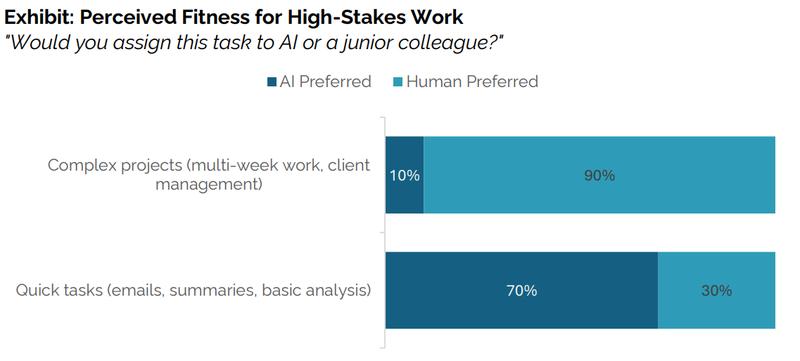
Harvard Business Review notes, "Senior leaders tend to use AI for high-level synthesis, strategic drafting, and decision support, tasks where the technology performs well, so the current capabilities tend to benefit their work."
Regarding more complicated daily operations such as "workflows built over years, teams with uneven technical comfort, output that has to be consistently right, not just fast," the technology demonstrates significantly weaker performance.
When the tool works, both groups understand and reap the benefits. When it fails, typically only one of them has to cope with the aftermath.
Harvard Business Review
ServiceNow's global innovation chief, Brian Solis, characterized this division as creating an "AI tax," specifically: "More checking. More rework. More anxiety. Faster pace. AI slop. Less trust."
While Andreessen may dismiss narratives around AI-related job cuts, OpenAI itself accepts the technology's employment impact, having published multiple policy recommendations addressing these concerns.
These proposals, which are "intentionally early and exploratory" functioning as "a starting point for discussion that we invite others to build on," encompass expanding healthcare access, enhancing retirement savings options, and establishing fresh industrial policy frameworks.
Contrasting sharply with Andreessen's optimistic perspective, OpenAI's recommendations included a cautionary statement: "Unless policy keeps pace with technological change, the institutions and safety nets needed to navigate this transition could fall behind."