BTC Slides Under $76K While Conflicting Onchain Metrics Create Uncertainty
BTC's attempt to surpass $80,000 encountered rejection due to weakening onchain fundamentals, though increasing spot CVD may facilitate a rebound.

The price of Bitcoin (BTC) descended beneath the $76,000 threshold on Tuesday following an unsuccessful attempt to penetrate the $80,000 barrier, as concerns over the Strait of Hormuz situation and broader macroeconomic factors rattled investor confidence. At the same time, technical indicators combined with onchain metrics delivered conflicting signals regarding BTC's capacity to maintain its recent recovery momentum.
Key takeaways
- BTC finds itself confined within a narrow trading band featuring robust technical support around $75,500 and substantial resistance approaching $80,000.
- Onchain indicators for Bitcoin present a conflicting picture, showing increasing buying pressure while spot trading volume and active network addresses experience declines.
BTC price action constrained between critical technical levels
The 30% rally in Bitcoin from levels below $60,000 that bottomed on Feb. 6 encountered significant selling pressure in the vicinity of the $78,000-$80,000 supply region.
It's worth noting that this particular area coincides with the current position of the 20-week exponential moving average (EMA), which strengthens the significance of this resistance barrier.
Michael van de Poppe, who founded MN Capital, characterized the current pullback as "typical behavior" in anticipation of the upcoming FOMC meeting.
"Bitcoin touched the resistance zone at $79,000 and is consolidating," van de Poppe said, adding:
"I think we're still in for a strong period on the markets."
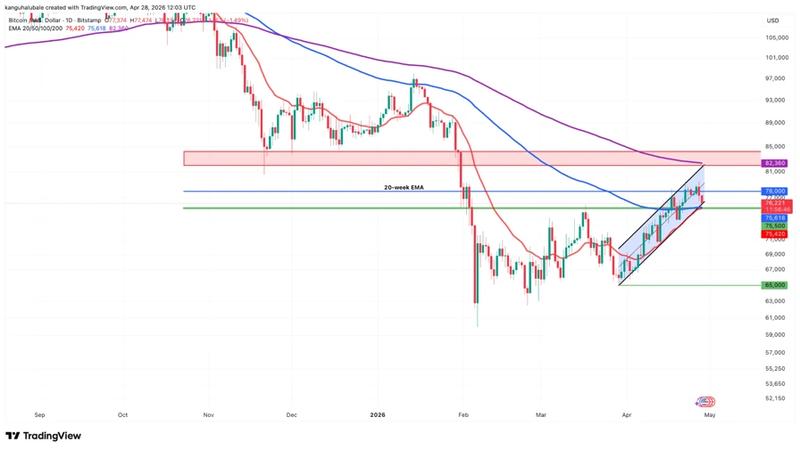
Looking at the downside scenario, Bitcoin has revisited support around the $75,500 mark, a level that also corresponds with the 20-day EMA, the 100-day EMA, and the lower boundary of an upward-sloping channel, as illustrated in the chart displayed above.
The UTXO realized price distribution (URPD) data from Glassnode, which illustrates the average acquisition prices at which ETH holders purchased their coins, indicates that the nearest resistance level exists around $78,000 where market participants accumulated 335,650 BTC. At the $75,500 average price point, investors purchased approximately 298,560 BTC, establishing it as a crucial support threshold.
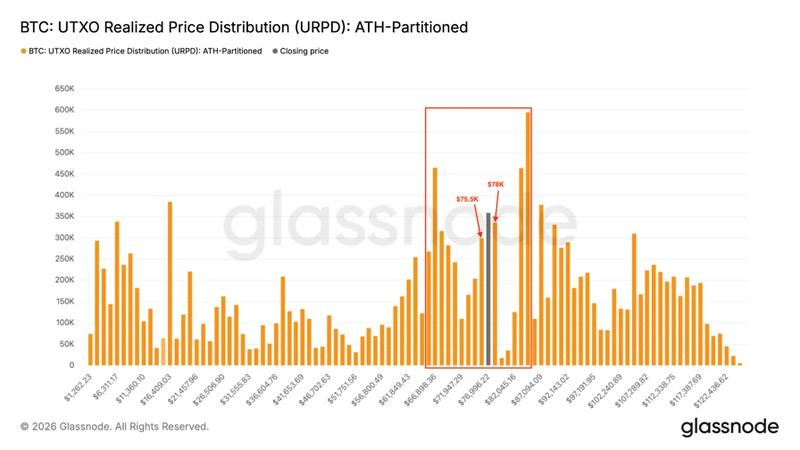
The chart presented above additionally reveals a more substantial supply cluster in the $82,000-$84,000 range, which has the potential to impede upward price movements, whereas a notable support area exists between $65,500 and $67,000.
It's important to highlight that this represents the price corridor delineated by the ascending parallel channel pattern visible in the TradingView chart shown above.
In the meantime, the liquidation heatmap for Bitcoin displays BTC trapped in what's known as a classic liquidation sandwich, with concentrated ask orders positioned around $78,600 and substantial bid positions situated beneath the current spot price, as demonstrated in the figure below. This underscores the comparatively compressed nature of the present market structure.
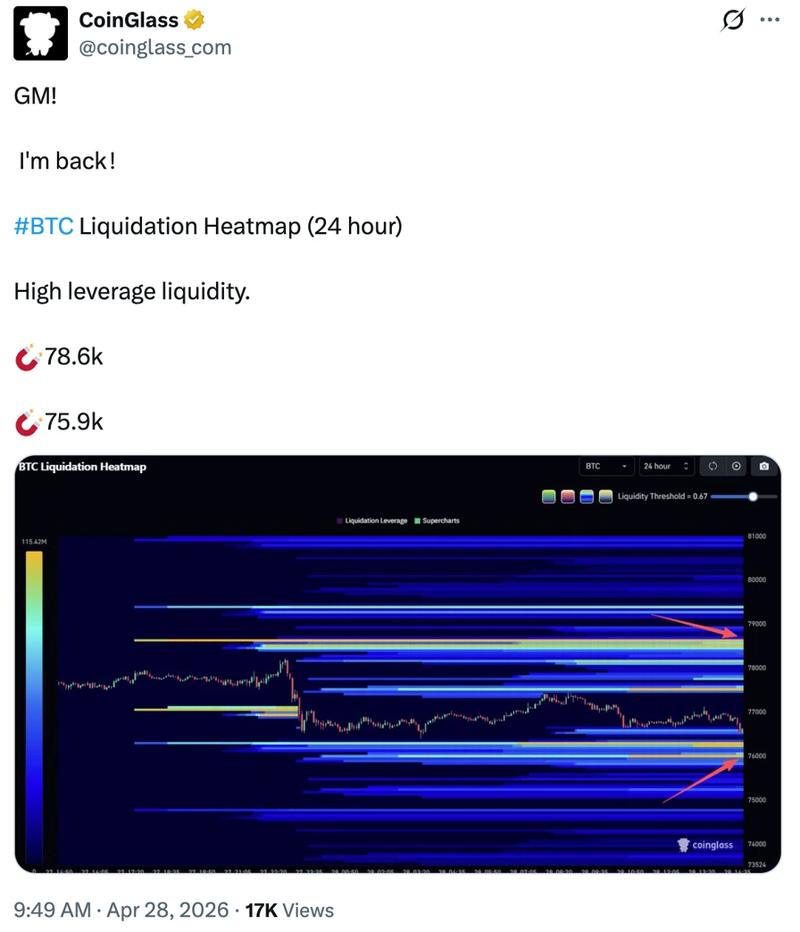
According to previous reporting by Cointelegraph, market participants on the buy side are anticipated to vigorously protect the $75,500-$76,000 support zone, whereas sellers are establishing a defensive position at the psychologically important $80,000 level.
Underlying onchain "fundamentals continue to show weakness"
Data from Bitcoin markets reveals a "mix of bullish momentum and cautious sentiment," which adds to the prevailing uncertainty across the market, according to information provided by Glassnode.
The spot CVD (cumulative volume delta, which measures the differential between buying and selling volume across time) has climbed to $54.8 million million from its previous reading of $18.3 million, representing an almost 200% surge during the past week.
"This reflects strong bullish sentiment among market participants, suggesting heightened confidence in Bitcoin's short-term direction," the onchain data provider said in its latest Market Pulse report.
Trading volume in the spot market has contracted by 13.8% to $5.99 billion from the previous week's $6.95 billion, "suggesting reduced market activity," Glassnode added.
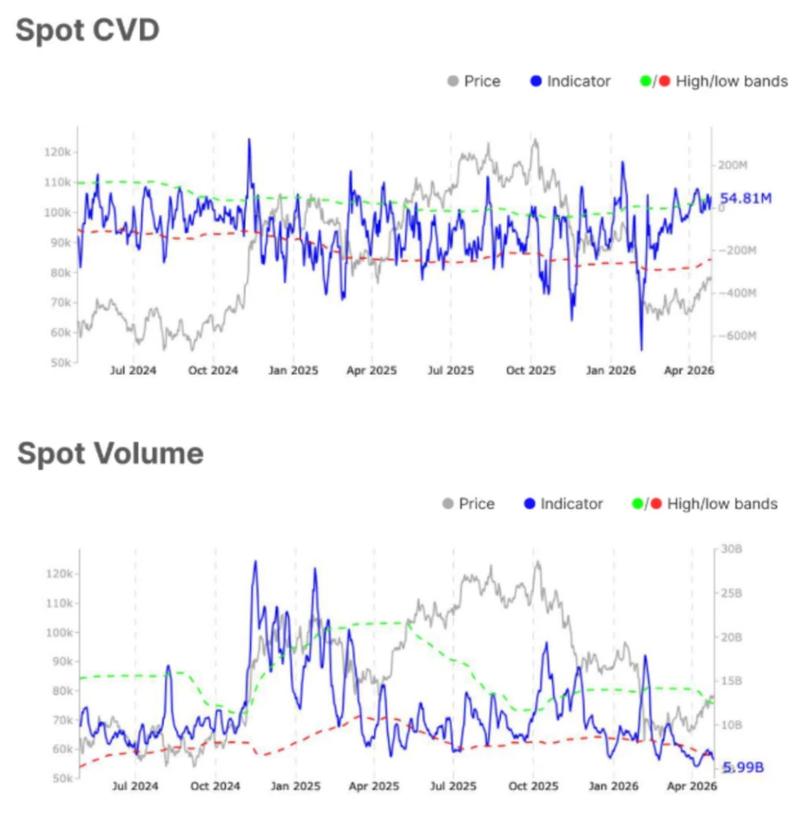
At the same time, the count of daily active addresses declined by 1.6% during the identical timeframe, "reflecting a more subdued state of network participation and reduced speculative interest," Glassnode said, adding:
"While buying pressure remains firm, reduced speculative activity suggests a more measured approach, with investors balancing risk and capital rotation."
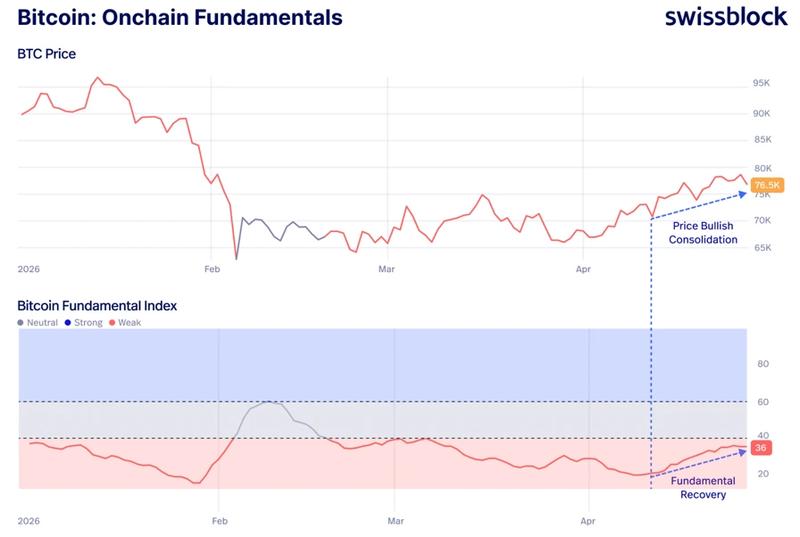
The Bitcoin Fundamental index from Swissblock, which evaluates network health, growth, demand, activity, and capital flows, mirrors this assessment.
The index climbed toward neutral territory alongside BTC's bounce from macro lows beneath $60,000, and experienced another uptick as price levels recaptured the $70,000 mark.
"Bitcoin's price structure points higher, but fundamentals remain weak," the private wealth manager said in an X post on Monday, adding:
"Price can still rise here. But for a medium-term trend shift, Bitcoin needs neutral-to-strong fundamentals to confirm."
Institutional appetite for Bitcoin remains within neutral parameters as well. Despite Strategy, which holds the position as the largest corporate Bitcoin holder, continuing its BTC acquisition strategy, capital flows into US-based spot Bitcoin ETFs reversed direction, registering $273 million in net outflows on Monday.