BTC Options Markets Reveal Trader Anxiety Despite Minimal ETF Withdrawal Activity
Modest Bitcoin ETF withdrawals fail to indicate a definitive bearish shift among investors, yet deteriorating macroeconomic indicators in the US and elevated crude oil costs maintain defensive positioning among BTC market participants.

Key takeaways:
- Market participants in Bitcoin are adopting a more cautious stance as elevated crude oil prices and geopolitical strife in the Middle East drive inflationary pressures and delay anticipated US interest rate reductions.
- While $254 million in spot Bitcoin ETF withdrawals remains insufficient to validate a bearish trend reversal, derivatives markets display substantial protective hedging activity.
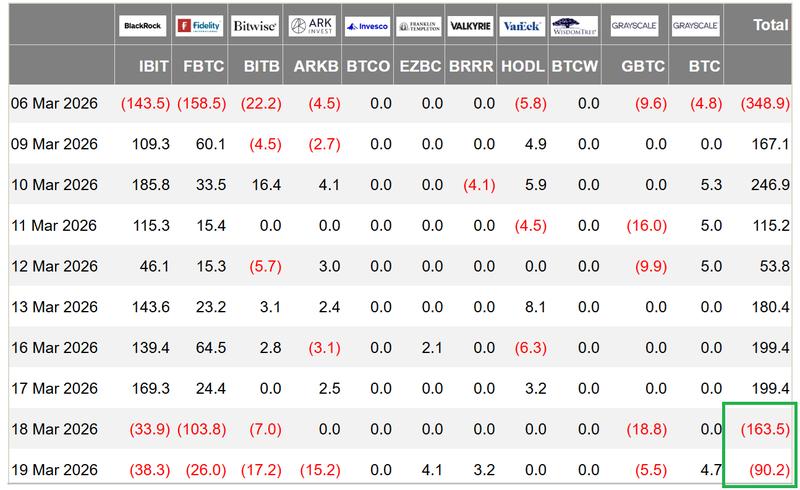
The price of Bitcoin (BTC) remained stagnant around the $70,000 mark during Friday's trading hours following an unsuccessful attempt to break back above $75,000 on Tuesday. This downward movement coincided with two consecutive days of net capital withdrawals from United States-listed Bitcoin spot exchange-traded funds (ETFs), breaking the positive inflow streak observed during the previous seven-day period. Market participants are now questioning whether institutional capital is adopting a bearish stance, particularly given the weakness displayed in US equity markets.
Pessimistic sentiment pervading worldwide financial markets is exerting downward pressure on Bitcoin as the S&P 500 dropped to its weakest point in half a year. Even the precious metal gold, traditionally viewed as a safe-haven asset, experienced a 10% correction spanning three trading days. With the escalating conflict between the US and Israel-Iran triggering widespread risk-averse behavior, Bitcoin derivatives indicators now demonstrate mounting apprehension among market participants.
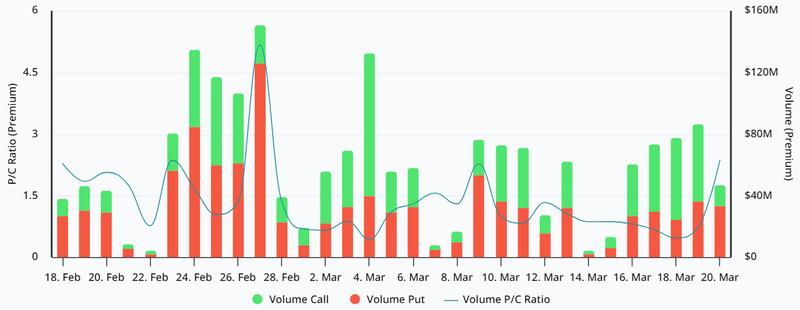
Interest in put (sell) Bitcoin options premiums on the Deribit platform reached levels nearly 2.5 times greater than comparable call (buy) instruments on Friday, suggesting heightened appetite for neutral-to-bearish trading approaches. The previous spike in this particular metric took place on Feb. 27 following Iran's rejection of diplomatic negotiations aimed at dismantling its critical nuclear infrastructure and exporting its enriched uranium stockpiles.
Market participants express frustration over Bitcoin's 17% underperformance versus the S&P 500
For verification of whether the heightened interest in put options has genuinely been employed for downside risk protection, analysts should examine the delta skew indicator. During periods when market makers anticipate imminent Bitcoin price decline risks, put options typically command a 6% or greater premium compared to equivalent call instruments. In contrast, bullish market phases drive this indicator into negative territory below -6%.
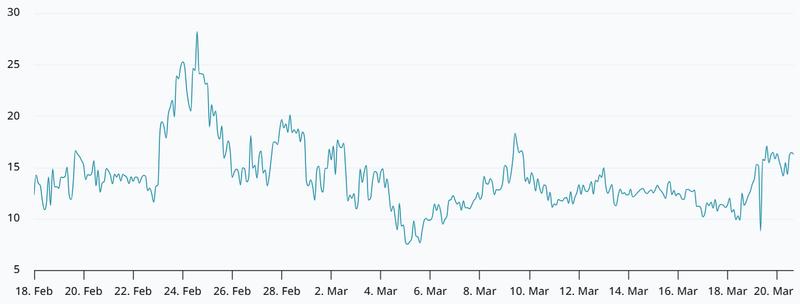
On Friday, the Bitcoin options delta skew (put-call) registered at 16%, signaling that institutional traders lacked confidence in the $69,000 support level maintaining its strength. Though far removed from the extreme fear levels witnessed during late February, present market conditions mirror the anxiety triggered by the 21% price decline over a three-month span, during which both gold and US equity markets demonstrated relative stability.
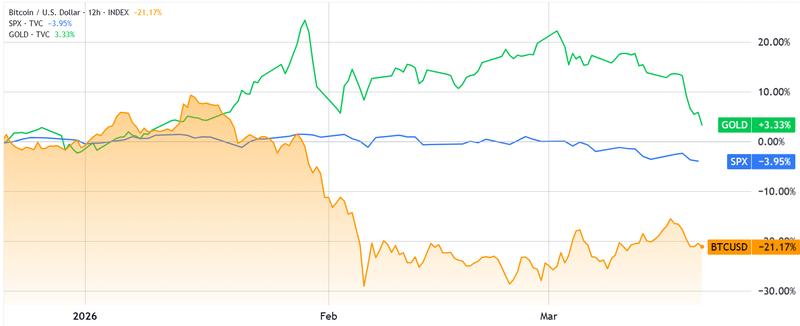
Independent of whether Bitcoin manages to successfully maintain support at the $70,000 threshold, market participants are expressing dissatisfaction with the 17% performance gap relative to the S&P 500 across the three-month timeframe. Even more significantly, the brief price surge to $75,000 witnessed on Tuesday failed to generate positive momentum in Bitcoin options markets, serving as a robust signal that traders are maintaining an excessively defensive posture.
A portion of this negative sentiment can be traced to the dramatic increase in energy commodity prices. WTI oil prices have maintained levels exceeding $94 since March 12, representing a 50% surge compared to the preceding month. The interruption of petroleum and natural gas production alongside supply chain disruptions in the Middle East region adversely affects economic expansion forecasts and constrains the US Federal Reserve's capacity to reduce interest rates amid mounting inflationary concerns.
The sharp escalation in fuel costs is projected to force consumer spending reductions, based on fresh analysis from Oxford Economics. Economic researchers cautioned that US manufacturing operations dependent on imported materials will similarly face negative consequences, leading to additional price escalation and potential "outright shortages of some products," as reported by Yahoo Finance.
The relatively modest $254 million in net withdrawals spanning two days are improbable to represent a definitive indication of institutional investors adopting bearish positioning, yet traders lack conviction that Bitcoin will sustain levels above the $68,000 threshold. Market participant sentiment has been predominantly influenced by deteriorating macroeconomic fundamentals and the uncertainty stemming from the extended military conflict, fueling increased appetite for downside risk protection through derivatives instruments.