BTC Holds Steady While Federal Reserve's Preferred PCE Inflation Metric Posts First Monthly Decline Since 2020
The cryptocurrency market and equities experienced upward movement following easing concerns over South Korean chip stocks and US PCE inflation figures meeting annual forecasts.

The leading cryptocurrency Bitcoin (BTC) managed to sidestep volatility pressures on Thursday while American equities rallied following encouraging inflation metrics.
Key points:
- The flagship digital currency Bitcoin sidesteps immediate volatility in response to US personal consumption expenditures (PCE) inflation figures, which show a reversal in the recent upward trajectory.
- Market observers maintain caution regarding inflation pressures even as PCE numbers align with market forecasts.
- Investment firm Bitwise anticipates Bitcoin will demonstrate reduced sensitivity to Federal Reserve interest-rate decisions in the future.
PCE Reverses Upward Trajectory Despite Remaining Above Fed's 2% Inflation Benchmark
According to data from TradingView, BTC price movement centered around the $64,500 level, showing minimal deviation from Wednesday's trading levels.
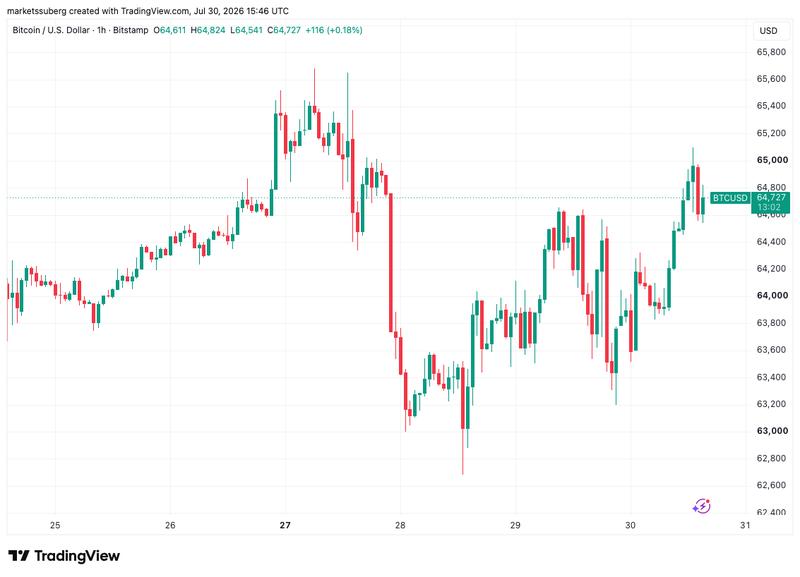
The significant headwind for risk assets that materialized earlier in the week stemming from a widespread selloff in semiconductor equities showed signs of abating, providing respite for the cryptocurrency market throughout the American trading hours. At the time of publication, the S&P 500 index posted gains of 1% while the Nasdaq Composite index climbed 2.3%.
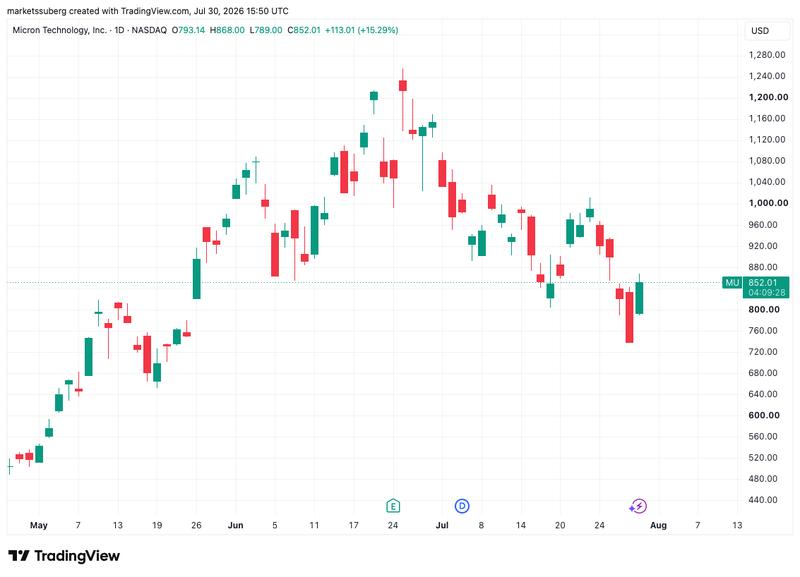
The Personal Consumption Expenditures (PCE) index reading for June provided an additional favorable development, registering at 3.7% on an annual basis — matching market consensus forecasts. The previous month's PCE reading of 4.1% in May represented the highest level recorded over a three-year period.
The Personal Consumption Expenditures index is regarded as the Federal Reserve's favored inflation gauge because it provides a more expansive and thorough assessment of inflationary pressures and captures shifts in consumer purchasing behavior in reaction to pricing fluctuations more rapidly, as stated by the Federal Reserve Bank of Cleveland.
"The increase in current-dollar personal income in June primarily reflected increases in compensation, personal income receipts on assets, and government social benefits that were partly offset by a decrease in farm proprietors' income," the US Bureau of Economic Analysis (BEA) said. The BEA said in its data release:
"The $65.2 billion increase in current-dollar PCE in June reflected increases of $58.2 billion in spending on services and $7.0 billion in spending on goods."
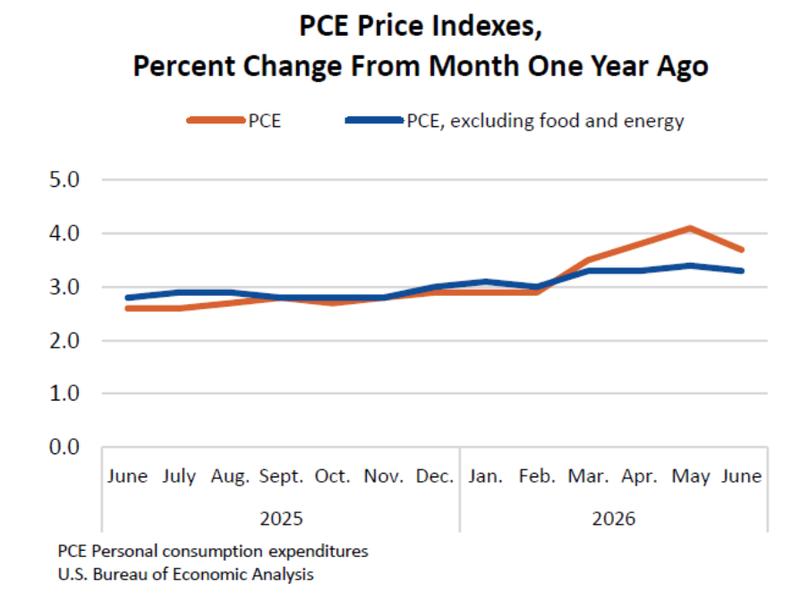
Despite marking the conclusion of an upward trend in PCE measurements and representing the first decline on a monthly basis since 2020, the June reading generated cautious market responses. Market analysis platform The Kobeissi Letter observed that the 3.7% reading still ranked as the second-highest outcome recorded since October 2024.
"US inflation continues to run at nearly double the Fed's 2.0% target," it said on X.
Steve Hanke, an economist at Johns Hopkins, characterized inflation as "the genie the Fed just can't put back in the bottle," while simultaneously highlighting the disparity with its 2% objective.
Bitwise CIO Forecasts BTC Demonstrating Reduced Sensitivity to Future Rate Signals
The Federal Reserve maintained interest rates at current levels during its most recent policy meeting on Wednesday, with an emerging divergence among Federal Open Market Committee (FOMC) members concerning the optimal course of action.
In the aftermath of the announcement, Matt Hougan, chief investment officer at digital asset management firm Bitwise, projected that upcoming interest-rate decisions would exert diminished influence on BTC price movements.
"Rationale: Throughout bitcoin's history, interest rates swung wildly -- from 0% to 2.5% to 0% to 5% to 3.5%. Changes have been measured in whole percentage points. But future changes seem likely to be more modest; the CME expects a 50bps rise over the next year," he told X followers, referring to rate expectations as measured by CME Group's FedWatch Tool.
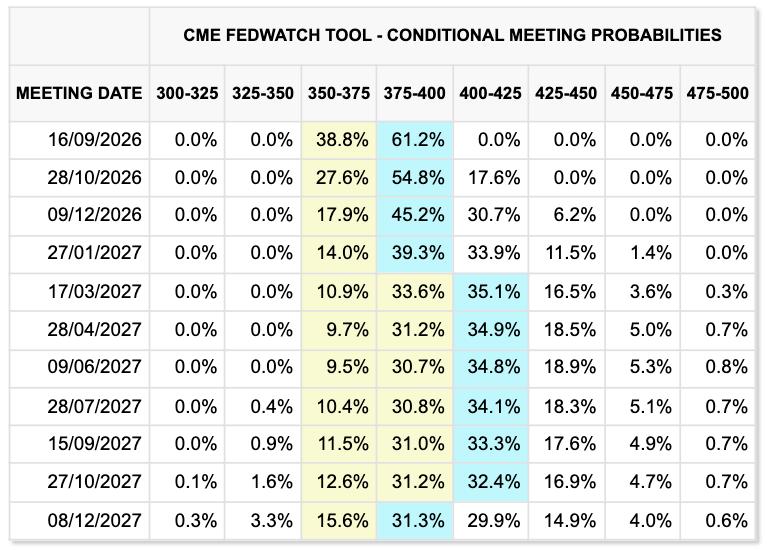
Hougan indicated that the newly appointed Fed chair, Kevin Warsh, will probably mirror the approach of former chair Alan Greenspan regarding the magnitude of rate adjustments, representing a departure from his immediate predecessor, Jerome Powell.
Before Warsh's confirmation to the position, US president Donald Trump delivered multiple indications suggesting his expectation that Warsh would embrace a dovish policy orientation on monetary matters, a strategic direction that would provide support for risk-asset market performance.