BTC Derivatives Markets Signal Caution Despite Push Toward $70K Milestone
While Bitcoin optimists pursue the $70,000 price point, warning indicators from futures and derivatives trading suggest why this target continues to prove challenging.
Key takeaways:
Derivatives trading for Bitcoin demonstrates ongoing apprehension notwithstanding the present upward movement toward $70,000, with futures premiums remaining significantly beneath neutral thresholds.
Market participants maintain a guarded position due to widespread risk-aversion alongside continuing worries regarding institutional BTC sell-offs and security concerns surrounding the Bitcoin network.
On Wednesday, Bitcoin (BTC) made another attempt at the $70,000 price point, bouncing back from the prior day's $62,500 bottom. Despite Bitcoin exchange-traded funds (ETFs) experiencing inflows that contributed to stabilizing overall market sentiment, this positive momentum proved insufficient to rebuild trader confidence across BTC derivatives platforms. Market participants continue worrying that fundamental issues are blocking a sustainable advance toward the $75,000 milestone.
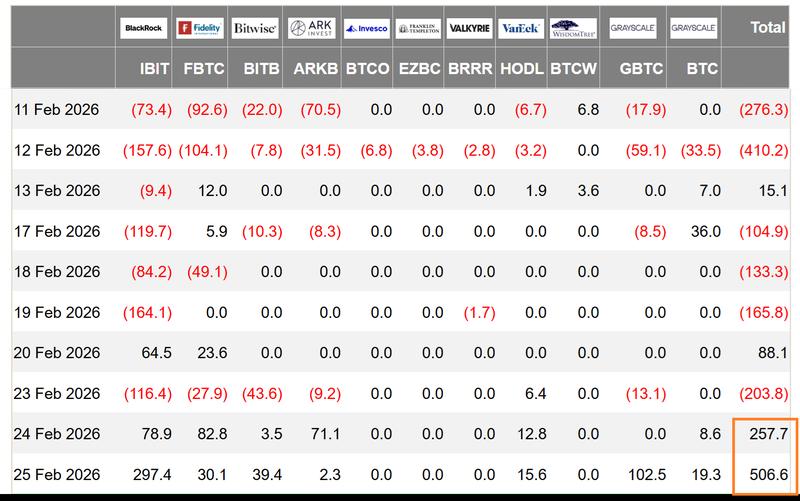
Bitcoin ETFs trading in the United States saw $764 million worth of net inflows across a two-day period, which partially counterbalanced the $1.2 billion worth of outflows witnessed throughout the preceding eight days of trading. Such significant capital movements are generally linked to institutional investor behavior, pointing toward robust buying interest whenever prices fall beneath the $65,000 threshold.
Notwithstanding this buying pressure, the desire for leveraged long positions within BTC futures contracts has experienced a dramatic decline.
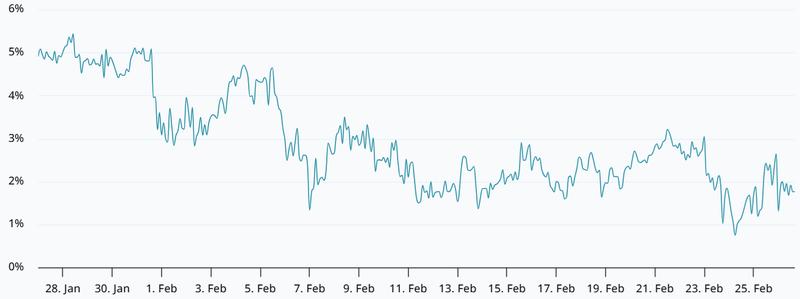
On Thursday, the annualized premium for Bitcoin futures contracts compared to spot trading stood at 2%, continuing to trade substantially underneath the 5% neutral benchmark. Optimistic market sentiment has been conspicuously missing since Jan. 31, when Bitcoin lost the $85,000 support threshold after maintaining it for more than nine months. Information derived from the options marketplace additionally reveals that professional market participants are emphasizing protection against downside risk exposure.
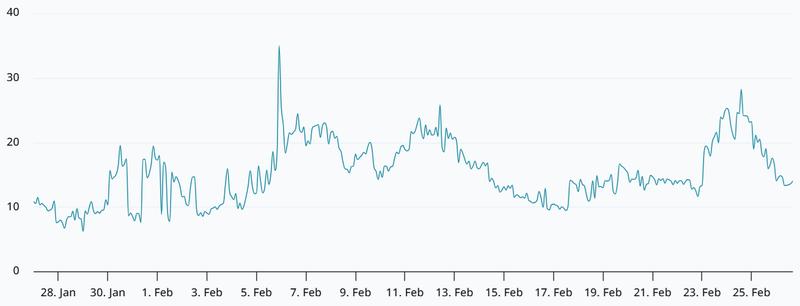
On Thursday, Bitcoin put (sell) options commanded a 14% premium when compared to their equivalent call (buy) counterparts. Under neutral market conditions, this particular indicator generally oscillates within a range of -6% to +6%, demonstrating that fearful sentiment continues as the prevailing market force. While this skew measurement has shown improvement from the 28% "panic" readings observed on Tuesday, the price recovery toward $70,000 has achieved minimal success in altering the cautious perspective held by derivatives market traders.
Could a single entity be responsible for Bitcoin's price weakness?
In recent times, multiple unverified explanations have emerged attempting to account for Bitcoin's 32% price deterioration spanning seven weeks. This downward trajectory commenced subsequent to the Oct. 10, 2025, market collapse, which wiped out $19 billion worth of leveraged trading positions throughout the entire cryptocurrency industry. This price turbulence occurred simultaneously with US President Donald Trump's announcement of a 100% tariff increase on imports originating from Chinese sources.
In the aftermath of that incident, Binance allegedly delivered $283 million in user compensation for those impacted by liquidations stemming from internal oracle pricing malfunctions, system performance delays, and degraded asset transfer capabilities. Binance co-founder and previous CEO Changpeng "CZ" Zhao has subsequently disputed claims suggesting that the exchange deliberately engineered the October 2025 market crash.
Additional market observers have connected the recent bearish trend to anxieties surrounding quantum computing capabilities. Such concerns escalated following Jefferies strategist Christopher Wood's decision to eliminate Bitcoin from his "Greed & Fear" model investment portfolio in January, referencing potential threats to long-term network security. As a countermeasure, development teams formulated a proposal, BIP-360, which concentrates on implementing post-quantum cryptography solutions onchain.
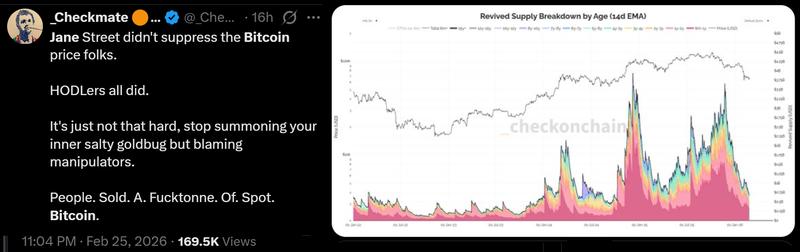
The latest theory attempting to explain Bitcoin's underwhelming price action centers on quantitative trading firm Jane Street. Such speculation gained traction following a lawsuit filed by Terraform Labs' court-appointed administrator against the firm, making accusations of insider trading connected to transactions that hastened the Terra Luna ecosystem's May 2022 collapse.
Jane Street's latest 13-F regulatory filing revealed substantial positions in BlackRock's iShares Bitcoin Trust ETF alongside multiple Bitcoin mining enterprises. Nevertheless, Julio Moreno, head of research at CryptoQuant, observed that this type of trading behavior is characteristic of delta-neutral investment strategies.
In the final analysis, the 5% drop in Nvidia (NVDA US) stock price on Thursday despite reporting robust earnings points toward an expanding risk-averse mindset among market participants, which could offer partial justification for Bitcoin's ongoing difficulties in recapturing the $75,000 price level.