BTC could revisit $60K levels following Bank of Japan's rate increase
Interest rates reaching their highest point in Japan since 1995 are refocusing attention on global liquidity as market participants forecast BTC corrections of 26%–38%.

The flagship cryptocurrency Bitcoin (BTC) faced the possibility of erasing recent gains achieved during the Iran truce period and heading back toward the key $60,000 psychological level following the Bank of Japan (BoJ) decision to push its interest rates to a three-decade high.
Key takeaways:
- Following the previous four BoJ rate increases, BTC has recorded an average 5.74% drop over the subsequent 30-day periods.
- If historical post-hike patterns repeat themselves, Bitcoin could potentially decline to a range spanning $62,700 down to $56,700.
Historical BOJ rate increases signal potential 30-day Bitcoin corrections
During Tuesday's policy meeting, the BoJ implemented a 25 basis point increase to its short-term policy rate, elevating it to 1.0% on June 16, representing Japan's most elevated interest-rate benchmark since 1995.
This policy adjustment arrived as central bank officials addressed ongoing inflationary pressures stemming from elevated energy prices and continuing supply chain disruptions across the Middle East region.
Bitcoin experienced a decline of approximately 2.5% from its recent local peak at $67,250 — though the cryptocurrency was still preserving its gains accumulated throughout June. Nevertheless, the digital asset's track record following previous BoJ rate adjustments suggests potential downward pressure ahead.
Examining the 30-day windows following the most recent four BOJ rate hikes reveals Bitcoin averaged a 5.74% depreciation. BTC experienced a 5.59% decline following the March 2024 adjustment, a 10.89% drop after the July 2024 increase, and a 14.77% decrease subsequent to the January 2025 hike.
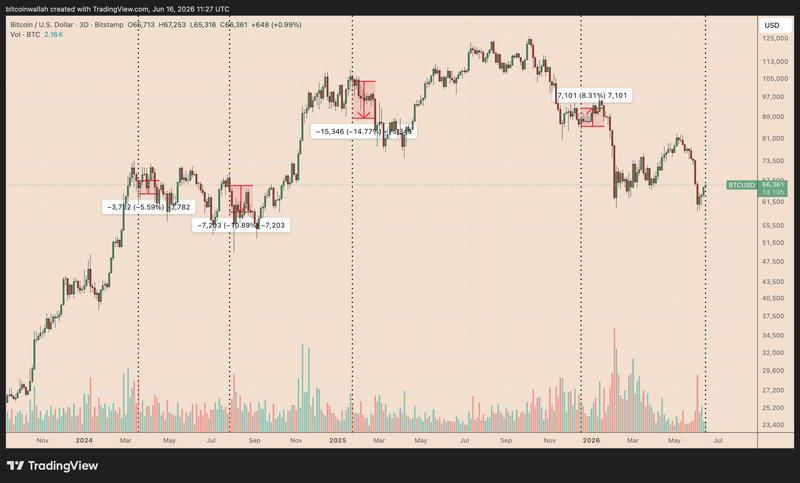
The sole exception to this bearish pattern emerged following the December 2025 rate increase, during which BTC registered an 8.31% appreciation over the next 30 days. That said, this particular rally materialized after Bitcoin had undergone a substantial correction from its October 2025 all-time high, indicating the market had entered deeply oversold territory prior to the BoJ's policy decision.
Extrapolating Bitcoin's mean 5.74% post-BoJ correction from its present trading level around $66,500 projects a downside objective in the vicinity of $62,700, positioned just above the critical $59,000–$62,000 support zone (highlighted in red on the accompanying chart).
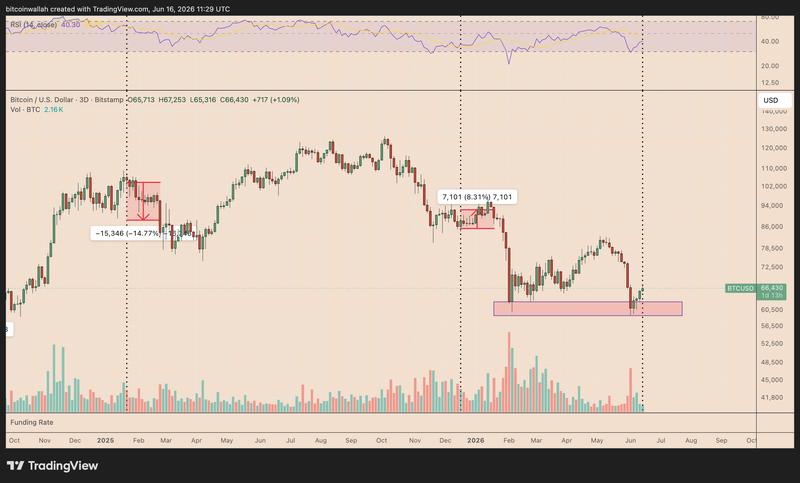
A more pronounced retracement mirroring the magnitude of the July 2024 post-hike selloff would drive BTC down to approximately $59,200, whereas a repetition of the January 2025 decline would suggest a potential descent to $56,700.
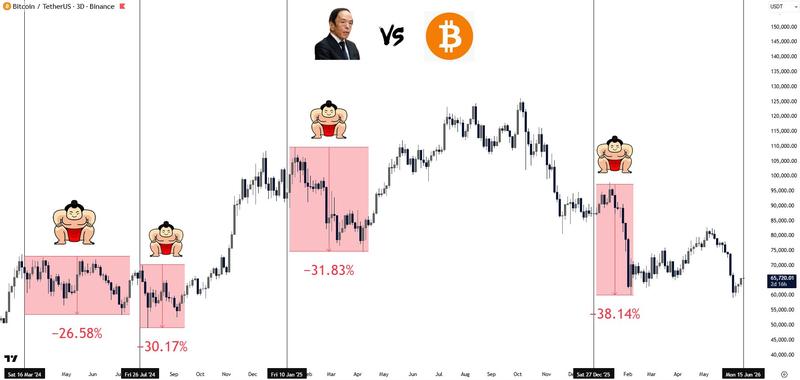
More extensive drawdown periods following BoJ policy tightening have demonstrated even more severe price action, with Bitcoin surrendering between 26% and 38% of its value after Japan's rate decisions dating back to March 2024, according to chart analysis presented by cryptocurrency analyst Gerla.
BoJ rate-hiking campaigns have frequently aligned with US economic contractions
Rate-tightening cycles implemented by the BoJ have demonstrated a historical tendency to align temporally with recessionary periods in the United States, with the pandemic-induced economic disruption representing the primary outlier, according to André Dragosch, European Head of Research at Bitwise, in commentary shared Tuesday.
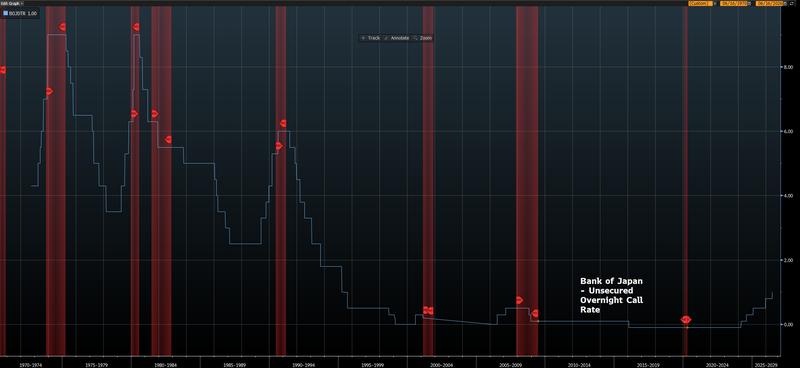
This recurring correlation indicates the BoJ frequently implements restrictive monetary policy during the later stages of the global economic cycle, at a juncture when inflationary forces have already intensified, and market liquidity dynamics are turning increasingly unfavorable for speculative assets.
For an extended period, Japan has functioned as a critical provider of inexpensive capital for international financial markets.
During the era when Japanese interest rates hovered near zero, market participants could secure yen-denominated loans at minimal cost and deploy that capital into higher-yielding assets across global markets, encompassing equities and cryptocurrencies. However, as Japan implements rate increases, this carry trade strategy progressively loses its economic appeal.
Certain traders may consequently unwind their leveraged positions as a risk management measure. This unwinding process can negatively impact assets such as Bitcoin, which typically experiences amplified volatility when international investors adopt more defensive positioning.