Broker-Dealers Get SEC Green Light for 2% Stablecoin Haircut Policy
The US financial regulator's staff indicated they would accept broker-dealers including stablecoin assets in net capital calculations with minimal reduction.
Staff members at the US Securities and Exchange Commission (SEC) provided clarity last week regarding broker-dealers' ability to utilize a 2% "haircut" on stablecoin assets, indicating the regulator would raise no objections to this approach.
Before this guidance was issued, broker-dealers faced uncertainty about whether they needed to implement a 100% haircut on their holdings of dollar-backed stablecoins, which would have meant these digital tokens couldn't be included in their net capital calculations under current regulatory frameworks.
The guidance was delivered through a publication from the SEC's Division of Trading and Markets staff, formatted as "Frequently Asked Questions Relating to Crypto Asset Activities and Distributed Ledger Technology."
Commenting on the development, Commissioner Hester Peirce stated: In my view, a 100% haircut would be unnecessarily punitive given the underlying reserve assets that back payment stablecoins."
Broker-dealers must maintain specific minimum thresholds of net capital to ensure they can fulfill financial commitments and withstand potential losses stemming from market declines and price fluctuations, as explained in the staff's guidance document.
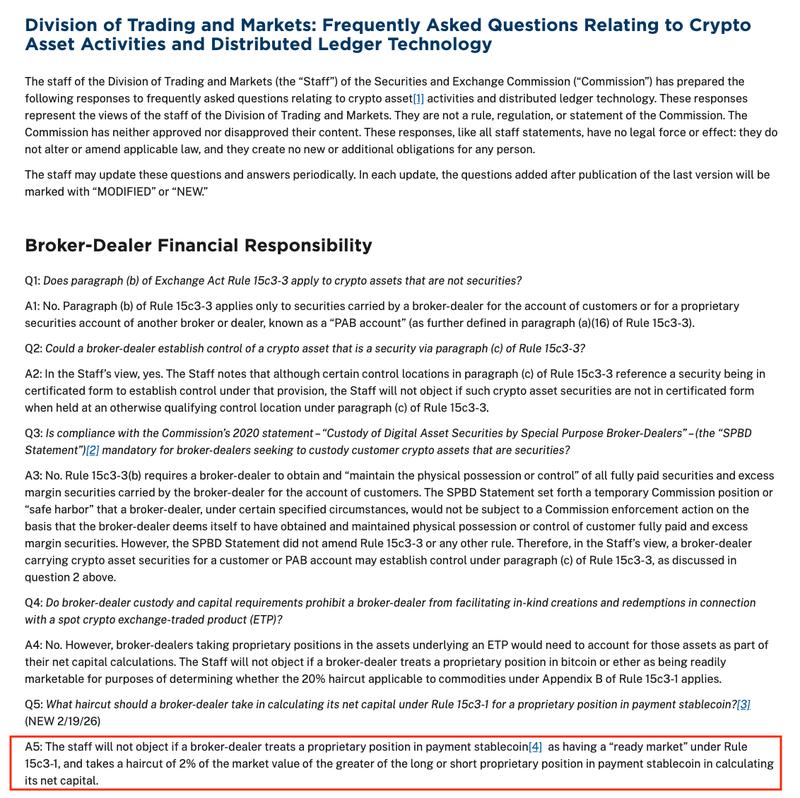
To illustrate, when a broker-dealer maintains $100 million worth of stablecoins, applying a 2% haircut enables them to include $98 million in their net capital requirement calculations. Praising the guidance as beneficial for financial infrastructure, Peirce commented:
"Stablecoins are essential to transacting on blockchain rails. Using stablecoins will make it feasible for broker-dealers to engage in a broader range of business activities relating to tokenized securities and other crypto assets."
The guidance ensures broker-dealers can maintain stablecoin positions without concerns about excessive net capital obligations, and allows them to handle these tokens in a manner comparable to money market funds, investment vehicles that contain low-risk cash alternatives such as US Treasurys and certificates of deposit.
Through a social media message posted during the weekend, Marc Baumann, CEO of crypto intelligence firm 51, described the SEC staff's communication as "a big deal," noting that "Wall Street can now actually hold and use stablecoins without destroying their capital ratios."
Stablecoins gain traction in the United States, but not all US officials are convinced
The overall market capitalization of stablecoins experienced a recent decline, dropping approximately $6 billion from its December 2025 high point of more than $300 billion.
Nevertheless, the market continues to maintain a $295 billion market cap, which has demonstrated consistent upward growth since 2023, based on information from RWA.XYZ.
In July 2025, United States President Donald Trump enacted the GENIUS stablecoin bill, signing it into law in what was viewed as a watershed event for the cryptocurrency sector.
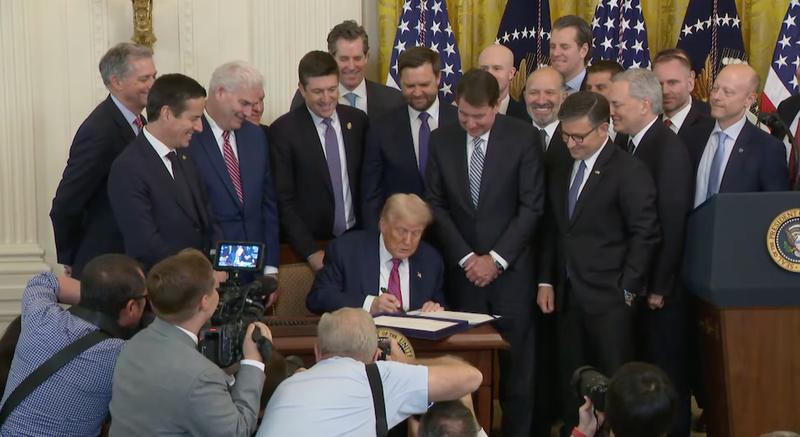
At the moment the bill was signed, the stablecoin market capitalization stood slightly above $252 billion and experienced significant growth in the aftermath of the legislation's approval, as shown by data from RWA.XYZ.
Notwithstanding the dramatic increase in stablecoin adoption and the potential implications for US dollar supremacy in international financial systems, Neel Kashkari, president of the Federal Reserve Bank of Minneapolis, continues to argue that stablecoins and cryptocurrency lack genuine practical applications.
"I could send any one of you $5 with Venmo, or PayPal, or Zelle, so what is it that this magical stablecoin can do?" he said on Thursday.