Britain Must Establish Viable Pathways for Regulated DeFi Engagement
Katie Harries, Coinbase's head of European policy, warns that the UK's upcoming 2027 cryptocurrency regulations could effectively prevent regulated financial institutions from offering DeFi access.

Opinion by Katie Harries, head of policy, Europe, Coinbase
The United Kingdom stands at a crossroads that may determine the trajectory of its financial sector: will decentralized finance (DeFi) be permitted to flourish through regulated channels, or will it be relegated to isolation?
This question extends beyond the interests of cryptocurrency advocates; it concerns the evolution of capital markets, the competitive standing of the City, and Britain's capacity to influence the emerging generation of financial infrastructure.
DeFi represents software enabling individuals to engage in borrowing, lending, and trading activities directly with each other, eliminating the need for intermediaries such as banks or brokers. Its operation resembles the internet more closely than traditional financial institutions, offering the prospect of more affordable, expedient financial services available to all users at any time.
Though DeFi will remain perpetually accessible via open-source or decentralized channels, regulated service providers can equally facilitate access to DeFi, enabling their clients to interact with the technology while obtaining essential information regarding the services being utilized and the associated risks.
Nevertheless, the proposed cryptocurrency regulations from the Financial Conduct Authority (FCA) may render this impossible. The FCA intends to require regulated platforms to ensure that customer orders receive execution exclusively on FCA-authorized venues. Though designed to prevent foreign firms from unlawfully entering the UK market, this requirement also threatens to eliminate access to DeFi, as the decentralized protocols and exchanges where users complete transactions lack a responsible individual who could obtain authorization.
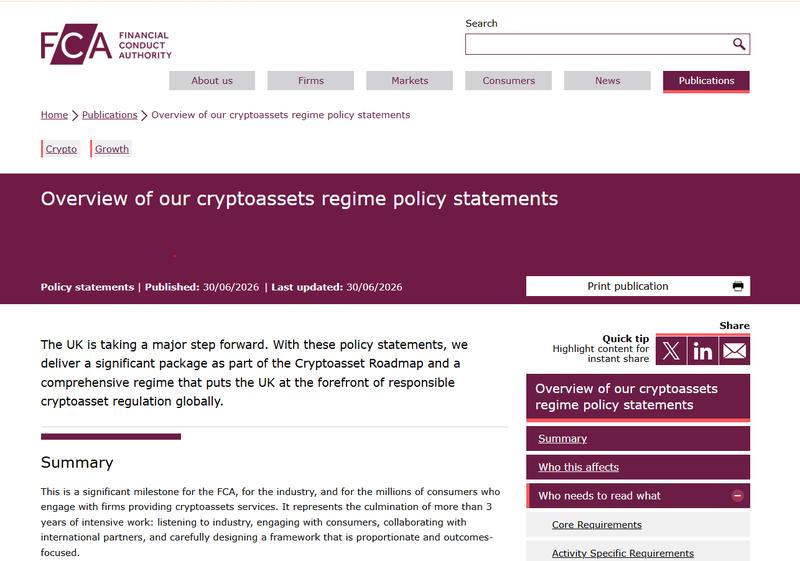
While no regulation explicitly prohibits firms from offering DeFi integrations to their clientele, the FCA has clearly stated its intention not to develop rules tailored to these products, choosing instead to apply identical rules as those governing completely centralized trading. The consequence may be an implicit prohibition.
Beginning in October 2027, regulated platforms might find themselves unable to furnish customers with access to DeFi services unless the FCA modifies its stance.
The government has committed to wanting the UK to "lead the world on digital assets." Achieving this objective will prove challenging if British firms become disconnected from the decentralized infrastructure upon which digital asset markets are constructed.
DeFi is becoming part of the next financial infrastructure
Regulatory authorities in alternative jurisdictions acknowledge the opportunities and are investigating methods to facilitate DeFi innovation. Within the European Union, the European Securities and Markets Authority has recommended permitting regulated firms to offer DeFi access, stating it could "allow innovation in decentralized finance in a regulated and transparent environment."
In September, the United States Securities and Exchange Commission approved an "Innovation Exemption" for peer-to-peer trading of tokenized stocks, utilizing automated trading systems and liquidity pools.
In essence, the US and EU are investigating how traditional finance and DeFi infrastructure can collaborate effectively. The UK ought to be examining this same potential before completely foreclosing this possibility.
Onchain tokenized finance cannot achieve its maximum potential if restricted to closed and fragmented systems that encounter difficulties interacting with the decentralized technology underlying them.
A de facto ban may push DeFi beyond the regulator's reach
The UK has unveiled its initial comprehensive rulebook for cryptocurrency regulation. Starting Oct. 25, 2027, firms providing crypto services to UK customers must secure authorization from the FCA. The FCA is presently consulting on guidance regarding how its regulations will apply to firms offering financial services that utilize or interact with DeFi.
Potential concerns surrounding DeFi integrations fall into three categories. Firstly, a customer utilizing a familiar regulated platform might not recognize when they have transitioned into an environment where customary protections are absent. Secondly, certain firms might exploit DeFi integrations to circumvent regulatory obligations. Thirdly, DeFi could introduce risks pertaining to financial crime and market resilience.

However, these risks indicate the necessity for transparent information for consumers and clear responsibilities for firms — not an outright prohibition.
An implicit ban would generate the reverse of its desired outcome. It would not eradicate DeFi. Rather, it would drive additional activity outside the FCA's practical oversight and diminish regulated firms' capacity to influence how customers engage with it.
Regulated platforms can serve as valuable points for supervision. They can clearly communicate to customers when they are exiting a regulated environment and obtain their consent before permitting this transition. Regulated firms can additionally curate access to specific protocols, evaluate operational and governance risks, and report incidents and usage data to regulators.
Regulate the gateway, not the technology
The UK already acknowledges, in different areas of finance, that regulated institutions can facilitate access to products or markets that don't possess the same level of oversight.
Numerous retail trading platforms or so-called "super apps" currently provide consumers with access to a spectrum of products, ranging from stocks and money market funds to commodities and foreign exchange, each with varying regulatory protections. The FCA allows this, provided that platforms clearly indicate to consumers which protections are applicable to different products and services.
This is precisely why DeFi integrations necessitate a superior solution. The FCA should safeguard consumers, but it should not attempt to accomplish protection through complete exclusion.
Responsible integration would deliver consumers more transparent information, grant supervisors enhanced visibility, and afford UK financial services the opportunity to remain competitive in the subsequent phase of financial innovation.
Consumers will use DeFi, so the question is where
DeFi protocols can already be accessed directly without utilizing regulated firms. The question becomes whether consumers will additionally be able to access DeFi through a regulated gateway, accompanied by clear disclosures and protective measures.
The implications extend beyond crypto trading. DeFi underlies the most significant potential cost reductions as financial services transition onchain, featuring fewer expensive intermediaries and systems capable of supporting 24/7 activity across international borders. Regulation that establishes a clear pathway to support DeFi is essential to provide firms with the confidence to invest in UK innovation over the long term.
Should access barriers be implemented in the UK, tokenized capital markets and financial innovation more comprehensively could develop in nations that are resolute in supporting DeFi infrastructure.
The UK cannot realistically aspire to achieve leadership in digital finance while simultaneously blocking access to the decentralized infrastructure upon which the future of finance is being constructed.
About the author: Katie Harries is the head of policy for Europe at Coinbase. Katie leads on international policy, engaging with regulators, governments and industry stakeholders to shape a regulatory environment that fosters growth, competition and responsible oversight for digital assets in the UK and Europe. Prior to joining Coinbase, Katie was a VP at Goldman Sachs. Katie is also heavily involved in the UK Cryptoasset Business Council (UKCBC), the country's leading crypto trade body.