Breez Enables Cross-Chain Stablecoin Transactions From Bitcoin Across 30+ Networks
A newly released SDK capability enables developers to facilitate payments directly from Bitcoin holdings to USDC and USDT recipients, eliminating the need for users to maintain stablecoin reserves.

Breez, a company focused on Bitcoin infrastructure development, has introduced a new capability within its software development kit that enables users to transmit USDC (USDC) and USDt (USDT) across over 30 different blockchain networks using only their Bitcoin holdings, eliminating the need to convert or maintain stablecoin balances beforehand.
Based on information shared exclusively with Cointelegraph in an announcement, this capability leverages the Lightning Network combined with automatic conversion mechanisms to facilitate payment routing from Bitcoin (BTC) into USDC or USDT format before the funds reach the recipient on their selected blockchain.
Upon entering a recipient's wallet address, the Breez SDK automatically detects which blockchain serves as the destination, computes an optimal conversion pathway, and presents the user with the amount, network details, and associated fees prior to payment confirmation. Following confirmation, the transaction flows through liquidity provider networks, which include Flashnet and Boltz, responsible for transforming the sender's Bitcoin holdings into stablecoins and completing delivery to the recipient's designated blockchain.
In a conversation with Cointelegraph, Breez CEO Roy Sheinfeld explained that the feature operates without requiring USDT or USDC to exist natively on the Lightning Network. The system instead depends on "interoperability" mechanisms that allow users to make payments from Bitcoin balances while ensuring recipients obtain stablecoins on their supported blockchain networks.
According to Breez, users maintain their Bitcoin holdings right up until the moment they execute a payment, whereas recipients obtain stablecoins delivered to their preferred blockchain without any requirement for the sender to oversee distinct stablecoin balance accounts. The functionality operates on a non-custodial basis and currently facilitates only outbound stablecoin transactions, though Breez has announced plans to introduce support for receiving stablecoins from external blockchain networks in an upcoming release.
The capability has been engineered to empower developers to incorporate stablecoin payment functionality without the complexity of integrating numerous blockchain networks or imposing requirements on users to juggle separate Bitcoin and stablecoin account balances.
Bitcoin payment infrastructure expands
This launch arrives during a period when various companies are extending Bitcoin and the Lightning Network, which functions as a layer-2 payment infrastructure engineered to accelerate Bitcoin transactions while reducing costs, into emerging financial and commercial use cases.
During February, Secure Digital Markets, an institutional-grade trading and lending platform, successfully executed a $1 million Bitcoin payment transfer to Kraken via the Lightning Network in under half a second, showcasing the protocol's capabilities for large-scale institutional value transfers. This transaction provided a clear demonstration of how Lightning infrastructure is progressively being evaluated for applications extending well beyond small-scale retail payment scenarios.
Within that identical month, Voltage, a Bitcoin infrastructure provider, unveiled a US dollar-denominated revolving credit facility that integrates business financing directly into Lightning payment operations, providing companies with the ability to settle repayment obligations in either US dollars or Bitcoin. This financial product aims to grant businesses access to operational capital utilizing Lightning for payment processing, while avoiding the necessity of maintaining cryptocurrency assets on their financial statements.
Additionally, Satlantis, an event management platform, rolled out a Bitcoin-focused ticketing system featuring integrated Lightning wallet functionality, enabling event organizers to distribute tickets and receive BTC payments in conjunction with conventional payment processing methods.
During March, Ark Labs, a Bitcoin infrastructure startup backed by Tether, secured funding in a $5.2 million investment round dedicated to building technology infrastructure that supports stablecoin creation, transfer capabilities, and settlement operations on Bitcoin.
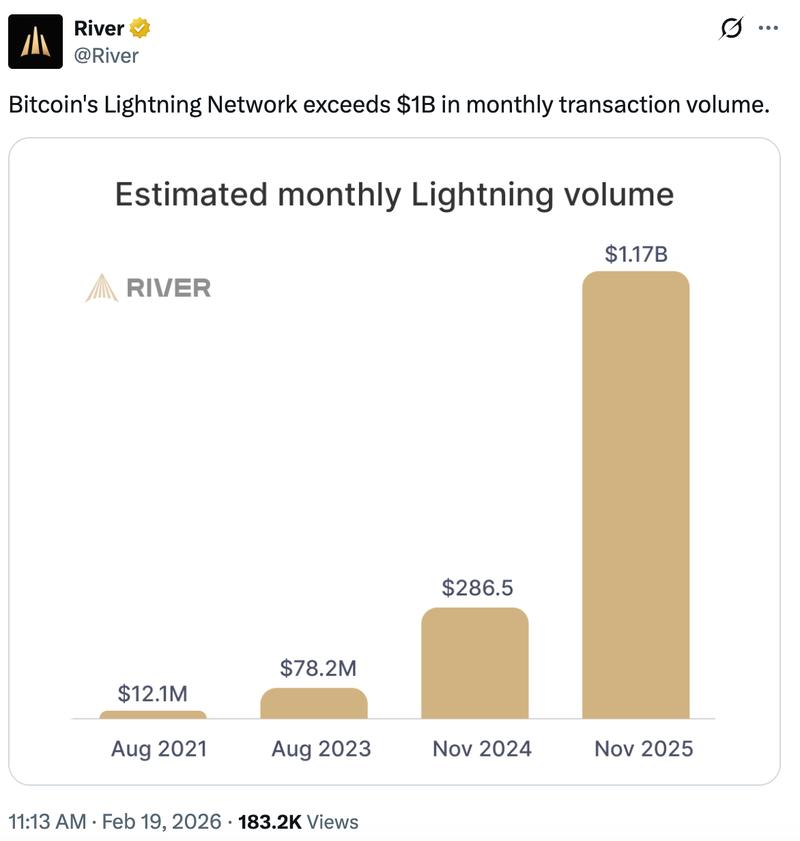
The adoption trajectory for Lightning has maintained upward momentum. According to a February analysis published by River, the network exceeded $1 billion in monthly transaction throughput during late 2025, representing substantial growth from approximately $12 million recorded in 2021.