Brazilian Legislation Permits Confiscated Digital Assets to Fund Law Enforcement
Targeting criminal syndicates, the legislation enables authorities to redirect seized cryptocurrencies toward "equipment modernization, personnel development, and specialized law enforcement missions."

Law enforcement organizations throughout Brazil now possess an additional resource in their battle against criminal syndicates following the passage of legislation that permits the utilization of seized digital currencies in their operations.
Brazil's parliament unveiled Law No. 15.358 on Wednesday, which creates a comprehensive legal structure for confronting organized criminal networks. This legislation grants officials the authority to block digital asset transactions on cryptocurrency platforms by categorizing virtual currencies as criminal instruments, while also enabling the seizure of crypto assets to finance law enforcement initiatives.
"When determining asset forfeiture, any property utilized in the commission of criminal activity shall be deemed an instrument of that crime, regardless of whether such property was dedicated solely to criminal purposes," stated a translated version of the legislation, which further specified:
"The forfeited assets and valuables may be used provisionally by public security agencies for police re-equipment, training, and special operations, subject to authorization from the judge overseeing the execution of the sentence."
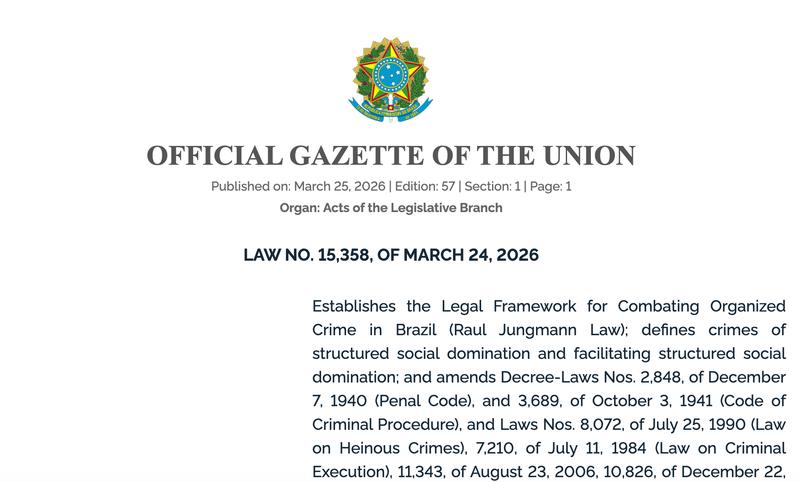
Of particular significance, this legislation would grant Brazil authority to establish coordination and cooperative relationships with international law enforcement bodies for investigative purposes and the recovery of criminal assets, which may encompass situations involving virtual currencies. Given Brazil's population exceeding 213 million citizens, a substantial portion of whom participate in cryptocurrency markets, this legal framework could carry meaningful consequences for the Brazilian government's financial resources dedicated to law enforcement.
This law's enactment came after media coverage indicated that Brazil's Finance Minister, Dario Durigan, intended to postpone deliberations regarding modifications to the nation's cryptocurrency taxation framework. Media sources reported that Durigan sought to sidestep controversial alterations to fiscal policy, opting to defer such discussions until completion of Brazil's presidential election scheduled for October.
During 2025, the Brazilian Federal Police launched Operation Lusocoin, which focused on dismantling a money laundering and currency evasion network of extraordinary proportions, as documented by TRM Labs. Law enforcement officials estimate that this criminal enterprise facilitated the movement of tens of billions of Brazilian reais utilizing an intricate network of front companies, over-the-counter cryptocurrency dealers, and self-custody digital wallets.
Brazil is still reviewing a national crypto reserve
Unlike nations such as the US, where confiscated cryptocurrency from criminal prosecutions might contribute to building a sovereign digital asset repository, Brazil's legislation redirects these resources toward law enforcement enhancement measures including personnel training programs. Nevertheless, Brazilian governmental officials have examined a legislative proposal for establishing a national Bitcoin (BTC) strategic reserve, with discussions occurring in August 2025.
The proposed BTC reserve legislation, which was first presented in 2024, would potentially permit Brazil to dedicate as much as 5% of the nation's treasury funds for Bitcoin acquisition purposes. During February, legislative representatives revived the proposal with expanded provisions allowing for the procurement of up to one million BTC. As of March, it remained uncertain whether the proposed legislation would garner sufficient legislative backing to achieve passage in subsequent proceedings.