Brazilian Central Bank Prohibits Cryptocurrency Use in Official Cross-Border Payment Systems
The Banco Central do Brasil has implemented a prohibition on digital assets within its regulated electronic foreign exchange payment infrastructure, intensifying regulatory control over cryptocurrency-related transactions.

The Banco Central do Brasil (BCB), serving as Brazil's central banking authority, has implemented a prohibition preventing virtual assets from being utilized within specific regulated international payment and transfer services, establishing stricter regulations for cross-border payment service providers that operate within the nation's electronic foreign exchange (eFX) regulatory framework.
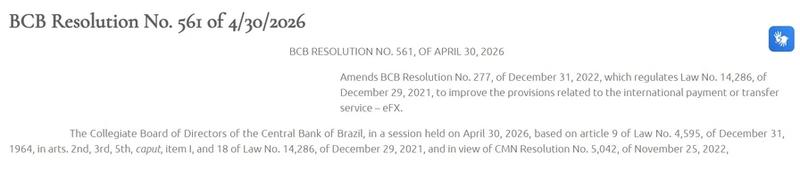
The BCB issued Resolution BCB No. 561 on Thursday, introducing amendments to the current regulations governing eFX, which represents a regulated classification encompassing international payments and transfers. According to the resolution's provisions, all payments or receipts conducted between an eFX service provider and its international counterpart must be executed solely via a foreign exchange transaction or through movements in a non-resident Brazilian real account, explicitly prohibiting the utilization of virtual assets.
The prohibition extends its reach to encompass transitional regulations affecting eFX providers that have not yet secured placement among the approved provider categories. These companies retain the ability to continue offering eFX services only under the condition that they submit an application for official authorization from the central bank no later than May 31, 2027, while their payment and receipt operations must continue to rely exclusively on foreign exchange transactions or non-resident real accounts, explicitly excluding virtual assets from use.
This regulatory measure does not constitute a comprehensive prohibition on cryptocurrency transfers throughout Brazil. Rather, it effectively eliminates the possibility of using cryptocurrencies and stablecoins within the regulated eFX channel, strengthening the central bank's initiative to maintain cross-border payment flows within monitored foreign exchange infrastructure.
Brazil tightens oversight of crypto-linked cross-border flows
The Brazilian government has been taking steps to integrate virtual assets into its comprehensive financial and foreign exchange regulatory framework as stablecoins assume an increasingly significant role in the nation's cryptocurrency-related activities.
During November 2025, the central bank outlined comprehensive new regulations governing virtual asset service providers, encompassing authorization requirements alongside rules for services that involve virtual assets within the foreign-exchange market infrastructure.
The central bank's regulatory initiative follows growing concerns regarding the utilization of stablecoins for payment transactions and cross-border transfers. Reuters published a report in February indicating that BCB Governor Gabriel Galipolo stated cryptocurrency usage had experienced a significant surge throughout the country during the preceding two to three years, with approximately 90% of these flows being connected to stablecoins. According to his statement, this trend has generated concerns surrounding taxation compliance, money laundering activities and asset backing verification.
This eFX regulation emerges at a time when Brazil's central bank has also expressed concern regarding stablecoins that are issued by companies operating beyond its regulatory jurisdiction. Within a technical document transmitted to Congress and reviewed by Cointelegraph Brasil, the central bank indicated that stablecoins issued by entities not falling under BCB supervision could potentially face either a ban or severely restrictive conditions within the domestic marketplace.
The technical document stated that real-denominated stablecoins issued by entities operating outside BCB supervision may present risks to regulatory equality principles and monetary sovereignty, whereas foreign-currency stablecoins generate concerns regarding jurisdiction, capital flow movements and fragmentation within the payments system infrastructure.