Blockchain Transaction Data Proves Decisive in Indonesian Terror Financing Cases: TRM Labs
Three terrorism financing convictions in Indonesia during 2024 and 2025 relied heavily on blockchain analysis tools, with authorities successfully presenting onchain evidence in court proceedings.

The prosecution and conviction of three separate individuals on terrorism financing charges in Indonesia throughout 2024 and 2025 hinged critically on onchain evidence, marking a significant evolution in how judicial systems are treating blockchain-based proof.
"Cryptocurrency evidence — wallet addresses, transaction histories, on-chain flows — has been shown by Indonesian courts to be not only admissible in legal proceedings but capable of serving as the foundation for terrorism financing prosecutions," TRM stated in a Sunday announcement.
According to TRM, terrorist financing operations have increasingly gravitated toward cryptocurrency as their preferred method for transferring funds, capitalizing on the fact that authorities and regulatory bodies have been slower to apply the same rigorous oversight to digital assets as they do to conventional fiat currency channels, though this dynamic is currently shifting.
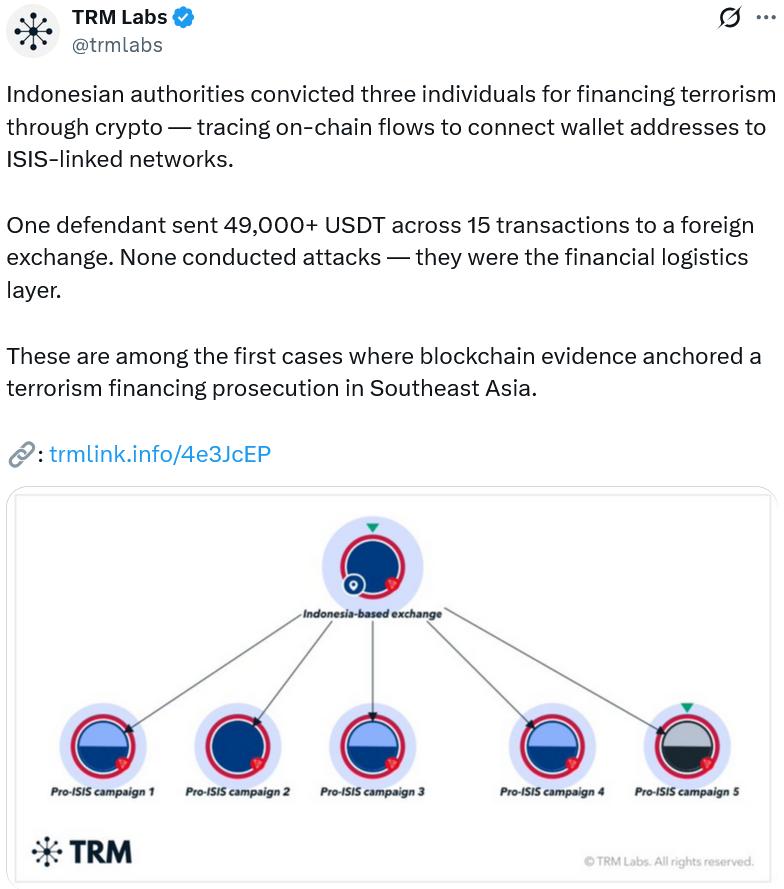
Blockchain investigators traced one of the convicted defendants transferring more than $49,000 in USDt (USDT) through 15 separate transactions, moving the funds from a domestic exchange to an international platform, with the money subsequently being channeled to an ISIS-affiliated terrorism fundraising operation in Syria, the blockchain intelligence firm reported.
The analytical work was conducted by Indonesia's financial intelligence team working in conjunction with Densus 88, the country's specialized counterterrorism police unit, and the results of their investigation were submitted as evidence to Indonesian courts, which recognized the blockchain data as critical proof in all three separate cases.
According to TRM, Indonesia is far from being the sole nation in Southeast Asia leveraging blockchain analytics technology to apprehend criminal actors.
"Similar patterns are emerging across Southeast Asia, where governments are investing in blockchain intelligence capabilities and enhancing collaboration between public and private sectors to address illicit finance risks."
According to TRM Labs, both Singapore and Malaysia's financial intelligence units, along with their respective law enforcement agencies, are actively developing technical capabilities to track and trace cryptocurrency transaction flows.
On April 1, authorities from Cambodia and China successfully apprehended Li Xiong, a senior leader of the Huione Group, an organization that provided services to scam operations based in Cambodia that perpetrated "pig butchering" fraudulent schemes and various investment scams designed to steal cryptocurrency from victims across the globe.
Xiong underwent extradition to China, where he will face charges related to fraud and money-laundering activities.
The extradition of Xiong occurred three months following the apprehension of Chen Zhi, who serves as the head of Prince Group, the parent entity that controls Huione Group.
In a February report, TRM disclosed that illicit actors and entities received approximately $141 billion worth of stablecoins throughout 2025, representing a five-year peak in such activity.