Bitwise Projects Bitcoin Could Reach $224K Fair Valuation Amid Growing Sovereign Debt Crisis
According to a sovereign default-risk valuation model, Bitcoin's true worth stands at $224,000, with escalating government debt concerns and bond market turbulence potentially bolstering the cryptocurrency's case as a strategic long-term investment.

Recent analysis from Bitwise indicates that Bitcoin's (BTC) current undervaluation may become more pronounced should investor anxiety surrounding sovereign debt intensify. According to the asset management company, increasing strain within worldwide bond markets combined with escalating government debt burdens could reinforce Bitcoin's position as a protective measure against macroeconomic uncertainty, with a particular valuation framework pointing to a theoretical fair price of $224,000.
Bond market instability could bolster Bitcoin's long-term prospects
The investment firm highlighted growing strain throughout international bond markets. According to estimates from the Organization for Economic Co-operation and Development (OECD), governments and corporations will require approximately $29 trillion in borrowing during 2026, representing a 17% increase from 2024 and nearly twice the funding secured ten years prior. Approximately 78% of government borrowing within OECD nations is projected to serve exclusively for refinancing outstanding debt obligations.
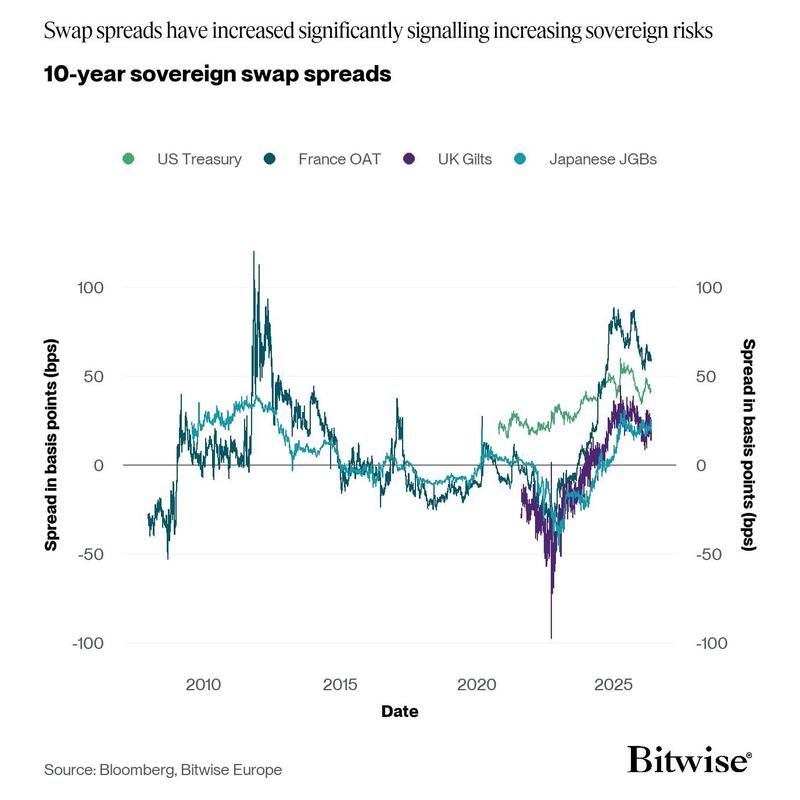
The analysis emphasized that Japan deserves particular attention. The nation's 10-year government bond yield has recently risen to 2.78%, with its 30-year bond yield achieving an unprecedented peak. Simultaneously, Japan's governmental debt hovers around 230% of GDP, positioning it among the most elevated ratios in the contemporary macroeconomic landscape.
According to the research, Japanese market participants currently maintain holdings of roughly $1.2 trillion in US Treasurys, though elevated yields within domestic markets are diminishing the appeal of foreign bonds. As of Tuesday, the 10-year Japanese bond yield stands at 2.66%, contrasting with 2.19% for Yen-hedged 10-year US Treasurys, which may incentivize capital repatriation to local markets.
Challenges within bond markets extend beyond Japan's borders. The 30-year US Treasury yield recently touched 5.11% on May 11, marking its peak since 2007, while sovereign risk premiums, as tracked through 10-year swap spreads, have climbed to their most significant levels since the 2011-2012 European debt crisis.
Although these dynamics might exert downward pressure on risk assets over the short term, Bitwise contends that a more severe disruption within bond markets could ultimately serve as a positive catalyst for Bitcoin should central banks find themselves compelled to introduce liquidity measures aimed at stabilizing financial systems.
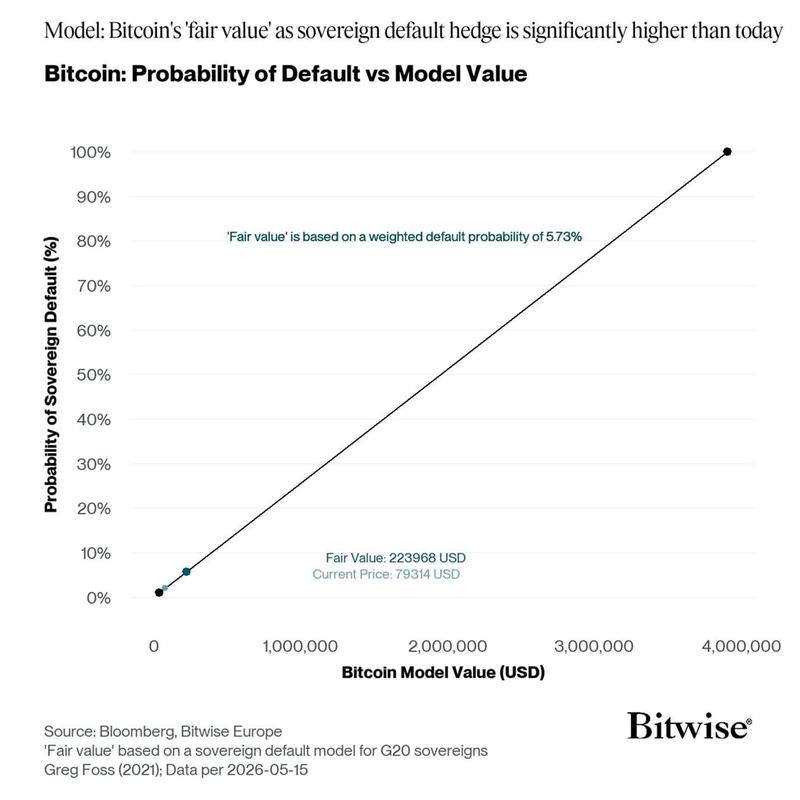
The company referenced a framework created by investor Greg Foss that assigns Bitcoin a valuation of approximately $224,000 should it achieve wider acceptance as protection against sovereign default risk. Bitwise emphasized that this number represents a theoretical calculation rather than an actual price projection.
Notwithstanding the optimistic long-term perspective, the analysis acknowledged that Bitcoin may continue trading within a defined range over the near term as elevated real yields and more restrictive financial conditions persist in constraining demand.
Falling real yields could enhance Bitcoin's macroeconomic environment
According to Bitwise, Bitcoin's short-term performance may hinge significantly on real interest rates, which represent the Federal Reserve's policy rate following adjustment for inflation. Within the report, real rates are determined by subtracting US CPI inflation from the Fed Funds rate. Throughout history, Bitcoin has generally exhibited strong performance during periods of declining real rates, as cash holdings and bonds lose attractiveness when measured in inflation-adjusted terms.
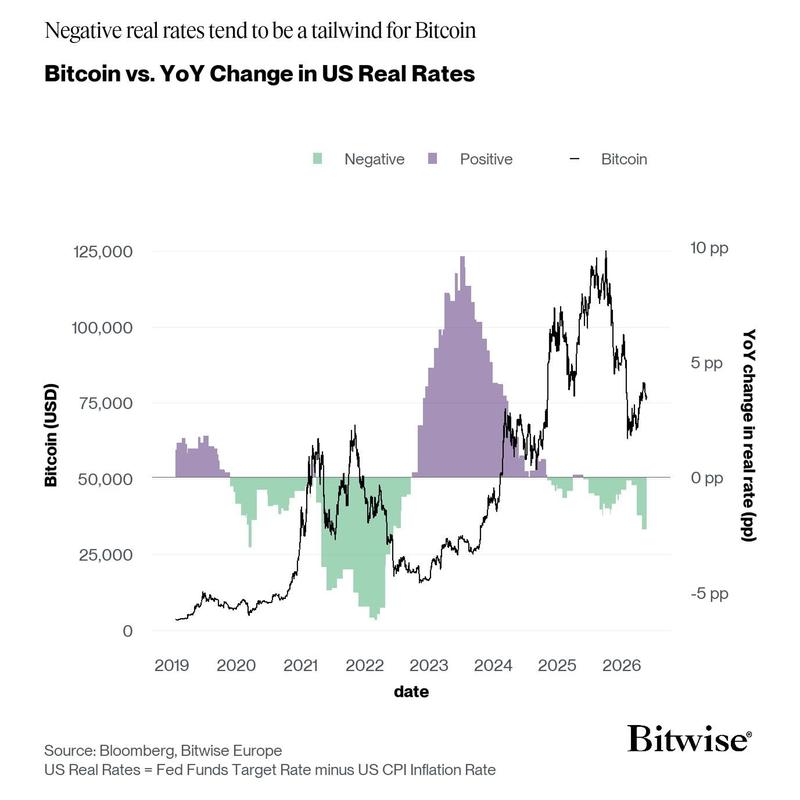
The company observed that Bitcoin's bull run in 2021 occurred during a period of decreasing real rates, whereas the 2022 downturn developed alongside increasing real rates and forceful monetary restriction policies. While real rates continue to be restrictive, Bitwise suggested that circumstances wherein inflation accelerates while the Fed maintains current rates unchanged could drive real rates downward, potentially establishing a more favorable environment for Bitcoin.
In related analysis, Bitcoin researcher Sminston presented findings indicating that BTC might fluctuate between $90,000 and $255,000 before the conclusion of 2026, according to the Bitcoin Decay Channel, a logarithmic pricing framework that has successfully identified significant cycle peaks and troughs throughout history. The researcher pointed out that Bitcoin's latest recovery materialized close to the model's extended-term support area, preserving the overarching bullish perspective.