Bitwise Partners with Lombard to Bring Bitcoin Lending and Yield Services to Institutional Custody Solutions
A new collaborative platform from Lombard and Bitwise allows institutional investors to generate returns and access loans using Bitcoin holdings while maintaining custody control, focusing on dormant institutional BTC assets.

Lombard, which specializes in developing Bitcoin-focused lending infrastructure, is joining forces with Bitwise Asset Management in a collaboration designed to allow institutional players to generate yield and secure loans against their Bitcoin (BTC) holdings while keeping their assets in custody, with the goal of activating hundreds of billions of dollars worth of Bitcoin currently sitting in institutional custody accounts.
The collaboration was made public on Tuesday during the Digital Asset Summit taking place in New York.
Jacob Phillips, who serves as CEO and co-founder of Lombard, shared with Cointelegraph:
The breakthrough is Bitcoin Smart Accounts—connecting two previously isolated worlds: institutional custody and onchain finance.
Based on an announcement provided to Cointelegraph, Bitwise will construct yield-generating strategies that blend DeFi lending with tokenized real-world assets, whereas Morpho, which operates as a decentralized lending protocol, will supply the lending infrastructure necessary for borrowing operations backed by Bitcoin collateral.
The system employs Bitcoin-native technologies including partially signed transactions and timelocks for collateral verification purposes, enabling positions to achieve onchain representation without requiring the transfer or rehypothecation of the underlying Bitcoin assets.
Instead of depending on bridges or wrapped token variants, Phillips explained that "Bitcoin Smart Accounts eliminate all three risk vectors simultaneously," tackling custody, bridge and counterparty risks that have traditionally constrained institutional participation in Bitcoin lending markets.
The service is designed for high-net-worth individuals, asset management firms and corporate treasuries looking to activate long-term Bitcoin holdings without altering existing custody frameworks.
The launch timeline points to the second quarter of 2026, with Lombard intending to onboard additional custodians and protocols to broaden accessibility throughout institutional Bitcoin holdings.
Phillips indicated the framework could transform institutional thinking around Bitcoin allocations:
We're moving Bitcoin from a pure store of value to productive institutional capital. That's the shift.
This is due to the fact that Bitcoin within institutional investment portfolios has traditionally operated as a passive store of value, he explained, offering limited pathways to generate yield or obtain liquidity without abandoning custody, accepting counterparty risk or creating taxable events.
Lombard's estimates indicate that approximately $500 billion worth of the largest cryptocurrency is currently held in institutional custody arrangements, with a significant portion remaining disconnected from onchain financial markets.
Bitcoin DeFi gains traction as vaults and lending expand
Information from DefiLlama indicates Bitcoin's total value locked in DeFi stands at approximately $2.93 billion, representing a small fraction of its roughly $1.4 trillion market capitalization. Nevertheless, momentum is starting to accumulate as initiatives to transform Bitcoin into a yield-producing asset gain momentum.
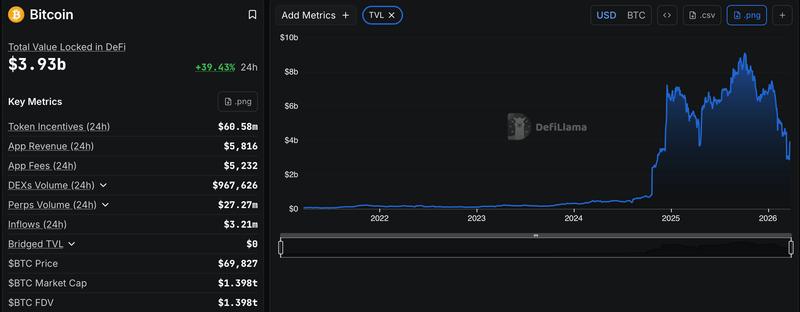
A primary catalyst is the emergence of onchain vaults, which operate similarly to automated investment funds that allocate user capital across various DeFi strategies. In January, Bitwise revealed a partnership with DeFi lending protocol Morpho to introduce non-custodial vaults engineered to produce yield through overcollateralized lending mechanisms.
The movement has gained speed in recent months. In February, Telegram incorporated yield-generating vaults into its integrated crypto wallet, providing users the ability to earn returns on Bitcoin, Ether and USDT directly within the application.
In March, Bitcoin staking protocol Babylon completed integration with hardware wallet manufacturer Ledger, providing users the capability to deploy BTC in financial applications while retaining self-custody through hardware-based transaction signing mechanisms.
At the time of writing, Babylon Protocol maintains the lead in Bitcoin-based DeFi with approximately $2.8 billion in total value locked, whereas Lombard holds the second position with roughly $744 million.