BitMine pushes Ethereum reserves toward $10B milestone with persistent bear market buying
Throughout the ongoing market decline, BitMine has maintained its Ether purchasing strategy, expanding its position to approach 5% of total circulating supply while earning staking rewards despite growing challenges facing the ecosystem.

Last week saw BitMine Immersion Technologies further grow its Ether position, purchasing additional units of the second-largest digital asset even as an extended market decline persists, with its substantial staking infrastructure continuing to produce returns.
The crypto treasury firm disclosed on Monday that it had purchased 76,881 Ether (ETH) during the previous seven-day period, likely lowering its average acquisition cost as ETH momentarily dropped under $1,600 throughout that timeframe. The firm has maintained a consistent Ether accumulation strategy throughout the bear market, irrespective of market movements.
The company's current holdings stand at 5,620,754 ETH purchased at an average cost of $1,718.
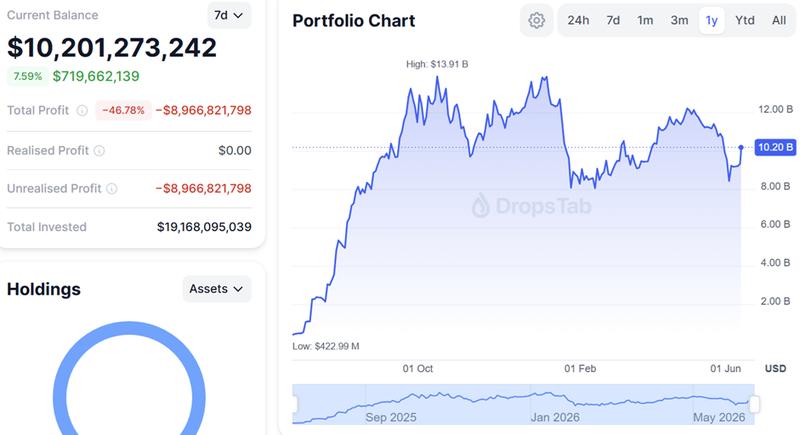
Based on present market valuations, the firm's ETH stockpile carries an approximate value of $10.2 billion, although it currently faces an unrealized deficit approaching $9 billion, based on DropsTab analytics. During Monday's trading session, Ether exchanged hands at $1,843.69, per CoinMarketCap information.
The most recent acquisitions by BitMine advance the firm toward its publicly announced objective of controlling 5% of Ether's aggregate circulating supply, which stands at 120.68 million tokens. The firm presently owns roughly 4.66% of the entire ETH supply.
Simultaneously, BitMine maintains more than 4.1 million ETH in staking positions, representing approximately $8.1 billion at prevailing market rates. Through staking, the firm generates protocol-based rewards by contributing to Ethereum network security, creating a consistent yield stream independent of price fluctuations.
Ethereum faces structural headwinds
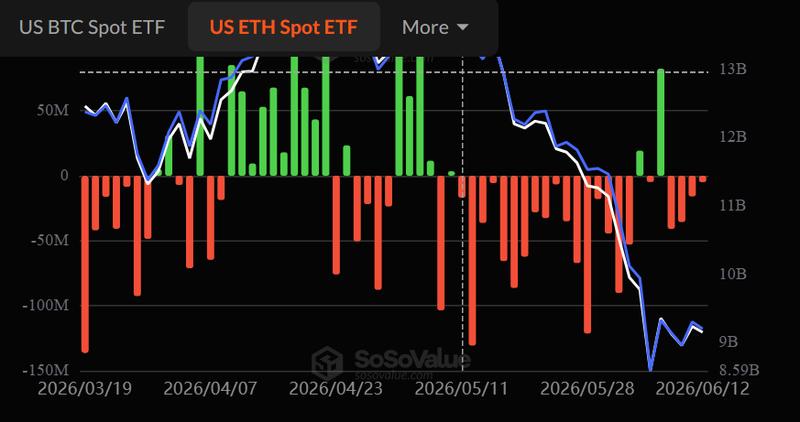
This year has brought mounting pressure on the crypto treasury business model as digital asset valuations have declined substantially. The broader downturn has similarly impacted spot Ether exchange-traded funds (ETFs), which experienced four straight days of net capital outflows during the previous week.
Consistent selling pressure has remained in place since the beginning of May, with net daily outflows surpassing $60 million on multiple occasions.
The iShares Ethereum Trust ETF (ETHA) from BlackRock continues to lead US-listed ETH ETFs in size, boasting net assets totaling $4.75 billion. Its holdings represent 2.36% of the cryptocurrency's circulating supply.
However, Ethereum confronts obstacles that transcend simple price performance.
The blockchain's layer-2 expansion approach, intended to enable quicker and more cost-effective transactions, has attracted heightened examination. With increasing volumes of activity shifting toward layer-2 solutions, the Ethereum base layer collects diminished transaction-fee income and destroys reduced quantities of ETH, which could undermine its deflationary mechanisms.
Personnel shifts within the Ethereum Foundation have contributed additional uncertainty to the situation. A minimum of nine senior executives, researchers and key contributors have exited the nonprofit organization during the current year, representing one of the most significant talent exodus episodes throughout its existence. These departures have occurred alongside the foundation's structural reorganization and intensified community discussions regarding its governance framework, strategic priorities and function in Ethereum's future evolution.