BitGo unveils modular infrastructure platform targeting banking sector for digital assets
The infrastructure solution integrates cryptocurrency custody, trading capabilities, settlement systems, staking services and stablecoin technology for financial institutions and banking organizations.

Digital asset custody provider BitGo has introduced a modular infrastructure platform designed for banking institutions that integrates custody solutions, trading capabilities, settlement systems, staking options and stablecoin services for financial organizations seeking to explore cryptocurrency offerings and blockchain-based payment solutions.
According to the company, financial institutions can integrate individual services separately while retaining oversight of compliance requirements, governance frameworks and customer-facing business operations. BitGo noted that the infrastructure platform is currently in use by several institutions such as Erebor Bank, Banco de Crédito del Perú, TowerBank and InvestiFi.
The company explained that the platform also features "crypto-as-a-service" capabilities enabling financial institutions to provide custody solutions, wallet services and trading functionalities under their proprietary branding. According to BitGo, institutions have the flexibility to implement products incrementally according to their operational capabilities and regulatory compliance needs.
"The rapid growth in the value of cryptocurrencies and digital assets has led to growing banking needs for the crypto industry and growing interest in new potential business opportunities from the banking industry."
US Congressional Research Service, February 2025 issue analysis
Established in 2013, BitGo operates as a California-headquartered digital asset infrastructure provider that delivers cryptocurrency custody, trading, staking and settlement solutions for banking institutions, cryptocurrency exchanges and institutional investment firms.
In the previous week, the organization disclosed $3.8 billion in revenue for the first quarter, representing an increase from $1.8 billion recorded in the same period one year prior, driven by elevated cryptocurrency trading volumes and expansion in its stablecoin operations that enhanced overall performance. Notwithstanding the revenue growth, the organization recorded a net loss of $60.7 million during the quarter, attributed in part to a non-cash loss connected to the valuation of its Bitcoin treasury assets.
Crypto companies expand banking and institutional infrastructure services
Cryptocurrency organizations are continuing to develop infrastructure solutions targeted at banking institutions and financial organizations exploring stablecoins, asset tokenization and digital asset custody capabilities.
Ripple has grown its prime brokerage operations following the completion of its approximately $1.25 billion purchase of Hidden Road in the previous year. The acquisition provided Ripple with a platform that serves hedge fund clients and trading organizations across both digital asset and conventional market sectors.
During April, Fireblocks launched a platform enabling institutional clients to allocate stablecoin holdings into blockchain-based lending protocols through products powered by Aave and Morpho.
In recent weeks, Anchorage Digital established a partnership with Mexico's Grupo Salinas to deliver stablecoin-based settlement infrastructure and dollar-denominated payment systems for banking activities throughout Latin America. The organizations stated that the framework would utilize GENIUS Act-compliant stablecoins for treasury operations and international transfer services.
Certain cryptocurrency exchange platforms are also pursuing regulated banking and custody authorization structures. Kraken's parent entity Payward recently submitted an application for a national trust company charter with the US Office of the Comptroller of the Currency aimed at expanding digital asset custody capabilities.
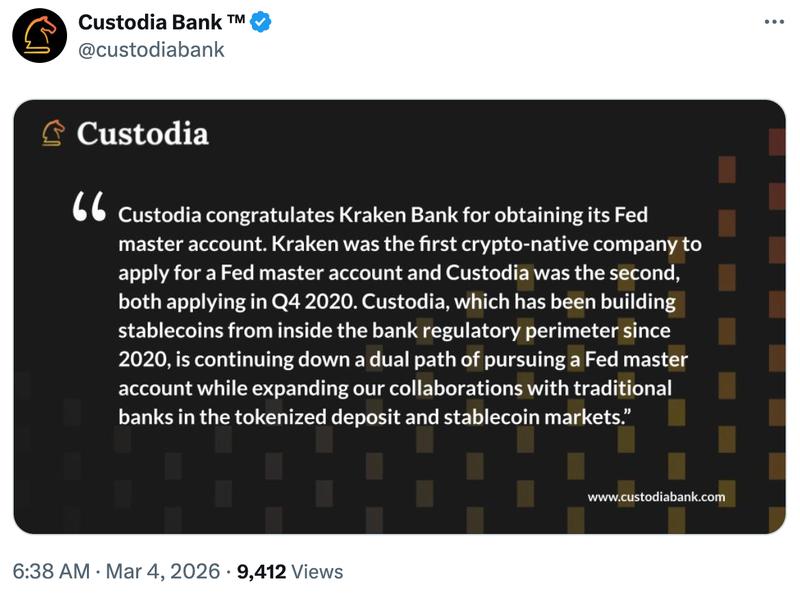
During March, Kraken Financial obtained access to the Federal Reserve's Fedwire payment system through a Federal Reserve master account, providing the organization with the ability to settle payment transactions directly on United States banking infrastructure rather than depending on correspondent banking relationships.