Bitcoin's Value Proposition Debated as America's National Debt Crosses $40 Trillion Threshold
Market experts suggest Bitcoin's long-term investment thesis gains momentum as US debt reaches $40 trillion, though immediate price action still hinges on Treasury yields, dollar performance and market liquidity.

The United States federal debt has crossed the $40 trillion threshold for the first time in history, sparking fresh discussion among financial analysts about whether escalating national borrowing levels might enhance Bitcoin's appeal as a finite, decentralized alternative asset.
The burden of servicing this debt has grown substantially as well, with interest payments now exceeding Medicare expenditures to rank as the government's second-biggest budget item after Social Security during the initial ten months of fiscal 2026, Reuters reports.
This historic debt benchmark arrived alongside efforts by the Treasury Department to address a bond market selloff that has driven long-dated yields to levels not witnessed since 2007. On Wednesday, Treasury Secretary Scott Bessent announced the department's decision to expand buybacks of debt with 10- to 30-year maturities to a minimum of $4 billion per transaction, a move that initially drove yields and the US dollar downward while Bitcoin (BTC) and gold experienced price increases.
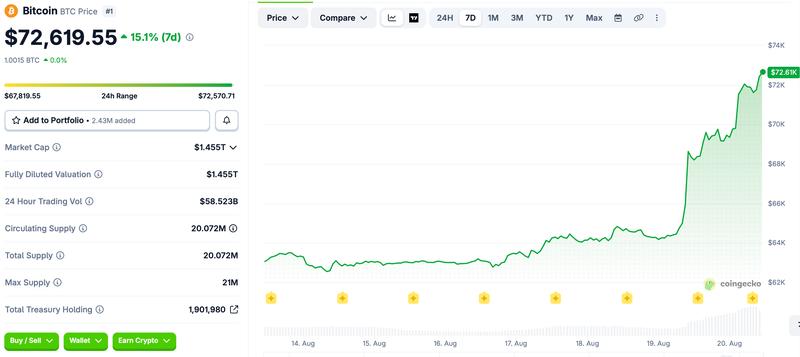
Bitcoin has maintained its upward momentum, with trading activity showing the cryptocurrency hovering near $72,600 on Thursday morning, representing approximately 6% growth during the previous 24 hours and a 15% gain across the past week, based on CoinGecko data.
Treasury buybacks add another potential Bitcoin catalyst
Although Bloomberg and other media outlets have linked portions of Bitcoin's price surge to growing expectations of more favorable United States cryptocurrency regulations following President Donald Trump's Wednesday meeting with cryptocurrency industry leaders at the White House, market strategists have identified Treasury actions and wider fiscal circumstances as contributing elements.
JC Parets, founder of TrendLabs and a chartered market technician, highlighted the Treasury's decision to expand acquisitions of longer-dated government securities, which he characterized as a strategy that bond market players interpreted as resistance against climbing long-term interest rates. Parets said:
If the market believes the government is going to push back against rapidly rising long-term rates, that can change the math for everything else investors own. Including Bitcoin.
Dean Chen, an analyst at Bitunix, presented a contrasting perspective, arguing that the debt milestone does not automatically translate to positive sentiment for Bitcoin. Although Treasury buybacks temporarily suppressed long-term yields and diminished dollar strength, ongoing deficits and expanding financing requirements might ultimately drive borrowing costs upward once more.
According to Chen, Bitcoin's short-term price trajectory will be more influenced by overall financial market conditions, highlighting US dollar performance, long-term Treasury yield movements and inflation expectations as critical factors worth monitoring.
Specialists at decentralized finance protocol Yield Basis adopted a more extended time horizon in their analysis, informing Cointelegraph that persistent expansion in US debt levels might amplify interest in Bitcoin as protection against fiat currency depreciation due to its capped supply and absence of sovereign control. They said:
Whether it will actually become a new reserve asset remains to be seen, but as concerns around fiat currency debasement grow, it will definitely stand out more as a straightforward protective instrument (alongside more traditional assets like gold).